Fliers made by unaffiliated students:


provisional home of the College of Debtors in Defiance

Regents of the University of California, meeting for the first time since campus police used pepper spray and riot batons to disperse student protests at Berkeley and Davis, listened to nearly three hours of public complaints about those incidents and tuition increases before chanting protesters disrupted the meeting and drove them from the room.(pic via Daily Cal)
The Regents then reconvened in a smaller room down the hall from the protesters, where they voted to raise the salaries of nearly a dozen university administrators and lawyers by as much as 21.9 percent.
[...]
The regents also approved salary raises for 10 administrators and managers, including a 9.9 percent increase for Meredith Michaels, vice chancellor of planning and budget at UC Irvine, whose annual salary will increase to $247,275 from $225,000.
Six campus attorneys also received salary increases. The largest increase, 21.9 percent, went to Steven A. Drown, chief campus counsel and associate general counsel at UC Davis. His yearly salary will rise to $250,000 from $205,045.
Six individuals, including former and current UC Berkeley students, have filed a federal class action lawsuit alleging that four campus officials violated their constitutional rights by punitively arresting and jailing 66 people participating in a December 2009 demonstration.
According to the complaint — filed Oct. 7 in the U.S. District Court for the Northern District of California — the plaintiffs seek damages for violations they alleged to have occurred during the “Open University” demonstration in Wheeler Hall, which occurred from Dec. 7 to Dec. 11, 2009.
The four campus officials — Chancellor Robert Birgeneau, Vice Chancellor for Student Affairs Harry Le Grande, UCPD Chief Mitch Celaya and UCPD Lt. Marc DeCoulode — were served with the complaint Monday afternoon, said Kevin Brunner, an attorney with Siegel and Yee, the law firm representing the individuals filing the lawsuit.
The complaint seeks to stop the officials from continuing what it alleges is a policy of sending nonviolent detainees taken into custody during campus protests to the Alameda County Jail rather than citing and releasing them.
“The policy of jailing non-violent protestors is punitive and a violation of the protestors’ rights to freedom of speech and assembly,” the complaint states.
According to campus spokesperson Janet Gilmore, the lawsuit is still being reviewed by campus counsel.
“We can’t comment on the details of the lawsuit at this time because it is still being reviewed by counsel,” she said. “Nevertheless, we are confident that the university’s actions were legally justified.”
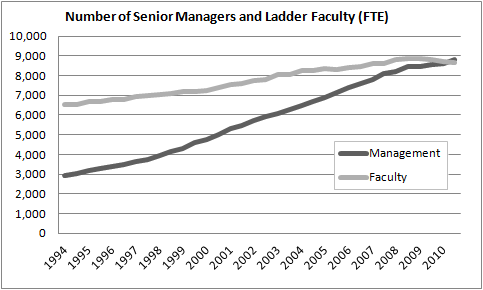
In November of 2009, KeepCaliforniasPromise.org posted a report by Richard Evans titled “Soon every faculty member will have a personal senior manager” which pointed out that the number of managers at UC was growing far faster than the ranks of the faculty and that, if the trend continued, it would not be long before there were more senior managers than ladder rank faculty. Richard just sent me an e-mail pointing out that data through April of 2011 was out.
I wondered if the data would show how the “Working Smarter Initiative” and much talked about cuts of $80 million to the UC Office of the President, had combined with promises to first and foremost “preserve excellence in instruction, research and public service… which it cannot do without continuing to attract and retain top-flight faculty” (see, http://www.universityofcalifornia.edu/news/article/25580) to reverse that trend.
Well, it turns out faculty ranks have declined by 2.3 percent since the 2009 post, at a time when student enrollment increased by 3.6 percent. (I would hope the UC administration wouldn’t try to spin a continuing erosion of a major measure of academic quality such as the student faculty ratio as increased efficiency.)
But we all know the budget cuts have been tough. Even an administration striving to preserve the education and research missions of the University by directing as many of the cuts as possible at administrative overhead might have to make painful cuts to the employees responsible for education and research in such an environment. The cuts to senior administrators must be even steeper, right? At least as steep?
Somehow the ranks of managers have continued to grow right through this difficult period – up 4.2% between April, 2009 and April, 2011. In fact, the dismal prediction of our 2009 post has now come to pass: UC now has more senior managers (8,822 FTE) than ladder rank faculty (8,669 FTE).

Santa Ana, California - Today court resumed with closing statements in the IrvineFor more information, check out Nora Barrows-Friedman's coverage at the Electronic Intifada.1110 case. After the jury walked in, the judge took over 45 minutes to instruct the jury as to the procedure of trial and the law including a statement that pertained to "bias", declaring that it shouldn't influence the jury's judgement. The judge also read some of the statements made by the accused during the event in which they protested Israeli Ambassador, Michael Oren's Speech, but curiously the only statements read by the judge where those which called Oren a "murderer" or implied that he was akin to one.
Thereafter, the Prosecution took the stage and proceeded with their sports metaphors as usual (read previous post), arguing that the Irvine 11 had conspired to commit a "heckler's veto" of the Ambassador's Speech in order to "shut down" the event, a word that was used in a fancy overhead display in bold red letters to persuade the jury. The Prosecution then continued to lay out the case as they saw it, declaring that the Irvine 11 were guilty of violating "the rules that apply to society" since they did not heed the admonishment from Prof. Petracca of UC Irvine as he was heard to say the words "Behave yourself" in a video shown from the event. The Prosecution argued that Petracca's words (as well as Chancellor's Michael Drake's brief commentary) were in fact the "implicit customs" and "rules" of the meeting which were supposedly violated by the defendants. The Prosecution stated that the protest was "not freedom" but an example of "Anarchy". The prosecution added, "when you don't follow the law, our community breaks down" and "permitting censorship of ideeers [sic] destroys the marketplace". The Prosecution discussed that the accused could have effected their protest during a Q&A section at the end of Oren's Speech, but that the accused chose to violate the law instead.
Among other statements by the Prosecution, they argued that what happened to President Obama when someone yelled out "You lie" during an address to Congress was a very different case since what happened in Congress was "only two words" by an "individual". Other "evidence" presented by the Prosecution included several pie charts that depicted in black and red the "time" that they believed the protest lasted (as opposed to the time that Oren spoke) in order to show that the accused "substantially" disrupted the meeting. Also, a debriefing video of an unidentified person saying "we pretty much shut them down" was shown as evidence of the "intent" of the protest. Lastly, the Prosecution argued that the accused did "not resist" arrest, because it was part of their "plan" or "conspiracy".
After the Prosecution delivered their closing statement the court went to recess. During this intermission there was a Press Conference outside the courthouse with local leaders from the community in support of the Irvine 11, (See video of press conference, coming soon).
In the afternoon, the court resumed with the closing statements from Defense attorney Dan Mayfield. In his statement, Mayfield expressed that the Prosecution was leading the jury to believe that "when people are arrested they are guilty".Mayfield also argued that the pie charts presented by the Prosecution were inaccurate given that they counted the time "attributable to protesters" in which the crowd was shouting as well as when UC-Irvine Professor, Petracca chose to "hear his own voice" by expressing his "personal embarrassment" to the crowd. Upon this last reference there was the first incidence of clapping in the courtroom. Then laughter came as Mayfield introduced one of the accused as the "world's biggest teddy bears" during the part of his presentation dedicated to show that the protesters indeed had planned to "not resist" the police. Mayfield explained that the accused were very carefully planning to "abide" by the law, a word that was later emphasized by the other defense attorney in closing statements, Reem Salahi. Mayfield argued that if the planning that took place by the Irvine 11 was enough to convict them of "conspiracy" then the planning of the UCPD was also a "conspiracy" as Mayfield recalled a witness testimony from Police Chief, Hennesy stating the fact that there were "metal handcuffs" at the scene prior to the protest. Mayfield added that "Oren himself believed that he was not substantially interfered with" as he recalled Oren's statement "wishing those students" had "remained" in the room (See our previous post on the Irvine 11). Lastly, Mayfield argued that the "rules" or "customs" of the meeting were uncorroborated arguments since neither Petracca nor Drake ever took the stand to verify the meaning of their statements in court. Then Mayfield went on to have a mock witness examination of Drake and Petracca to demonstrate why it was important for them to testify to the accuracy of their statements by asking an empty chair if he [an imaginary Drake] had "other bosses" and whether they interpreted the "rules" and "customs" in the same fashion, as well as an imaginary Petracca, asking him whether he "had something to drink that evening". More laughter filled the packed courtroom (which had to employ over 5 bailiffs by the end of the day). Mayfield closed with a famous e.e. cummings poem to emphasize the importance of language.
Thereafter, Defense attorney Reem Salahi took the podium to address the jury. In her closing statement, Salahi emphasized Mayfield's argument that the UCPD's "plan" to counter the protest was planned in the same fashion as the accused "plan" for the protest. Salahi added that the statements given by UCPD Chief Hennesy were contradictory to evidence since he stated having no "prior knowledge" of a protest, when in UC-Irvine's Dean of Students, Edgar Dormitorio's statement, he mentions having found out about the plan for the protest from the Chief of Police himself. Salahi also mentioned that the Prosecution was relying on other testimony from an unknown subject since the person in the video presentation from the prosecution saying the words "we pretty much shut them down" (in reference to the meeting) could never be identified or ever brought to the courtroom. Salahi also stated that in Dormitorio's own words "no disruption would be allowed", thus violating the right to protest. Salahi then showed a series of videos which portrayed several protests taking place at the UC Irvine campus which were disrupted in the same fashion and in which "police" and "administration" "were present" and no arrest took place, thus emphasizing the disproportionate attention that this case has garnered. To close, Salahi was going to tell a personal anecdote, but the Prosecution objected as to its relevance and the judge sustained the motion. Salahi looked perplexed at first, but then she said, "I guess I can't tell you the story. I got shut down" and the crowd in the courtroom erupted in clapping and cheering.
After she sat, the judge declared a brief recess. When he returned (10 minutes late from the time he set), he admonished the crowd while the jury was still out, saying he would not permit anymore "gesturing". Then he let in the jury and told the crowd to leave and that the case would continue tomorrow morning...
Yudof and his finance team had hoped the regents would discuss their multiyear budget and tuition proposal, then vote in November.
But even though the regents liked the idea of imposing some stability on their wildly fluctuating budget, they stayed away from the hot-button issue of yearly tuition increases.
"It scares the bejesus out of folks," was how Lt. Gov. Gavin Newsom, a regent, summed it up.
The four-year budget plan was intended to tackle a looming gap of $1.5 billion over the next four years, about a third of which UC says is needed for higher pay, and a quarter for retiree health and pension benefits. This year's tuition increase and cutbacks have resolved an additional $1 billion shortfall, officials said.
The idea was that a steady flow of tuition hikes would help pay these costs. Tuition would rise more in years when the state gave less, and vice versa. In the worst-case scenario - if the state provided no increase - basic tuition would rise by 16 percent a year, reaching $22,200 by fall 2015, not including mandatory campus fees, room and board. That's 81 percent higher than the current $12,192.
[...]
Negotiating with Sacramento is "a waste of our time," said Regent Dick Blum.
Instead, the regents should approach people "who actually can write a check," he said. "Chevron, Apple, Cisco and Google - all these companies sitting on money they don't know what to do with."
Regent David Crane picked up on the theme, urging colleagues to "start acting like you're a private university. Get real - and don't fool yourselves and think the Legislature will turn around, or you'll be waiting for Godot," he said, referring to the Samuel Beckett play in which the protagonists wait in vain.
Some regents said corporate money could be used for scholarships. Others said an ad campaign for UC would be better.
Chairwoman Sherry Lansing suggested they form subcommittees to tackle each approach. The bottom line, she said, is, "I don't want to bring this (proposal) forward in November."
[...]
The regents, who have been approving tuition hikes for years, sometimes twice in the same year, actually appear quite comfortable with multiyear fee increases. Since 2006, when tuition was $6,141, the regents have raised it each year by 8, 7, 26, 15 and 18 percent.
Meanwhile, the regents gave raises and incentive pay to some of UC's highest-paid executives, including Chief Investment Officer Marie Berggren, who got a $744,950 award for boosting UC's assets by $661 million beyond what was expected.
Senior Vice President John Stobo, in charge of UC's health system, received a $130,500 award for, among other things, reducing blood infections.
When Stobo's raise was announced and he was praised for his achievements, a health care worker - a member of a union that has been without a contract for months - jumped up from the audience and yelled, "It's sad that you give yourself all these raises. The decrease in infections is because of our work, but you guys get credit for it. Shame on you!"
Guards led her away.
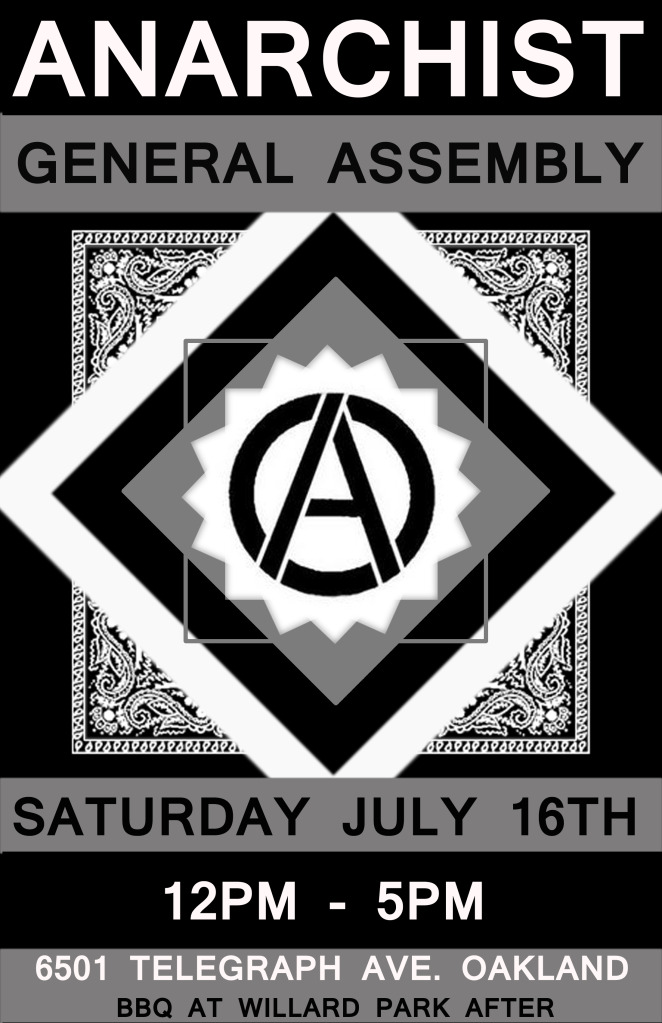
Let’s create a new kind of ANARCHIST GENERAL ASSEMBLY!More detailed information about the various sessions and breakout groups is available in the official announcement at Indybay. It's also worth listening to the following interview that aired on a recent broadcast of the show Relatos Zapatistas. You can listen to it here:
Saturday July 16th
12 – 5pm, BBQ to follow
6501 Telegraph Ave. (Near Ashby BART)
Oakland, CA
~~~
The first in an experimental series of regional anarchist general assemblies will be held in Oakland on July 16th, 2011.
The purpose of this assembly is to strengthen ties within the Bay Area's anarchist community by providing a regularly occurring event to share projects we’re working on, discuss the topics we are organizing around, promote collaboration and solidarity between different groups, spark new initiatives and build our collective capacity as a social antagonist force. The assembly will not be a decision-making body; it will not create platforms or manifestos.
 Today the UC regents officially voted to once again raise student tuition while at the same time increasing compensation for high level execs:
SAN FRANCISCO -- University of California Regents voted Thursday to raise tuition by 9.6 percent -- on top of an 8 percent increase already approved for this fall -- over the objections of students who said they'll drown in debt.If austerity is class war, as our compañeros at Bay of Rage like to say, then these repeated tuition hikes should be considered a weapon in the administrative arsenal. Notably, the regents themselves relied heavily on war rhetoric today in discussing student tuition. Sherry Lansing, the regents' recently inaugurated chairperson who stumbled through the motions of her new role today, called for students to join with "staff and chancellors and all of us" to "continue this battle." For his part, Richard Blum, husband of U.S. senator Dianne Feinstein, huge investor in for-profit education, and perhaps the single most corrupt of all the regents, outlined what he saw as the first step of this battle as follows: "we should determine who our friends are and who are our enemies."
At the same meeting, the regents also gave large pay raises to three executives, including two who are paid from state funds.
This fall, undergraduate tuition will rise to $12,192, more than 18 percent higher than last year's $10,302 -- a level that prompted violent student protests. With a mandatory campus fee of $1,026, a year at UC now costs $13,218 before room and board.
That's more than twice what it cost in 2005.
In other words, not only are students paying directly for the project -- after all, we voted for it! Democracy in action! -- we're paying for it indirectly as well, through tuition increases that have already taken place (that money goes into the general fund) and the promise of future tuition increases that the UC now owes the bond raters.Today, the Daily Cal reports that this same construction project, which will take many years to complete, is already showing a negative cash flow. The article draws on a presentation given by an outside consulting firm, Brailsford & Dunlavey, which is based in Washington, DC. (It's not entirely clear how much the firm is charging for its services, but it's possible that we might be seeing a repeat of the scandalous Bain & Company contract worth $7.5 million.)
A deficit as high as $800,000 may occur between 2019 and 2022, after an expected bump in revenue due to increased student fees in 2018, according to the presentation.Either the consultants are privy to information about future tuition increases that the rest of us aren't or they're just making shit up (in which case why is UC Berkeley hiring them?). It's important to remember that privatization is not a response to immediate crisis but a long-term strategy. Tuition hikes, it appears, are plotted out years in advance. While they are adjusted to take immediate political concerns into account (like state budgets, for example), these adjustments are little more than slight deviations here and there from the original projections. [Update 7/12 10am: Our mistake. The comment below is correct on this point, that the fees in question are not actually tuition but rather the student fees approved in the vote. However, this doesn't change the fact that the construction project is still financed through multiple sources, including the sale of construction bonds backed by student tuition as collateral. In any case, you can find the schedule for increased student fees for the project here. Further update 7/14 12:39pm: For a full discussion of what the vote actually approved, and why the earlier comment isn't exactly right, check out the comment from Zach Williams below.]
“If the students are footing the bill for things that are not only the students’ responsibility, then those things have to be very defensible,” Marthinsen said.If the students are footing the bill... From her isolated office in the A&E Building, Marthinsen can't understand the full implications of her words. Because what Meister shows us is that as students we foot all the bills: "Because UC pledges 100% of tuition to maintain its bond rating, it has also implicitly assured bond financiers that it will raise your tuition so that it can borrow more. Since 2004, UC has based its financial planning on the growing confidence of bond markets that your tuition will increase." Defensibility, furthermore, performs an interesting function here. What administrators find defensible is obviously not defensible for the rest of us -- students, workers, faculty, those of us who use the university. But beyond that, the logic of defensibility is the logic of the liberal technocrat, the enlightened bureaucrat who cannot be held accountable for decisions and as such offers little more than explanations and well-formulated "defenses" -- at best -- that lock the rest of us into decades of debt.
Gov. Jerry Brown relinquished a cornerstone of his budget plan Monday by forfeiting a 2011 tax election and securing a deal with Democratic lawmakers that shortens the school year if tax revenues fall short of optimistic projections.In that earlier budget plan, Democrats in the California legislature proposed an additional $150 million in cuts to both the UC and CSU systems (that is, $300 million total), on top of the $500 million (again to each) that's already been cut. Brown vetoed that budget, but it's now clear that it wasn't out of a desire to protect public education:
After months of seeking GOP votes, Brown decided four days before the new fiscal year that a bipartisan deal was impossible. The Democratic governor wanted Republicans to pass a temporary extension of higher sales and vehicle taxes as a "bridge" to a fall election, but Senate Republicans would not vote for taxes.
"I thought we were getting close, but as I look back on it, there is an almost religious reluctance to ever deal with the state budget in a way that requires new revenues," Brown said, sitting at the end of a wooden bench in his office with Senate President Pro Tem Darrell Steinberg and Assembly Speaker John A. Pérez.
Under the new plan, the University of California and California State University will each absorb additional $150 million reductions, for a total of $650 million apiece. They risk losing another $100 million each if the state falls short of revenues. The university systems already have said they will seek tuition hikes to offset new state reductions.And it's likely to get even worse:
Based on additional revenues that have come to the state so far this year, the budget assumes a very optimistic revenue scenario for the rest of the year. But if the revenue estimates prove unrealistic then there are triggers for additional cuts. These include an additional $100 Million in cuts for both UC and CSU, the possibility of further cuts to K-12 and a further shortening of the school year [by seven days].Yesterday, the Daily Bruin published an interview with outgoing chair of the UC regents Russell Gould, in which some pretty decent questions are posed (though there's not a whole lot of follow-up). One of the issues that came up was the recent budget passed by the Democratic legislature (on which today's deal is based). Why, the paper quite reasonably asked, should we believe in the UC administration's commitment to fighting for public education, let alone their strategy for winning that fight, especially when even the Democrats have apparently sold us out? Gould's pathetic answer:
Regrettably I think that Sacramento is listening to lots of voices. We’re among them, and I think we’ve got a stronger effort than we’ve ever had to push legislature and governor to push UC, but we’re fighting a lot of other interest groups that say, ‘We’re more important.’And, right on time, UC president Mark Yudof comes out with a statement on his Facebook page outlining how the UC administration would "continue to fight," as Gould put it: by "fully supporting" Brown's attempt to balance the budget.
Yet when I talk to legislators and talk to people in the governor’s office, they seem to understand the link toward building businesses, building opportunity and having (a) kind of society and economy that’s sustainable. But when it comes to the short-term decision they seem to put their resources in other places. And that’s what we’re continuing to fight.
I fully support Gov. Brown's plan to bring the state budget into balance. This includes his call for an extension of certain temporary taxes that he believes is needed to act as a bridge until the plan can be placed before California voters.Good to know you have our back, Mark.
In my view, what the governor has proposed offers the surest pathway available to a more stable fiscal future for all of California, including its public universities. Reliable state support is crucial to the continued excellence of the University of California and the students and families it serves.
Attorneys for the defendants objected to a protective order against them, with one attorney saying their clients "are not similarly situated" with the district attorney's office and therefore should not be subjected to the same limitations.Obviously, it's impossible to go back and erase what people have already heard. But there is nevertheless something strange about the disproportionate effects of the gag order -- it silences the present while entirely overlooking the past. There's also something interesting here about the way that "free speech" operates. In a case where college students are facing half a year of jail time for allegedly violating the right to free speech of an Israeli politician, the logic of "free speech" demands that (some) speech be silenced, and (other) speech effectively reinforced. It redistributes speech, spatially and temporally. This is where technologies like "free speech zones" and "time, place, and manner restrictions" come into play.
Attorneys for the 11 also requested that the court mandate the D.A.'s office remove other information relating to the case from its website, including removal of press releases and emails among the defendants that could be submitted to the court later as evidence. The judge denied the request, saying that there is no need to "go back and sanitize" what has already been released.
The defendants also have critics, including prominent Jewish leaders who say they support free speech but believe the students' behavior crossed a line.There's so much going on here. Even if we totally leave aside the claims of white victimization and the odd tokenization of Louis Farrakhan, what's interesting is how the politics of free speech renders some utterances speech and others non-speech. Apparently, Gilchrist recognizes that the protesters have a "point of view," a political argument they want to express. In reality, Oren's speech wasn't prevented, blocked, or suppressed (in other words, the protest was less "effective," in absolute material terms, than the gag order) -- rather, it was delayed, or temporally displaced. And, insofar as all speech is contextual and situated, the protesters' can only make that particular argument in the way they did. It is a fundamentally different speech act to denounce the Israeli occupation while the Israeli ambassador is speaking than it is to denounce it outside the building, or the following day.
Among those who were in the Santa Ana courtroom Friday was Jim Gilchrist, founder and president of the Minuteman Project. Gilchrist, whose organization places civilian patrols on the U.S. border, said he was interested in the case because it related to 1st Amendment free speech rights.
"We need to set ground rules," Gilchrist said, adding that he was "victimized" by people interrupting speeches he's given across the country.
"Louis Farrakhan could speak [to me]," Gilchrist said. "You don't stop people from speaking. I want to talk to the accused and see their point of view."

Now, during the many demonstrations against fee increases, students and their allies have consistently taken up the chant: "Whose university? Our University!" In my day, and admittedly when the dinosaurs roamed the earth, the battle cry was "make love, not war," a call to arms which I personally find more alluring. [Laughter]Apart from his stale jokes, there are a couple things to notice here in the way Yudof frames the meaning of the rhetorical question and answer "Whose university? Our university!" As in the case of the protesters who chant these words, the question for Yudof is a rhetorical one -- the speaker already knows what the answer is. Tensions emerge at the seams, that is, over the path of the lines that we, with these words, attempt to trace between friends and enemies. What is at stake, in other words, is the meaning of the word "our" and, by extension, of its opposite, "them." Solidarity is how we define friends and enemies.
But I do get the point the current students are trying to make -- that is, that they have a stake in theadministration's decisionsadministration, they have a stake in the university, they have a stake in the decisions the legislature, the board of regents, and others make.
Still, the more I ruminate over the question "Whose university," the more I realize that this chant actually frames a more profound societal question, one with implications far beyond the University of California, or even public education in general.
It's a question for American society as a whole -- how to distinguish between the "public good" versus the "private good," and how to strike a balance between the two. A balance that navigates at least in my judgment a course between JFK's noble call and the rhetorical stance of some politicians that government is never the solution, only the problem.
[T]he university maintains a critical role in this state's wealth creation. Because if the pie doesn't grow, it's difficult to realize the ambition of bridging the divide between our private and public sectors.The equilibrium of the "hybrid university," balanced between private and public funding, is undone: the "three-part funding base" has overturned the dual foundations that Yudof originally seemed to propose. It is now two parts private (the student-family debt burden along with corporate investment) to one part public (state funding). As Bob Meister has observed, however, the UC administration has a vested interest in shifting away from state funding, which comes with certain restrictions regarding how it can be used:
So, in order to preserve these missions, public universities must be able to depend on a three-part funding base -- one of student-family contribution, private support and state funding.
[A]lthough tuition can be used for the same purposes as state educational funds, it can also be used for other purposes including construction, the collateral for construction bonds, and paying interest on those bonds. None of the latter uses is permissible for state funds, so the gradual substitution of tuition for state funds gives UC a growing opportunity to break free of the state in its capital funding.In attempting to shift the location of "Our university!" to the broad terrain of democracy and the "American public in general," Yudof constructs a unified "we" that seeks to conjoin the administration with the protesters, blurring and diffusing the tensions between these structurally opposed positions. Against this "we," presumably, stands the "them" of the state. But we know that those who run the UC are the state: Yudof himself was appointed by the Board of Regents, each of whom was directly appointed by the governor, commonly in return for political favors. Sacramento is everywhere. Yudof's "we" thus serves to confuse and disrupt our lines of solidarity. In the end, it is the UC administration that is to be held responsible for the tuition increases, for the layoffs, for programs eliminated, at the same time as they increase their own ranks and salaries. They are austerity; they are our enemies.
I've been forced to preside over the furlough of employees, myself included, and a 40 percent increase in tuition. I've faced a variety of demonstrations -- a rich cornucopia of folks exercising their free speech rights. It's certainly given me a new perspective on my First Amendment course.But what he actually says is this (starting at 9:10):
I've been forced to do some things which I daresay have not been popular with the faculty, the staff, and the students. I've presided over furloughs of virtually all of our employees, including me -- that really hurt, they celebrated my furlough days at the office; a 40 percent increase in tuition in three years; and I've found . . . that I always had an enthusiasm for the First Amendment. I taught a course on it, Constitutional Law. What can I say: California is a rich cornucopia of folks exercising their free speech rights. [Laughter] It's certainly given me a certain perspective on the Constitution: if I ever go back to law teaching, which I expect, I'm going to start with the Second Amendment, that's my plan. [Laughter] And I may deal with quartering of soldiers, I don't know, Letters of Marque and Reprisal, there are all sorts of things I could deal with. [Laughter]This is lawyerly humor of the pathological variety -- it's no wonder the lawyers in the audience crack up. Yudof's response to the protests is not, as he suggests in the earlier passage, to "ruminate" on the students' demands, but to rhetorically draw his gun and quarter his soldiers (UCPD) on university grounds. This is the kind of leadership that ends in Jared Kemper pulling his gun on unarmed students at the UC Regents' meeting in November 2010; and police surveillance and infiltration of student groups across the UC system.

In the days of fighting sail, a Letter of Marque and Reprisal was a government license authorizing a private vessel to attack and capture enemy vessels, and bring them before admiralty courts for condemnation and sale.What we have here, in other words, is a declaration of war. But this war takes a very specific form: the state-sponsored and -authorized expropriation and privatization of enemy (in this case public) goods. In this little bit of improvisation, Yudof reveals, if not the administration's strategy of counterinsurgency, then certainly the violent logic of austerity in its clearest form. Behind heavily-armed and militarized agents vested with the full juridical authority of the state, austerity advances slowly but steadily.

Today, in issuing a May revision of his budget proposal, the governor also described reductions that would be proposed should the state adopt an "all-cuts" budget in lieu of extending certain temporary taxes.Yudof's entire argument is based on the premise that the first $500 million is no big deal. It's gone, disappeared, vanished, erased, like it never happened. Let bygones be bygones. What matters, in other words, is not the cut but only the possibility of "doubling the cut." One way of reading this argument is that Yudof is being proactive -- he's getting out there ahead of the curve, to denounce budget cuts before they happen. To a certain extent, that's true. But the problem is that once the budget cuts actually happen -- and they always happen, sooner or later -- they are automatically taken off the table in the name of "being pragmatic." The new budget, with $500 million less, becomes the new baseline against which all future arguments about the budget are framed. Clearly, this is not the way to defend public education. On the other hand, it's a great way to continue to push tuition increases on the public, transferring the burden of debt from the university to the individual student and enabling the university to sell highly rated construction bonds for further infrastructure development.
The governor in his budget document asserted that, in an all-cuts budget, reductions in state funding for the University of California would be doubled, to $1 billion in cuts.
A cut of this magnitude would be unconscionable -- to the university, its students and families, and to the state that it has served for nearly a century and a half.
Doubling the cut would reduce the state's contribution to the university's core funds -- monies that pay professors and staff members, light the libraries, maintain the campuses, and all the rest -- to roughly $2 billion. State funding of UC at this diminished level has not been seen since the early 1990s, a time when the university enrolled 80,000 fewer students.


I only have a few minutes today to look at the Governor's May budget revision, and here's what I see. Current-year revenues are up $2.8 billion over forecasts, and $6.6 billion over two years. Governor Brown, true to his turnscrew austerity vision of a Hooverite unstimulus for all Californians, increases allocations to no one except K-12 and the community colleges "pursuant to Proposition 98," and, unbelievably, prisons, with a drop for mental health (page 4).Even worse, as Michael Meranze observes, the budget revision still assumes that almost all of the tax extensions proposed by Brown in the original budget will be approved. "In other words, it is still possible that he will end up with an 'all-cuts' budget with even more fierce slashing of the budget for education, health, etc."
The Regents' strategy of saying that state funding is never coming back has paid off big-time: UC and CSU get exactly zero -- not even a $10 million or $50 million booby prize for not fighting the $500 million cuts. The crappy squeezing of health services is intact (page 3), as is the closing of 70 state parks to save a whopping $11 million this year. There is no wavering of Gov Brown's vision in which the government's one and only priority is reducing the deficit.
So if you can’t actually win an election with the popular vote, declare it invalid and hope you win the next time around? Look at how ridiculous some of these allegations are.We can't hope to cover this issue with the same attention to detail as our compañeros at thosewhouseit, so for the continuing struggle in the union we recommend you check out their blog.
This is why it is a very serious violation of the Election Committee protocol that one slate’s supporters (AWDU) was left alone with the ballot boxes for 4-5 days, after the elections committee felt compelled to suspend counting on April 30.
The Admin Caucus dominated elections committee suspended the election unilaterally and without quorum. AWDU supporters locked the ballots in a room at UCLA and set up a webcam monitoring the ballots for the duration of the time they were left unattended. There were no AWDU members in there with the ballot boxes. Another crazy allegation:
[A] poll worker at the Sather Gate voting location at UC Berkeley was reaching into a wide-open ballot box during polling hours on April 27
We can’t believe they have the audacity to try to get this photo clearly taken before the polls opened to qualify as an impropriety. Preposterous. The poll worker is setting up the ballot box before the polls opened for the day. As we’ve explained before, this is pretty obvious if you look at the sunlight coming from the east in the picture. There’s no basis for counting this out of context photograph as evidence of anything, tampering or otherwise. If AC/USEJ can point to any more specific evidence of fraud on display in the photograph that we’re just too dense to comprehend, we’d be happy to hear it. We’re waiting.
That Cheng received probation, and was allowed to keep his seat on the UC Regents until he himself chose to give it up, while the Irvine 11 saw the student organization to which they belong suspended and now each face the possibility of six months in jail? That’s not right. That’s not proportionate. That’s not legitimate.
And that disproportion, that illegitimacy, casts the whole University of California judicial system, as well as the UC’s relationship with law enforcement, into question.
She added that sometimes issues arise because of a panel chair's interpretation of the idea of a closed hearing as well as the "poorly written" nature of the campus code.[Update Monday 12:06 pm]: If you're interested in following the hearing, @reclaimuc and @sgnfr will be live-tweeting it.
"Honestly, part of the issue is that panel chairs also don't always know what is acceptable and what's not," she said. "That doesn't mean that it's OK, but it's probably a good reason why we're doing a revision of the code."
 Last Thursday, UC administrators including President Mark Yudof sat down for an interview with reporters for a number of UC newspapers. In between the bullshit and propagandizing, the following exchange took place:
California Aggie, UC Davis: So LAO [Legislative Analyst's Office] also recommended a 7 percent fee hike in the next academic year — what do you think about that?Today, the UC Regents (among which Yudof counts himself) met at UCSF Mission Bay. Here's what came out of that meeting:
Yudof: Well, my position right now is, we’ve hit you so hard I’m not planning on recommending a fee hike beyond what is already on the books, which is 8 percent in September.
SAN FRANCISCO -- Students are likely to bear the brunt of the University of California's budget crisis for years to come.In other words, 40 percent in the last two years wasn't enough -- despite their "good intentions," despite their sympathetic words, despite their lobbying in Sacramento, despite their bullshit "advocacy," they're still raising our tuition. The decisions apparently won't be finalized until May. But whatever happens, we can say one thing with certainty: the administration lies. Fuck the administration, fuck their cuts, and fuck their fee hikes!
UC likely will face a $1.5 billion budget gap in the next few years even under the rosiest scenarios, UC regents were told Wednesday.
As a result, administrators said, the university probably will need to lean on students for annual tuition increases. Among four scenarios discussed Wednesday, only one would come close to bridging the deficit: annual tuition and state funding increases of 8 percent.
But a rebound in flagging state money is unlikely, so the university most likely would rely on a combination of cuts and tuition hikes. If the state contributes no additional money in the next four years and UC does not make additional cuts, for example, tuition would need to rise more than 18 percent per year to make up the difference, the university said.
All,This clause would codify the "rule of the arbitrary" in the Code's provisions -- it would allow the administration to do literally anything it sees fit, from suspending the timeline, to eliminating the role of the adviser, to getting rid of the student's right to remain silent. Anything you imagine would be subject to the will of the administration. That this clause is currently part of Code at UCSC is extremely worrisome, and suggests that it's not simply a case of administrative overreach that will necessarily be overruled at the next Task Force meeting. But it is exactly what we should expect, to the extent that the university claims absolute jurisdiction over both the individual student's body and the collective student body. This is the paternalistic claim that Le Grande and his cronies in the administration stand for: "University knows best."
I would like to discuss the possibility of having a clause in the code that would allow for the process to be suspended, but still allow for due process and provisions to remain. I think it would mostly result in being used in large disciplinary cases that the normal process has little ability to impact without it being an exception.
Below is text from another UC that allows that option. I would like to discuss this at our next general meeting.
"104.32 In the interest of fair administration of these regulations and procedures, and consistent with law and university policy, the chancellor or designees may interpret and make reasonable adjustments to jurisdictional and other provisions."
If you recall, we reported a little over a week ago that our comrade Julian Martinez’s student conduct hearing for the 11/20/09 Wheeler occupation ended before it even began. It was scheduled for Friday, February 18th, but the hearing panel spent most of the evening deliberating over several procedural matters, and neither side even had the opportunity to present their respective opening statements. After graduate student panelist David Fannon recused himself, Martinez’s hearing was rescheduled for February 28th. Martinez is not the only Wheeler student currently in the hearing stage of the student conduct process, but his hearing is the only one currently open to the public. Please come out and show your support![Update Monday, 12:45pm]: If you want to follow the hearing, it looks like @callie_hoo will be doing some live-tweeting.
We’ll have info on subsequent public hearings shortly. It sounds like one of our closest comrades will have his hearing for the Wheeler occupation a week from tomorrow. We’ll post details once it’s confirmed. In the meantime, please, please, please come out to Julian’s hearing and show him some solidarity.
The hearing will begin at 5:30 pm, Monday, February 28 in Building 14 on the Clark Kerr Campus.
For the first time, the Berkeley Office of Student Conduct (OSC) lost its case against a student protester who occupied Wheeler Hall on 11/20/09. Julian Martinez was found not guilty on all counts. The verdict was read around 1:30 am last night at his hearing on the Clark Kerr Campus. We highly recommend reading over the de facto summary on our comrade’s live-tweet. Thomas Frampton from the Campus Rights Project (CRP) ripped it. Highlights include Thomas telling the panel he is offended as a Berkeley student that this is the standard of justice on campus; pointing out that OSC threw a charge intended for rapists at most of the Wheeler occupiers; and telling the arresting officer that he is an embarrassment to UCPD. Congrats to Julian, Thomas, and CRP, and ironic kisses to the career functionaries at OSC.We can draw several immediate conclusions from this decision. First, of course, it demonstrates the utter incompetence of OSC, which was unable to prove (even given the absurdly low standard of proof) that one of the protesters who was arrested in Wheeler Hall during the occupation was "responsible" (i.e. guilty) for even a single charge. At times like this, such incompetence ends up working out in the favor of student protesters; most of the time, however, it works against us. The reason is that the student conduct procedure is specifically designed to hold certain kinds of people (namely, students) accountable, while consistently letting administrators and institutions at large off the hook. Thus, we should not take this as a sign that "the system works" or let down our guard in any way -- rather, we should recognize that what just happened is a flaw in the system. We should also expect that flaw to be "resolved" quickly -- much like the comment made by undergraduate member of the hearing panel on her AOL Lifestream page four days after Julian's prehearing ("Never pass up an opportunity to castrate a man") has since been removed. Don't worry -- we saved a screenshot of it. [Editor's note: As of 6/23/2020 we have edited this post to remove the identifying information of the undergraduate member of the hearing panel.]
Yudof said the university has long operated on three "compass points" -- access, affordability and excellence.I think that speaks for itself. Also, this:
"We are moving dangerously close to having to say: pick two of the three. That’s my view, and the excellence is nonnegotiable," he said. "We are going to have to look at access and affordability."
Relatively few members of the public -- including faculty, staff and students -- attended the meeting. In fact, uniformed and plainclothes UC police and yellow-jacketed private security guards outnumbered the public.Behind every fee increase, a line of private security guards. The riot cops, of course, are right behind them.

