Monday, July 25, 2011

Segregation, Public Transport, and the Murder of Kenneth Harding

Shipyard WWII
Bayview/Hunters Point is spatially and socially isolated, experiencing a sort of de facto segregation, from the rest of San Francisco. This separation, of course, is not a natural phenomenon but closely tied to a series of economic processes and, crucially, state planning (e.g. housing policies and the military-industrial complex). The fixture that has dominated the neighborhood through both its presence and its absence is the Naval Shipyard. Established in 1941, it generated thousands of jobs while at the same time poisoning the land, pushing out other businesses and industries, and establishing a firm economic dependency, which has continued to shape the neighborhood since the shipyard was decommissioned in 1974. Transportation has played a central role in cutting Bayview/Hunters Point off from the rest of San Francisco, erecting immense concrete barriers (the 101 and 280 freeways) and limiting paths of communication and access points (generally poor public transportation). It's no surprise that, as the above linked history points out, most San Franciscans have never been there.


Segregation doesn't only consist of physical walls or explicitly racist policies, but is also embedded in the structures and flows of the cityscape as well, in bridges, crumbling building facades, liquor stores, and, in this case, MUNI rails. This is one of the critical questions raised by the recent police murder of 19-year old Kenneth Harding, who was shot 10 times by police officers as he ran away from a fare inspection. While the mainstream media gets carried away breathlessly reporting (and later retracting) every new detail that SFPD feeds them, we are more interested in other questions: Why does SFPD patrol the trains in Bayview, while in the rest of the city the work is done (if at all) by simple fare inspectors? What insights do we get from understanding the murder as stemming first and foremost from a fare inspection?

In Bayview, the T-Third MUNI line functions as a gateway to the rest of San Francisco. Especially for youth and others who don't have access to cars, it's the primary path toward downtown and by extension to the rest of the MUNI grid that crisscrosses the city. Guarded by armed police officers who, we now know, are ready and willing to use their weapons, the Bayview MUNI station operates as a militarized checkpoint that serves as a form of population control, regulating the flow of primarily black youth into but most importantly out of the neighborhood. Even the police identify it as such. As the police chief has explained, fare inspections have been stepped up recently as a way of confiscating guns from Bayview residents who ride the trains. Fare inspections, in other words, are explicitly not about making sure people pay their fares. Rather, what they do is give the police an excuse to detain, search, and criminalize black youth in the moment that they attempt to navigate an urban landscape that has been closed off to them.

Segregation also rests on particular social relations -- again, to be clear, most San Franciscans have never even been to the neighborhood. Part of what's been so successful about the recent demonstrations against police terror in and around Bayview is not only the solidarity that they manifest but more importantly the high level of participation by residents of different neighborhoods in every action. Folks from Bayview turned out to the demo in the Mission last Tuesday; likewise, folks from the Mission and beyond have showed up at press conferences and rallies in the Bayview. Of course, the specter of the "outside agitator" (as imagined by both city officials and institutionalized non-profits) is never far off. But what seems to have characterized these moments of collaboration is something very different, a coming-together based on a recognition of points of commonality in the struggle against the police as enforcers of an unjust economic system. That such a convergence would arise doesn't require that everybody involved experience the same forms of violence -- of course they don't, and to suggest they do would be to purposefully ignore different manifestations of class/gender/race/etc -- but that they perceive the overlaps even within those differences.

_fly.jpg
This is how we should read the arrest of Fly Benzo (Debray Carpenter), a Bayview resident who has been one of the most vocal and visible critics of SFPD in the wake of the Kenneth Harding murder. Watch videos and you'll see his face; look at the SF Chronicle and you'll see his name; he was interviewed on the local ABC affiliate. His analysis of the situation, furthermore, is sharp; as he told the Chronicle:
"We need to shut down the T line until we get answers to our demands -- no police on trains, free trains or no trains at all. We'll make sure there are no trains at all if that's the way they want it."
Once again, it comes back (especially now, in the broader context of austerity) to public transportation, the trains that connect Bayview with the rest of the city. But if segregation also appears in the form of social relations, then the arrest of Fly Benzo -- a bridge between dispersed actors organizing around police terror -- represents yet another attempt to violently reinforce the segregation that has plagued Bayview/Hunters Point for decades.

Thursday, July 21, 2011

Roundup of Links from Tuesday Demo, Etc.

dumb_parade.jpg


A detailed participant reportback posted on Indybay: Notes Concerning Recent Actions Against the Police. This is by far the best write-up we've seen on the demo:
On Tuesday July 19th, hundreds of people took to the streets of San Francisco in order to demonstrate their rage against the recent murders of Charles Hill and Kenneth Harding in the city by BART police and SFPD respectively. We marched behind a banner reading “they can’t shoot us all; fuck the police” as an expression of our intention that police murder will be met with resistance and retaliation every time they rear their ugly heads in our city.
A statement written by an anti-state, anti-capitalist feminist bloc was distributed during the march:
Women in poor urban communities are often both breadwinners and housewives. They are the ones left behind in the wake of these murders, beatings, and incarcerations, to hold the funerals, pick up the pieces, and fight the fight against their sons’, husbands’, fathers’ murderers... all while still being subject to patriarchal violence, sexual assault, and the de-funding of social services, the cutting of the public sector particularly where it employs or supports women of color. The police targeting of young men of color is a phenomenon that ripples outward and effects the gendered structure of poor communities, that affects women as well as men, but in a different form.

An open letter to SFPD and BART police, from Surf City Revolt:
Dear SFPD and the BART Police,

Please do not consider yourselves special. We hate you this is true, but it does not come from our hearts. It comes from the entirety of our beings. Our lives our antagonistic to yours in every way shape and form. We did not develop a feeling of disdain for you over time but under capital and the state apparatus we were born enemies. This is why San Francisco was shaken like an earthquake on Tuesday. As police you exist to protect the relations of capital, the dominance of the state, the reproduction of apparatuses meant to enforce our subservience and docility. Capital depends on your existence for its protection. However we exist to see your total elimination. We are the ones who produce value for capital. Who work for others. Who pay rent. Who are unemployed. Who are students. Who are women. Who are queers. Who are brown. Who are hooligans looking for fun. Who evade fare and die trying. Who black out on BART platforms and get killed for it. Who are unarmed and executed on New Years just trying to get home. Who have nothing in this world. We are the elements you either must be scared of, prepared for or both. Confrontation is essential to our relationship. You stand between what is possible and what is horrible in this world of capital. And it is not just you, but all like you, police everywhere. We say this with the utmost seriousness and lucid consideration. This is not childish rage nor a mosh pit at a punk show, this is fact. You do not defend nor protect us, but kill us in cold blood for reasons out of individual officers control. There are no good cops and bad cops, only a social relation of submission, domination, and enforced value extraction. You are the material line of defense between us and another world beyond the tragedy we live in.

Stop playing stupid. You know exactly why paint, hammers, and fireworks were thrown. You know why 200 people from all over San Francisco and the Bay Area took to the streets angry. Why passersby stopped to yell obscenities at you in a fit of rage. There is no mystery - this is war. This is only the beginning, trust us there is more to come.

sincerely,
an autonomous working committee at Surf City Revolt!


Last night, a townhall meeting took place in Bayview where the SFPD Police Chief Greg Suhr was going to (once again) present the official story of the shooting and take questions from the community. It didn't go so well:
Police Chief Greg Suhr was met with a hail of boos, jeers and curses by members of the Bayview community Wednesday night, prompting an early end to a planned dialogue about Saturday’s fatal shooting of an armed parolee by officers.
From another report:
Barely anyone tonight asked about Saturday's shooting. Plenty of people asked about previous incidents they say amounted to police brutality -- often, incidents involving them directly.
And another one:
After Harding’s shooting, the street filled with 20 cops carrying semi-automatic weapons, [community activist Geofrea Morris] said. “Nobody burned anything or caused civil disobedience. Why would they send so many cops?”

She said she was happy that people had gathered in the Mission District on Wednesday. Even though the protest led to 43 arrests, police in the Bayview are much harder than cops in the Mission, she said.

“I am glad they did that in the Mission,” she said. “They are not scared, like us.”
Two articles on the murder have been published at Counterpunch in the last day or two. First, a longer analysis by UC Santa Cruz grad student Mike King, "A Life Worth Less than a Train Fare":
Another young, unarmed black man, Kenneth Harding, has been gunned down, shot numerous times in the back as he fled, his empty hands in the air in broad daylight. His crime had been a simple train fare evasion for which San Francisco police executed him in the street. Dozens of witnesses saw a sight that has become commonplace in US cities, capturing images with cell phones of police surrounding the man and watching him struggle and writhe from a distance, in a swelling pool of his own blood. Without either offering the severely wounded man assistance, searching him, or otherwise looking for the supposed weapon, the police, most of whom had their backs turned to the suspect, would later try and say that he had fired at the them and randomly into the crowd that had assembled. No one in the crowd said anything about him having or firing a gun. Police would later say one had mysteriously appeared, via an informant. The police publicly named Harding as a "person of interest" in a Seattle killing, a day after he had been shot dead by police. They are using a criminal conviction to attempt to further devalue his life. This piece is not about previous convictions, or the "official story" which the police are constructing as I write, about post-mortem murder suspicions and mystery guns. One thing is clear, as far as police knew he was a simple fare evader. As far as multiple witnesses could see, Harding had no gun and the shots all went one way.

Whether BART police, Oakland PD, or SFPD, the stories have been very similar. Suspects are gunned down in the street, no weapon, usually shot in the back as they ran, almost all men of color, a homeless or mentally-ill white man here or there. We get a similar story each time. One that is weak, lacks probable cause for lethal force, and is based on the opinion of the offending officers whose word is unquestioned by superiors, city officials, or the corporate press. Unless there is a video. Mehserle, the cop who shot Oscar Grant, thought his glock was a lighter and larger and fluorescent tazer, though it had a completely different grip. An exception to the rule, Mehserle did time for his crime – a few paltry months. He was recently released. The OPD shot Derrick Jones in the back, he was carrying a scale. No charges were filed. Several killings of unarmed men of color in Oakland have yielded temporary suspensions, followed by reinstatements with back pay. Some acting, individual OPD officers have killed more than one unarmed man on separate occasions and still patrol the street, guns loaded, and ready to go.

The root causes of these murders by the police are multiple and far too complex to be fully discussed here: insulated and unaccountable police power committed to upholding a particular racial and economic order; psychological fear-turned-violence or plain hostility among the police; white supremacy at several levels of society from the motivations of suburban law-and-order voters to the historical legacies of the police in this country; to geographies of segregation, of which the Bayview is a prime example.
And a shorter piece by Patrick Madden, "The Police Murder of Kenneth Harding":
The Hungarian-Marxist Philosopher Georg Lukacs once remarked that economic crises have a demystifying and revealing effect on the class relations of a capitalist economy. Capitalism is predicated on the indirect domination of the majority of people in society by a relatively small minority of the owners of the means of wealth; the indirect-ness of this domination results in a situation in which the domination itself doesn't necessarily appear as such. In a crisis, the violent social relations that undergird the system are laid bare.

Of course the truth of this observation has recently been on display worldwide, almost since the beginning of the economic crisis that erupted in 2008. From Greece to the UK, from California to the Arab world, street battles and their necessary consequence, state murder, are on the rise. The scale of them may be different but the problem is the same: capitalist social relations, the social relations that determine who gets what, who lives and dies, who is free and who is incarcerated, are ultimately backed up by extreme violence. When the "ideological apparatuses" that maintain the normal reproduction of social relations fail, the cops step in.
Finally, a powerful piece by Tiny a.k.a. Lisa Gray-Garcia, in the SF Bay Guardian, "Killed for Riding While Poor":
For the last few years, police presence on Muni has increased — as have attacks on poor people and people of color whose only crime is not having enough money to ride the increasingly expensive so-called public transportation known as Muni. From fare inspectors working for Muni to fully armed officers, they form a terrifying mob waiting menacingly at bus stops in the Mission, Ingleside, Bayview, and Tenderloin, and then enter buses to harass, eject, and cite anyone too poor to ride.

The police said the man pointed a gun. That's what they consistently claim when rationalizing involved shootings. Several eyewitnesses said otherwise.

But before we get caught up in whether he had a gun or not, let's stay with the real point: this young man was shot for not having a transfer. He was shot for not having $2. How did we get here?
Some pictures are up at Indybay; we expect more to follow.

Monday, July 18, 2011

Methodology for the Study of UC Capital Projects

Photo: Lower Sproul Plaza could be the heart of student activity if the renovation plan goes through. This is an artist's rendering of how the area would look. The other day, we wrote a brief post on the renovation of Lower Sproul Plaza at UC Berkeley, reading it (following Bob Meister's now classic exposé) as yet another capital project funded by UC construction bonds that are, for their part, backed by student tuition. Mostly we were interested in the way UC administrators imagined their accountability to the students who increasingly "foot the bill" for pretty much everything the university does, and we didn't get into the technical details of the project because, well, we aren't so great with that kind of stuff.

Fortunately, it turns out we didn't need to. After a brief back-and-forth in the comments of that post, Zach Williams has written an incredibly useful and detailed investigation into the funding mechanisms for this particular project. Think Charlie Schwartz with a killer instinct. Williams's analysis is not only useful for understanding this particular case, but more generally it serves as a framework or methodology for understanding UC capital projects, for seeing through the obscure complexity of these financial deals. This complexity offers the UC administration another rhetorical weapon to be deployed in its war on students and workers. We're going to post the conclusion here, but we highly recommend reading the full post:
The Lower Sproul renovation is funded, almost entirely, by payments from the students, despite University protestations to the contrary. . . .

13 million is from campus funds -- some of which is sourced from student fees, though not student tuition.

200 million is externally financed. This 200 million in financing is backed by two sources:
1. 112 million in special student fees, proposed and approved by the students themselves.
2. A General Revenue Bond
So, half of that external financing (which is, if you recall, nothing other than a general revenue bond, though it may be a federally subsidized one) will be financed by . . . another general revenue bond. The rest will be footed by a sort of ‘complicit in one’s own domination’ decision by the ASU to help turn a basic safety retrofit into a project to increase space for students, student organizations, and student run revenue streams.

And that general revenue bond will be financed by student fees. Quite clearly, none of the 35% of funding from grants is going to this capital project. Rather, it will be financed entirely from auxiliary and student fees. And the bulk of auxiliary fees are . . . oh, right, student fees.

So, let’s list no bullshit sources of revenue for this project.
1. Student fees (campus funds)
2. Student fees (special student fee)
3. Student fees (registration fees)
4. Student fees (auxiliary fees from housing, dining, parking, and so on)

Sunday, July 17, 2011

Cops Kill Again in San Francisco


From occupyca:
SAN FRANCISCO, California – Around 4:45pm today, police shot and killed a MUNI passenger in the Bayview district of San Francisco. The police claim they spotted a gun on the passenger and chased him down; then the passenger drew his gun and shot at the police. The police have provided empty bullet casings they found on the street as evidence, but have yet to recover a weapon, suggesting the passenger either threw it away or the weapon was taken by a passerby. Witnesses, however, claim that the young man had no weapon, but was being chased for fare evasion for the light-rail. One witness said, “It didn’t even make sense what-so-ever, honestly. A young man running, he didn’t even have no gun out at all, with his hands up in the air, and you’re still shooting?” (KTVU). This shooting comes only a few weeks after the killing of Charles Hill at the SF Civic Center BART platform, where police claimed Hill wielded a knife, and where witnesses claimed he had no knife.
Last night, folks congregated at 24th and Valencia and marched through the Mission District of San Francisco to show their rage at the killing. No arrests were made. The following statement was posted on Indybay:
Yesterday, hundreds of enraged people took to the streets of San Francisco in response to the murder of a 19 year old by SFPD in the Bayview neighborhood. He was killed for running from the police after not paying his MUNI fare. Immediately people in Bayview responded - confronting the police, screaming at the murderers and throwing bottles. At Midnight, another group called for a last minute march against the police. About 100 marchers took the street and attacked ATMs, banks and a cop car.

----

Whether we like it or not, this city is a fucking war-zone. For the second time in as many weeks, police officers have murdered someone in cold blood. Yesterday, they murdered a 19 year old in the Bayview district. For the crime of not paying his $2 bus fare, he was executed by SFPD; shot ten times in front of a crowd. On July 3rd, BART police responding to a report of a man too drunk to stand, arrived at Civic Center Station and shot Charles Hill within a minute of their arrival, killing him as well. His crime: being broke and homeless in a city that fucking despises us.

And so, within a few hours of hearing word of SFPD's latest atrocity, we called for a march against the police in the Mission District. About 100 of us gathered, donned masks, and marched down Valencia St. toward the Mission Police Station. We attacked the first pig car that approached. We attacked ATMs and a Wells Fargo as well. We upturned newspaper boxes and trash bins, throwing them into the streets at the encroaching riot cops. We screamed in the pigs faces and confronted them at their front door. By 1AM we had dispersed without arrest.

This march comes on the heels of Monday's attack on the BART system in response to the murder of Charles Hill. Again, over 100 of us clogged the BART system, blocking trains, vandalizing machines and bringing the rail system to a grinding halt. For over three hours BART suffered system-wide delays and the BART police were forced to close several stations throughout the city. After being forced out of the system, we took the streets in an impromptu march. Causing havoc and avoiding two attempts by the police to kettle us. The march ended in a heated stand-off with SFPD in front of hundreds of tourists at the Powell St. plaza.

In reporting this we hope to make it obvious: we will no longer allow the police (regardless of what badge they wear) to murder us in the streets. When they kill, we will respond with force. These two marches along with the burgeoning revolt in Bayview are only a beginning. We do not care about their attempts at justifying themselves. In each of these killings they claim that their lives were in danger. We say they lie, but honestly don't care either way. As the State has removed any illusion that it exists to serve or protect people, we can see clearly that it exists only to push us into prisons and to shoot us in cold blood. Two single dollars are worth more to them than our lives. The very existence of the police clearly endangers all of us, and we won't be safe until they are destroyed.

WAR ON THE POLICE
WAR ON THE BART SYSTEM
WAR ON THE MUNI SYSTEM

Stay tuned,

some anarchists in the Bay Area
There is no better example of how tightly austerity and police are woven together than this: a homeless man murdered on a BART platform, a black youth murdered for fare evasion on MUNI. Austerity means that folks -- especially those who are already most marginalized -- are increasingly pushed into precarity and desperation. If the politicians are responsible for implementing austerity, then the police are its necessary enforcers, operationalizing the extraction of profit (rent, fares) from the poorest while rushing to defend corporate interests and private property at the slightest provocation.

A call has gone out for an action to take place on Tuesday, meetup at Dolores Park, 5pm. More information here.

[Update Monday 9:27am]: Also check out "Why should you die for a transfer?" over at the SF Bayview:
None of the many witnesses I spoke with yesterday saw the young victim either holding or shooting a gun and firmly believe he was unarmed. ABC7’s Carolyn Tyler balanced the police claim that they shot the youngster in self-defense by interviewing Trivon Dixon, who said: “He was running. How could he be a threat in retreat? And he wasn’t running backwards, turning around shooting. He was in full throttle, running away from the police. I don’t see in any way how he could be a threat to the police.”

Saturday, July 16, 2011

Student Insurrection in Chile


Chile's education system is a neoliberal gem, reformed under the Pinochet dictatorship to privilege private and for-profit institutions. Today, tuition in Chile is about three times higher than in the United States. Since June, students in Chile have launched massive protests against this privatized education system, with hundreds of thousands marching in the streets of Santiago and Valparaíso and upwards of a hundred secondary schools occupied (tomados). On July 14, a massive march of at least 100,000 took place in Santiago. In contrast to previous marches, which had been "approved" by the state at the last minute, this time the government decided to prohibit the march, or to be more exact, to approve a march with a completely different route than the one that organizers had convoked. But people still turned out. When the march reached La Moneda, the seat of the president of Chile (infamously bombed by the air force during the CIA-led coup against Salvador Allende in 1973), militarized riot police immediately attacked the crowd with batons, tear gas, and water cannons mounted on tanks. The AFP reports that 54 arrests were made and 32 police officers were wounded.


(images)

Friday, July 15, 2011

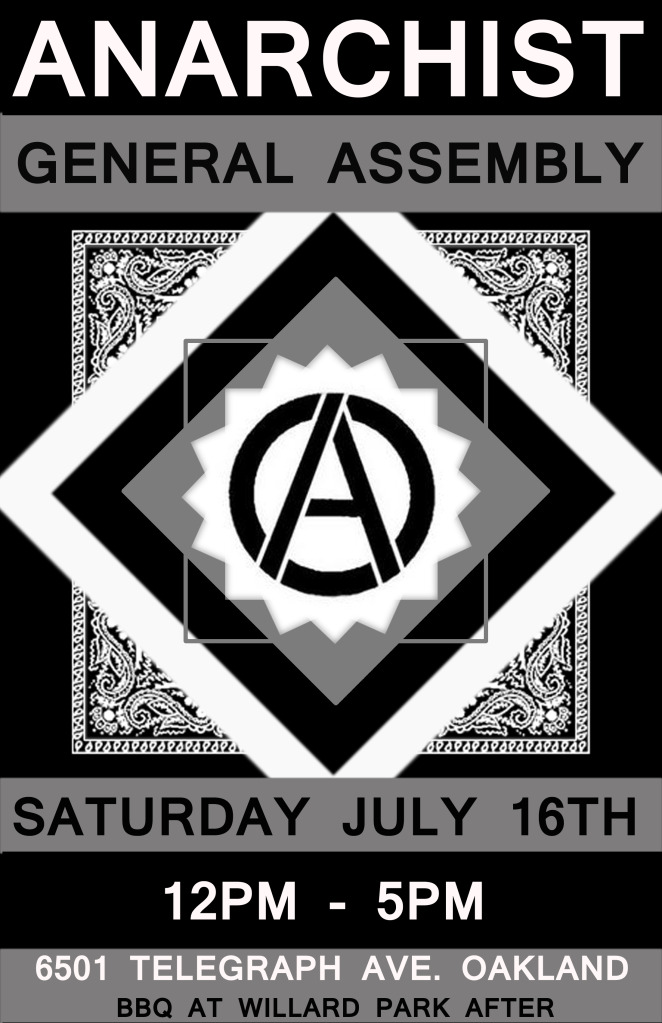
Anarchist General Assembly Tomorrow

640_generalassemblyposterrough.jpg original image ( 662x1023)
Let’s create a new kind of ANARCHIST GENERAL ASSEMBLY!

Saturday July 16th
12 – 5pm, BBQ to follow
6501 Telegraph Ave. (Near Ashby BART)
Oakland, CA

~~~

The first in an experimental series of regional anarchist general assemblies will be held in Oakland on July 16th, 2011.

The purpose of this assembly is to strengthen ties within the Bay Area's anarchist community by providing a regularly occurring event to share projects we’re working on, discuss the topics we are organizing around, promote collaboration and solidarity between different groups, spark new initiatives and build our collective capacity as a social antagonist force. The assembly will not be a decision-making body; it will not create platforms or manifestos.
More detailed information about the various sessions and breakout groups is available in the official announcement at Indybay. It's also worth listening to the following interview that aired on a recent broadcast of the show Relatos Zapatistas. You can listen to it here:

Thursday, July 14, 2011

UC Regents Meeting, July 12-14: Class War Edition

Graduate students protest the tuition hike.Today the UC regents officially voted to once again raise student tuition while at the same time increasing compensation for high level execs:

SAN FRANCISCO -- University of California Regents voted Thursday to raise tuition by 9.6 percent -- on top of an 8 percent increase already approved for this fall -- over the objections of students who said they'll drown in debt.

At the same meeting, the regents also gave large pay raises to three executives, including two who are paid from state funds.

This fall, undergraduate tuition will rise to $12,192, more than 18 percent higher than last year's $10,302 -- a level that prompted violent student protests. With a mandatory campus fee of $1,026, a year at UC now costs $13,218 before room and board.

That's more than twice what it cost in 2005.
If austerity is class war, as our compañeros at Bay of Rage like to say, then these repeated tuition hikes should be considered a weapon in the administrative arsenal. Notably, the regents themselves relied heavily on war rhetoric today in discussing student tuition. Sherry Lansing, the regents' recently inaugurated chairperson who stumbled through the motions of her new role today, called for students to join with "staff and chancellors and all of us" to "continue this battle." For his part, Richard Blum, husband of U.S. senator Dianne Feinstein, huge investor in for-profit education, and perhaps the single most corrupt of all the regents, outlined what he saw as the first step of this battle as follows: "we should determine who our friends are and who are our enemies."

We too see what's happening at the universities -- and in every other sector of this country -- as a form of war. But we draw different lines around our friends and our enemies. For regents like Blum and Lansing, the enemies are students, workers, and faculty. Each of these groups constitutes a target to be attacked via specialized instruments of war: tuition hikes for students, layoffs and wage cuts for workers and (to a lesser extent) faculty. That is why we are the crisis and the job of the university's corporate management is precisely that -- to manage the crisis, to manage us.

(image from the daily cal, quotes via dettman)

UC Debt and the Bond Raters

We talk a lot here about construction and debt, about the UC administration's addiction to using student tuition -- and the promise of future tuition increases -- as collateral to finance the sale of construction bonds. That's classic Meister. But it's important to remember that the UC's corporate management uses tuition in other ways as well. Remember, for example, how a couple days ago the state government asked the UC to loan it $1.7 billion, while the UC regents are once again raising student tuition at the exact same time? (The regents just officially approved the 9.6 percent additional tuition increase, on top of the 8 percent that had already been approved. So tuition will officially increase by 17.6 percent this fall.) Bob Samuels explains:
As we get ready for another large tuition increase, and we read about the elimination of several UC degree programs, the bond rating agency, Fitch, has re-affirmed the university’s strong fiscal standing. While the bond raters have been wrong in the past, we can still read the latest analysis of UC’s fiscal health as indicating the real priorities of the administration.

Since the UC has decided to help reduce its pension liability by selling about $1 billion of commercial paper (debt), it has asked to have its financial status rated. As I have argued in the past, due to the UCs high level of debt, it is dependent on getting a high rating from the bond raters so that it can receive a low interest rate, and one result of this dependency on debt is that the bond raters can tell the university how they think the system should structure its finances. Moreover, even though the bond raters pretend to be neutral and free of any ideology, they covertly push the same agenda that we find in the World Bank and the International Monetary fund. This agenda pushes for the privatization of public entities, a taking on of huge debts, and the deregulation of markets. The plan for the UC set out by Fitch is thus in many ways the global plan being pushed by conservatives and bond raters.

In reading the summary of Fitch’s report, we learn that the university has received a high rating because of, “UC's substantial level of balance sheet resources and liquidity; diverse revenue base, which enables the system to weather temporary weakness in any one funding source; and manageable debt burden, despite the expansive, capital intensive nature of its operations.” In other words, UC has many different revenue streams, and although it has a high level of debt, over $14 billion, it has the resources to take care of its financial obligations.

According to Fitch, one of the main signs of UC’s fiscal health is its ability to constantly raise tuition: “Recent reductions in state appropriations, and the potential for additional cuts through the intermediate term, are partially mitigated by the university's still considerable, though now more limited, ability to raise tuition and fees, and its overall limited reliance on state operating support.” In other words, the UC should not worry too much about losing state funds because it has shown a willingness to raise tuition. In fact, this same logic of privatization is driving the state’s reduction of funding for the UC; since the Democrats believe they cannot raise taxes, they cut the UC, which they know will turn around and raise tuition.

Not only does the state feel comfortable reducing the university’s funding, but they are planning to borrow another $1 billion from the UC system, and the reason why the administration will accept this deal is that the university will turn a profit by lending money to the state. This deal make sense on paper because due to UC’s high bond rating and the state’s low rating, the state has to pay a higher interest rate to borrow money, and if the UC lends money, the state can improve its bond rating, and the UC can profit from the difference between its low interest rate and the state’s high interest rate.

What is left out of this equation is that students are paying 6.8% to take out their loans, and these loans not only allow the UC to raise tuition, but the money generated from tuition can be leant to the state at something like 5%, which is better than the 2-3% the UC gets from putting tuition dollars into its Short Term Investment Pool. If we connect the dots, we see that students are lending money to the state, so that the university can bring in more money, but the end result is that the students will have to pay for this interest deal.
The UC administration and the regents, as dettman put it yesterday, "are simply another mechanism by which the state plunders the middle class to feed the rich."