Tuesday, May 26, 2015

The Political Economy of Enrollment

http://utotherescue.blogspot.com/2015/04/the-good-point-in-paul-camposs-bad-new.html

One the most important debates about the crisis of public higher education these days has to do with understanding the reasons for the restructuring of the public university, which is tied to everything from skyrocketing tuition and student debt to administrative corporatization. In very schematic terms, there are two answers: one focuses on state governments and budget cuts to public higher education, the other on university administrations and their profit-seeking protagonism. The way we choose to answer the question is politically important because it is part of what shapes our strategic and tactical response. If the state government is the primary actor, interventions will generally operate at the level of electoral politics, either through supporting candidates, lobbying, or more generally “making a case” for supporting public education. In contrast, if university administrations are the primary actors, interventions will generally occur more locally, at the level of the campus or system, through actions like rallies, walkouts, strikes, occupations, and so on. Of course, things aren’t always as clear cut as this dichotomy suggests. But in a context where austerity is so visible and “politics” is largely seen as something politicians do, it’s important to remember the active role of administrators in restructuring their universities into the ground.

These debates are organized in part by how the numbers are calculated. Take the recent and controversial New York Times essay by Paul Campos, which argued counterintuitively that government support for higher education has actually increased, not declined, since the 1960s. He claimed that the real reason tuition has gone up so much is not budget cuts but the skyrocketing expenditures that channel money into administrative bloat and building construction. Not surprisingly, the piece generated a quick response from folks who see state funding as the key. A number of these critiques turned on the claim that he was using the wrong metric—rather than aggregate support for higher education, he should instead be using per-student funding:
Overall, public spending on higher education has, as Campos argues, risen dramatically over the long term. But so have the number of Americans attending college. When administrators say that government support is shrinking, what they usually mean is that per student appropriations have fallen. This is a crucial point. Someone has to foot the bill for each and every undergraduate's education. If taxpayers don't do it, then families have to pick up the slack themselves.
And sure enough, the administrators did in fact say exactly that. Nathan Brostrom, the Chief Financial Officer of the University of California system (and former JP Morgan exec), wrote a letter to the Times criticizing the Campos piece in which he made exactly this argument:
Mr. Campos blames administrative bloat and high salaries; I disagree. The State of California, for example, funds the University of California system at the same level as it did in 1999—even though today we enroll 83,000 more students and have one more campus.
The per-student argument makes mathematical sense. It’s obvious that equal funding / more students = less funding per student. State funding per student has obviously declined. And yet... using this metric as the gold standard seems to miss something important about the function of the student at the public university today.

When higher education was relatively fully funded by the state—when tuition was zero—the per-student metric made sense. Under the Master Plan, state funding for the UC was pegged to in-state enrollment. In that context, enrollment served as a reasonable way to quantify the “public good” produced by state support for higher education. Rising enrollment theoretically meant more trained workers who could be funneled into the labor market. The massive expansion of the infrastructure of public higher education during the 1960s, when not only new buildings but entirely new campuses were constructed, was justified in exactly these terms.

Over the last three decades, however, these enrollment quotas have gradually been removed. Little remains, likewise, of the idea of higher education as a “public good.” What is the function of the student today? It depends who you ask. Teachers see (or should see) students as critical, thinking subjects, who they can learn with and from. But administrators see students as dollar signs. These days, students are little more than revenue streams that show up on credit reports as potential liquidity and favorable interest rates. We all understand that tuition increases are an attempt by university administrations to bring in more revenue. But enrollment increases do the same thing. And this actually shouldn’t be all that controversial, since we already talk about out-of-state enrollment in exactly this way. But is it the case for in-state enrollment as well?

Last week, the UC regents approved an increase in out-of-state tuition by 8 percent per year for the next 5 years. Next year, out-of-state students will pay an extra $1,830 in tuition. During the meeting, Brostrom himself pointed out that the UC could accommodate 10,000 more undergraduate students if the state provided additional funding for them. He also suggested that the administration would lobby the state for these funds. The CFO’s language frames increased enrollment as a public good, a drag on the university’s resources, certainly, but something that the state should do, as the state once did. What he doesn’t say, however, is that enrolling 10,000 more in-state undergrads (at 2015-2016 tuition levels) would provide the university with an extra $112.2 million per year. And even if we assume those 83,000 extra tuition-paying students are all California residents, that’s nearly a billion extra dollars in gross annual revenue over 1999 levels.

Now, the UC administration claims that the cost of instruction is greater than in-state tuition. But these claims are at best debatable and at worst simply not credible, because as Chris Newfield and Bob Samuels have shown they include research and other non-educational expenses in order to inflate the alleged instructional cost. (It's gotten to the point that, as Samuels observes, the administration literally claims it costs $342,500 to educate one medical student for one year.) According to Newfield, a more reasonable estimate of the cost of instruction for undergraduates would be somewhere between 40-80 percent of the administration’s figures. Even using the higher rate, then, the administration still generates a net profit for every extra student they bring in.

Per-student funding can be a useful metric for clarifying certain trends, but it’s equally important to understand the things it makes invisible. University administrators make decisions about enrollment not out of some abstract interest in the “public good” but rather out of a very concrete interest in the bottom line. Enrollment should not be treated as a given but as a variable that may shift as executives and financial officers seek to optimize revenue flows. In this context, using per-student funding may obscure the function of the student today while deflecting antagonism toward the state.

Thursday, May 14, 2015

Ambiguous news from Sacramento

Today Governor Brown announced his revised budget. Despite general enthusiasm about its two-year tuition freeze for in-state students, the budget presents a pretty ambiguous picture. In addition to allowing up to 8% annual hikes for out-of-state tuition, it also imposes a series of regressive transformations on the UCs. For example, the budget sets in place requirements that campuses push students toward three-year degrees:
In addition to supporting timely four‑year degrees, each campus will develop three‑year degree pathways for 10 out of its top 15 majors by March 1, 2016, which will provide students with another option to earn a UC degree. The UC has committed to promoting and encouraging these accelerated pathways with a goal that 5 percent of students will access these accelerated tracks by the summer of 2017.
The reduction of time-to-degree is presented as a solution to a problem that would not exist absent university privatization: 3 year degrees are affirmed by the State insofar as they allow students to avoid paying another year's worth of high tuition and room and board. But this accelerated pace would diminish educational quality, and would impose on students an even more intense schedule, making it difficult for them to organize strikes and other sorts of unproductive activities. A couple other areas of concern are the agreements between the governor and UCOP that in-state tuition should begin to rise by at least the rate of inflation after the two-year freeze, the establishment of a third pension tier, and the $18 million dollar cut to the Middle Class Scholarship Program.

But to return to the out-of-state tuition hike: the state's effort to divide the student body (in terms of their immediate political interests) between those from California and those from other states or from abroad seems to be working. While the out-of-state tuition hike is not nearly as high as what was being discussed last December (an up to 8% annual increase rather than 17%), the multi-thousand dollar hike is not insignificant in terms of out-of-state students' debt levels, nor is it politically insignificant. Those who rule the state seem to be on the verge of breaking what had been an established across the board tuition freeze: they are thus rolling back some of the student movement gains of 2012. The following charts, composed by Shannon Ikebe, show recent (and projected) trends in tuition rates (based on data from UCLA):


Not only does the out-of-state hike extract more money from certain students and thus divide the immediate interests of the student body, it also exacerbates inequalities between UC campuses, with those (like UCB and UCLA) with relatively whiter and wealthier student bodies receiving a disproportionate funding increase, while those (like UCR, UCM, and UCSC) with higher percentages of working class / students of color receiving relatively little increase following the hike, since they have significantly lower rates of out-of-state students. While the chart on the left shows the percentage of the out-of-state tuition hike that will go to the respective campuses, the chart on the right shows what a more equitable distribution of funding would look like.


All of this is to say that Brown's revised budget is a politically ambiguous document, reflecting at once the power of mobilized students and the current limits of this power. Those who rule the state (whether they be UCOP bureaucrats, the Regents, or State Representatives) have managed to chip away at the tuition freeze and to introduce regressive reforms of UC education, even as active students (led by those at Santa Cruz) have managed to hold off even worse privatizing reforms. 

Beyond tuition, there are a number of regressive dynamics happening at the moment with respect to the repression of student organizers. At Santa Cruz, students who blockaded a highway in early March are still suspended from campus under the orders of conduct officers. This is, I believe, the first extended suspension imposed by a UC administration on anti-privatization protesters in recent memory. And it's possible that Berkeley students who briefly occupied California Hall a few weeks ago demanding a community benefits agreement for the Richmond Bay campus could also be facing conduct charges. If such charges materialize, they would constitute the first student conduct prosecutions for political activity at UCB since the delegitimization of the Office of Student Conduct accomplished over the spring of 2010 by a group of Boalt law students and by other active students. 

Thus, on both anti-privatization and anti-repression fronts, much remains to be done.   

Update [5/15/15]: Chris Newfield is up with a new piece on the revised budget, that especially breaks down the total state contribution levels, the pension re-tiering, and the state's insistence on a certain minimum ratio of transfer to four-year students, among other aspects of the revised budget. 


Monday, May 11, 2015

What Makes a University Public?: Privatization, Environmental Racism, and UC Berkeley’s Real Estate Office


by Beezer de Martelly

“It’s a gift to be here—you can take that to the bank.”
EVCP Claude Steele, May 5 Berkeley Forum “What Makes a University Public?”

“There is deferred maintenance all over the place.”
Chancellor Nicholas Dirks, May 5 Berkeley Forum “What Makes a University Public?”

For those who haven’t been paying attention, UC Berkeley’s recent move to expand the Real Estate Office’s control has led to some strange and shocking administrative moments in the last couple weeks.

One such moment was a May 5 Berkeley Forum in which Chancellor Nicholas Dirks and Executive Vice Chancellor and Provost Claude Steele hosted a chat called “What Makes a University Public?” In this talk, they attempted to redefine “public education” to effectively argue that the kinds of private financial investments that circulate through the newly expanded Real Estate Office do not constitute privatization. These investments—alternately called “Public-Private Partnerships”—currently include privately funded construction projects such as the Berkeley Global Campus at Richmond Bay, a brand new UC campus that will focus on lucrative STEM and Silicon Valley research; the Gill Tract, a piece of land the UC is trying to lease to outside contractors for $900,000/year for six acre plots; Berkeley student housing, including the privately funded Bowles Hall, several other new large-scale dormitories, and real estate developments at UC Village, to name only a few. 

Many students, faculty, workers, and community members are challenging the administration’s superficial rhetoric that such construction on public land does not constitute privatization, citing the lack of oversight for these projects, the ways that private money shifts research possibilities and priorities, and the rising tuition costs which are used to secure the Real Estate Office’s low interest construction loans, called “bonds.” Further, many believe the exorbitant costs for these expensive construction investments will ultimately be deferred to students, as has been the practice in the past, and the public, should the University go bankrupt. Dirks even admitted that this new development comes at the expense of deferred maintenance, as much of the Berkeley campus is in desperate need of basic upkeep.

The egregious forum was protested by multiple allies, where critics seemed to far outnumber supporters and even neutral attendees at the event. Unionists came to ask questions about poverty-level wages and job insecurity amid Berkeley’s contracting out of non-unionized labor. A Teamsters 2010 flyer read “Low Wages Do Not Serve the Public Good.” Also present were various students working on anti-privatization efforts, some of whom distributed sample audience questions for administrators about the UC’s commitment to public education. One question read, “Many of the UC Regents are heavily involved in the financial and real estate sectors. How should the UC Regents balance their private interests with the public’s interest?...What do we, as a public institution, owe to the public of Richmond?”

Perhaps the most significant presence at the Forum was a group of Black student organizers who are fighting to reverse Prof. Carolyn Finney’s arbitrary and unexplained denial of tenure. Finney, the only Black Professor in the Environmental Sciences Policy and Management department, researches racial exclusion in the environmental movement. Hers is an especially crucial voice at a time when the UC is trying to break ground in Richmond to construct a new, privately funded campus atop an EPA “superfund” designated toxic waste site in a largely black and brown working class community. Finney’s much acclaimed work represents an especially critical perspective during this phase of Richmond’s development in an environmentally sensitive area. Concerningly, one of the campus functions the Real Estate Office has taken over in its transition is Berkeley’s Environmental Health and Safety Office, which enforces compliance with environmental regulations, water safety, and construction permitting. Whether the EH&S Office will retain its autonomy and commitment to environmental justice or become a permit mill for new construction remains to be seen. Unless the University reverses the decision to deny Prof. Finney’s tenure, a decision within Chancellor Dirks’ power, this battle to ensure environmental justice will need to be waged with one fewer respected local researcher and community ally. 

Also prominent was the Respect Richmond Coalition, a student group pushing the Chancellor to sign a Community Benefits Agreement that would ensure that Richmond residents are not harmed by and actually benefit from the new UC campus construction. Many Richmond community members are currently struggling to stay in their homes as land speculation and rent rises and contributes to gentrification, and they are fighting to ensure that the new campus provides jobs and educational opportunities for local residents. Six student members of this group are now facing Student Conduct Charges for staging a peaceful sit-in outside the Chancellor’s office last week to push Dirks to sign the Richmond Agreement, an attempt to silence student concerns about the direction of the Richmond Bay development project. At the Berkeley Forum, a dozen Respect Richmond Coalition members assembled in a line at the front of the stage, mouths taped shut, holding signs that read “You Can’t Arrest Our Voices” and “Drop the Student Conduct Charges.”

Amid these groups was Fossil Free Cal, whose members distributed pamphlets calling on the UC to divest itself from fossil fuel assets. This group, comprised of students and alums, connected the University’s financial interest in toxic commodities to its profiting off of environmental injustice. “Talk is cheap,” read Fossil Free Cal’s flyer, “A public university that fails to ACT in the public interest sells its mission short.”

For those of us committed to a public UC Berkeley, this is an exciting moment, where there is potential to link many ongoing campus struggles to fight structural racism, privatization and gentrification, environmental degradation, and anti-labor measures. The forum was eventually shut down when the Chancellor and Executive Vice Chancellor and Provost refused to answer audience questions about workers’ unlivable wages, when Finney’s tenure denial will be reversed and what it was denied in the first place, and why UC administrators are so actively undermining the UC’s public education mission. 


I write this update both to keep interested readers and coalition partners—wherever you may be—in the loop and also to urge people to continue organizing on these issues in whatever spaces you can and that feel right. This is a really significant time for our University, and it’s future as a public institution committed to racial and economic equality is truly on the line. 

Friday, March 27, 2015

Statement of Occupation from the Che Cafe at UC San Diego


The Che Cafe has been occupied. The 35 year old cultural center, social space, DIY music venue, student/worker co-operative and affordable eatery has come under the complete control of students, faculty, alumni and community members who have refused to leave its premises, despite a UC sanctioned eviction notice that became active on March 24 at 6:00 a.m. For over one year, the administration of UCSD has attempted to shut the Che Cafe Collective out of its historic home using a variety of secretive bureaucratic maneuvers, manipulations and blatant lies. This most recent battle between the Che Cafe Collective and UCSD administrators can be contextualized within the larger history of struggle that informs the identity and praxis of the Che Cafe. By our count, this is the 5th time that university administration has attempted to eliminate the Che Cafe Collective since it became operational in 1980. All prior eviction attempts carried out by the university have resulted in abject failure. Each subsequent eviction attempt has inspired wider community and student solidarity with the Che Cafe Collective and this occasion is no different. Students, community members, faculty and alumni from disparate backgrounds have become determined to demonstrate their power and willingness to engage in collective direct action to preserve the Che Cafe.

The Che Cafe Collective and its supporters are not so nearsighted that we ignore the obvious parallels between the fight that UC students have brought against the continuous fee and tuition hikes enacted by the Regents and the fight to prevent the closures of integral student facilities which would no doubt result in an erasure of culture and student self organization that is preserved by spaces like the Che Cafe. Our fight is one and the same.

When we act as we are now, by occupying a space that rightly belongs to the students and community members who utilize it, we act in solidarity with the 6 UC Santa Cruz students who are being criminalized by the UC after having taken direct action to preserve the accessibility of higher education. When we act as we are now, we are acting also in solidarity with the students of Quebec, who have once again taken to the streets with calls for a general strike in order to ensure their access to public universities. When we act as we are now, we invoke the knowledge, practice and ferocity that UC students across California acted with in 2009. When we act as we are now, we hope to inspire action on your part.

Our occupation is ongoing - we invite you to join our fight.

forward until victory,

some occupiers and collective members of the Che Cafe Collective

Wednesday, March 4, 2015

Please take action: Students seeking to redesignate restrooms as “all gender” face harassment and police detention at UC Berkeley


Reposted from UCOP Bathroom Brigade:

Yesterday, March 3, an anonymous group known as the Bathroom Brigade posted “all gender” signs on bathroom doors across UC Berkeley. The signs include the following text:
Please excuse our dust! The approval and planning process for a bathroom redesignation is surprisingly time-consuming, but in the interim the University’s priority is making sure everyone has safe access to a bathroom. As a temporary measure, we encourage everyone, of all genders, to use this bathroom. We’ll put up a permanent sign as soon as we can.
In a tongue-in-cheek way, the signs seek to pass as being officially authorized. They also highlight the reality that trans and gender nonconforming people on campus do not have adequate access to safe bathrooms. University administrators appeared to have recognized this unmet safety need: months ago, President Napolitano promised to redesignate every single-user bathroom as “all gender,” while UC labor relations agreed to provide reasonable access to all gender restrooms for student workers. Since then though, UC Berkeley administrators have not redesignated a single bathroom. 
     
Yesterday, when members of the Bathroom Brigade sought to expedite the process of redesignation, administrators and UC police officers responded in ways that threw into question the UC’s stated commitment to the safety of trans and gender nonconforming students and workers. First, administrators sent out emails disavowing the signs, as in the following: 
Dear Stanley Hall Faculty, Researchers, Students, and Staff,
Signs have appeared on the building’s restroom doors that indicate that restrooms are available to all genders. Please disregard the signs; they will be taken down as soon as possible.
It seems that these efforts to take down the signs have already overstepped, as previously authorized “all gender” signs in Stephens Hall were torn down yesterday. Additionally, members of the Bathroom Brigade and supportive students have reported facing harassment or violence in connection with the signs. Some members of the Bathroom Brigade were followed down the hallways of a building by a campus administrator. And a supportive student who attempted to discourage an administrator from tearing down the signs faced aggression. As she writes:
Still trying to collect my memories from the heat of the moment, but moments ago I stood in front of this sign to stop a man from aggressively tearing it down as we went to the bathroom after class. He had torn down 3 of 4 signs despite repeated requests to stop, and was so determined to get the last one that he attempted to pull it from behind my head. My friends and a passerby were shocked by how he went so far as to almost touch/hit me to get to that sign (which he may have, but I was too focused on protecting the sign to notice). There is a photo of me pointing my camera phone to get him to back off, since he stood incredibly close. All of this occurred even after I explained that the folks behind this campaign are trying to force the UC to take issues of gender and trans safety seriously. He and his friend are both older white men who likely work in the electrical engineering and computer science admin office, so we were surprised that they felt so comfortable proceeding aggressively in a confrontational dispute with students. But their behavior is a perfect example for why the UC needs to stop dragging their heels in implementing accessible gender neutral bathrooms.
Then, early yesterday afternoon, two students were detained by the UC Police in connection with the bathroom redesignations. A white trans woman and a black cis man, both members of the Bathroom Brigade, were initially confronted by two building administrators in the hallway of the Li Ka Shing Center – a building that currently contains no all gender restrooms. One of the administrators demanded that “all gender” signs be removed, which the students attempted to do. When the administrator continued harassing the students, they left the building and walked three blocks to a bus stop. He followed them the entire way, talking on his phone as he walked. The students then boarded a bus and rode on it for a block, at which point the bus was stopped by two UC Police officers. The officers came onto the bus and detained the students. After detaining them on the sidewalk, the officers said that they were planning to report the students to the Office of Student Conduct, and that, if there had been any damage to paint surfaces in the Li Ka Shing Center, they would consider pursuing a warrant for the students’ arrest.

That two students attempting to expand trans peoples’ access to safe bathrooms were harassed, followed, and detained by the UC Police highlights some of the connections between interrelated forms of sanctioned violence: the harassment trans people face in public spaces, including at our universities; the securitization of partially-privatized UC buildings, such as the Li Ka Shing Center; and the militarization of UC and Berkeley City police departments. A coalition of student and community groups has recently been pushing back against police violence in Berkeley. On February 10, the UCB Black Student Union helped organize a march to city council, where students and community members called on the council to take action against racial profiling and against militarized policing throughout Berkeley. The coalition also continued to press for justice for Kayla Moore, a black trans woman who was killed in her home by Berkeley City Police on February 13, 2013.   

Please take a moment to call or email Chancellor Dirks and share with him your thoughts about what happened today. You might consider demanding: 1) that UC Berkeley expedite the process of redesignating bathrooms as “all gender” in order to address the safety needs of trans and gender nonconforming people; and 2) that no student conduct or legal charges be brought against students for posting “all gender” restroom signs.    

Chancellor Dirks: (510) 642-7464; chancellor@berkeley.edu.

Monday, February 9, 2015

What University Administrators Gain from $300 Million in Cuts


Guest post by Lenora Hanson and Elsa Noterman, graduate students at University of Wisconsin, Madison.

Over the past two weeks the University of Wisconsin System and UW-Madison administrations have gone on the defensive against the hemorrhaging of state support for higher education recently proposed in Scott Walker’s Biennial Budget—including $300 million in budget cuts (the largest cut in the 44-year history of the UW System). But the current proposed budget cuts and university restructuring should be understood within a larger historical and political context—one in which a push for privatized education has happened not simply due to partisan divisions at the state Capitol, but also because of financial and material incentives for the UW System.

The UW administration’s narrative, along with that of others in the local and national media, blames Scott Walker and tea-party Republicans for both recent and ongoing budgetary crises in higher education in Wisconsin. In part, memories of the historic resistance to Walker’s attack on labor in 2011 only fuels this narrative. As a result, anger about and actions against the budget are being directed towards the state Capitol. Sending campus and system-wide emails, talking to local and national media outlets, meeting with legislators and creating open forums on campuses to discuss the cuts with students, faculty and staff, UW System administrators are taking every opportunity to inveigh against the 13 percent cut in state funding—and emphasizing the inevitability of tuition increases and job losses if these cuts go through. But the administration’s defensive posture around state cuts to university funding is not new; indeed, it has provided the catalyst for much of the System’s rhetoric around austerity measures in the past. As Chancellor Blank made clear in October 2014, even maintaining current state contributions would require “implementing substantial cuts” within the university, one reason she has recommended considering increases to out-of-state undergraduate tuition. This posturing arguably obscures the administration's ongoing efforts to consolidate control over the university, making them appear as passive respondents to a continuous Republican onslaught. 


More of the same

There is precedent in the UW System for trying to restructure the university and reduce reliance on state support, one that perhaps grows out of UW-Madison’s aggressive attempts to free itself from the burdens of state regulation. In 2011, then-Chancellor Biddy Martin infamously held secret talks with Walker’s administration to discuss what she called the “New Badger Partnership” (NBP), which would give UW-Madison autonomy from the state by making it, and it alone, a public authority (also known as a public-benefit corporation). Budgetary cuts and labor issues were at the forefront of critiques of the NBP. Less attention was paid to the fact that in the original version of the NBP, the UW-Madison would have won the ability to issue bonds (essentially debt plus interest) for its campus construction projects instead of relying on the state to do so. The NBP, at least as originally drafted, failed to be implemented due to public outcry and bipartisan legislative opposition. But in December 2012 a “Task Force on Restructuring and Operational Flexibilities” was put together to recommend to the state certain “flexibilities” that would be given to the entire System, and the Budget and the failed NBP had not provided specifically to UW-Madison. One of the recommendations issued was to grant the system the ability to lease or bond for their own projects:


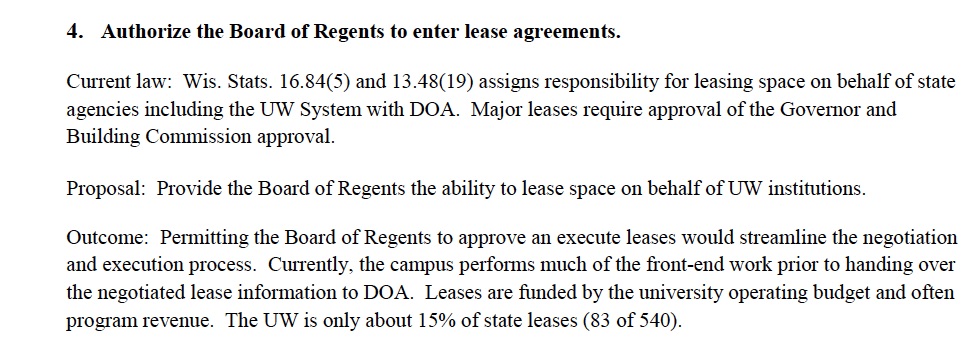
While the state disagreed with the Task Force recommendation to remove the state from the design and implementation of new buildings, they agreed that the System should be given the capacity to lease, or bond, their own projects. This ability, however, “would require statutory changes” (59) that the UW System did not have in 2012.

In making an appeal to the state for greater control over capital projects, the Task Force made an important point for us to keep in mind. Of all UW System projects, nearly 60 percent each biennium are funded by university‐generated revenue and receive no taxpayer support. This means that only 40 percent of the construction projects built on UW System campuses are paid for by state tax dollars, and thus only 40 percent are built primarily or specifically for instructional purposes.


Buildings Race


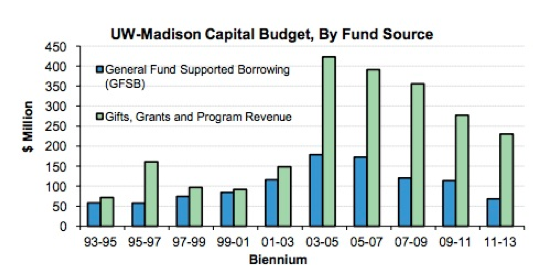
In their drive for increasing revenue, universities around the country are competing to attract the same wealthy out-of-state students to their campuses. In the fall 2014 semester—for the first time in at least fifteen years, over half of the students at the Ann Arbor campus of the University of Michigan were from outside the state. This followed the announcement last year of a $500 million building spree at the university. At UW, out-of-state new undergraduate freshmen increased by 42 percent between 2003 and 2012—and these out-of-state students paid more than twice as much as their in-state classmates (UW Data Digest). To attract these non-resident students, administrators are increasingly taking on capital building projects and recreational amenities—such as upscale apartments, climbing walls, and food services. This buildings race—where universities are trying to out-build the competition—has lead to increases in tuition (the most flexible source of revenue). In Wisconsin, spending on non-instructional campus buildings has drastically increased in recent years (see above graph). On average, these building projects now cost students $192 a year—and will continue to do so for up to 30 years. Of course, this cost does not include the price of building maintenance, upkeep, and debt services (the interest that is paid—over many years—on the loans used to finance these projects). In the end, these building projects often cost more in debt service payments than the initial construction price-tag. Currently, costs and debt service are largely guaranteed by segregated fees and revenues generated from parking lots, dining services and other non-instructional services. But with the public authority model tuition is likely to become a significant—if not the primary—source for paying off bonds as well providing the capital necessary for taking on future debt.


Pledging Tuition?

Lo and behold, the statutory changes previously recommended by the UW Taskforce (see above) have emerged in the current budget bill proposed by Governor Walker, which grants bonding issuance and management to the UW System for those projects not backed by public monies, or general purpose revenues (60 percent of construction projects in the system). It explicitly allows the newly-formed UWSA Board of Regents to: “issue bonds that are not public debt and specifies that the state pledges that, unless bondholders are adequately protected, the state will not limit or alter any rights before the UWSA satisfies the bonds. The bill eliminates all appropriations to the UW System under current law, except general purpose revenues for educational programs and the payment of certain construction debt” (emphasis added 16-17).

The latter section of the above quote is important because it seems to suggest that funds to pay for non-instructional construction costs and debt service (remember, the majority of construction projects on campus) are no longer guaranteed by the state, but by the UW Board of Regents (BOR) and its revenue sources. Previously, UW Madison’s construction costs and debt service were backed by the state through general obligation bonds, which means they were backed by a certain percentage raise in taxes that could be levied to cover costs. In other words, all previous bonds issued to pay for university construction projects—for both academic and non-academic purpose buildings—were at least hypothetically backed by public debt. But what are the revenue sources that the BOR will be able to rely on, then?

If we needed a crystal ball to know where the UW System is going, we only need to look to the past. In 2009, Prof. Bob Meister at UC-Santa Cruz sent shockwaves through the University of California system when he revealed that in order to continue funding the building boom on campuses across the state, the UC System had pledged access to 100 percent of tuition revenues to pay off the debt service on those projects should all other revenues be cut. Why was tuition promised? Because, “although tuition can be used for the same purposes as state educational funds, it can also be used for other purposes including construction, the collateral for construction projects, and paying interest on those bonds. None of these latter uses is permissible for state funds.” In other words, it is a more flexible source of revenue for the university administration. As of 2017, just as the state cuts enumerated by the current budget will get even worse for the UW System, tuition setting ability will rest wholly with the Board of Regents. So while the $300 million dollar cuts will certainly necessitate tuition increases, so will the System’s newly acquired control over construction projects if they follow the trend suggested above. And if the cuts have appeared as a surprise in recent weeks, the construction project “flexibilities” been in the works for years. 


Flexible not free

Given the amplifying costs of debt services for capital projects, there is then a greater incentive (and arguably a financial imperative) for the university administration to regularly increase the price of university education. At the University of California System and University of Michigan—where university administration has complete control over bonding (and are thus responsible for paying the debt services)—tuition rates have increased dramatically. Across the UC system, for example, between 2008 and 2010 student tuition rose by 109 percent. At the University of Michigan, tuition has increased by 233 percent since 1990. While the state of Wisconsin currently has a tuition freeze for in-state students until at least until 2017, Chancellor Blank has asserted that she will be lobbying the Board of Regents to raise tuition for students not affected by the freeze—including nonresident students and those in professional schools. Given that after the last tuition freeze in 2004, tuition increased 18 percent, it is also very likely that following 2017, the cost of education will increase for all UW students.

This most recent attack on higher education in Wisconsin needs to be understood not strictly as a partisan issue, but as a new development within the university itself as a site of accumulation, investment and speculation. This development needs to be considered when we decide who our targets and who our allies are not only in responding to attacks, but in working towards building the university we want now and in the future.

Friday, January 9, 2015

Securitization, risk management, and the new university


Talk delivered by Amanda Armstrong at the 2015 MLA Subconference. Vancouver, B.C./Coast Salish Territory. 1/9/15.

The germ for this presentation emerged as I was reading Ruth Wilson Gilmore’s Golden Gulag. Her second chapter argues that the prison construction boom in 1980s California was a response, on the part of those managing capital and governing the state, to four surpluses, including of capital, labor, land, and state capacity. With respect to capital surpluses, Gilmore shows how investment bankers, in search of profitable sites of investment, developed new financial mechanisms in the early eighties that enabled debt-financed prison construction to go forward without voter approval. These new financial mechanisms, called lease revenue bonds, had recently been put to use as well for the funding of construction projects at California colleges and universities.

In what follows, I want to talk a bit about these convergent shifts in prison and university financing, which Gilmore reads as ruling class responses to the protracted economic crisis of the seventies. While formally similar in certain respects, these parallel shifts also indicate a tilting of the state toward policing and incarceration and away from direct support for education and other socially reproductive state functions. I’m interested in the aftereffects of these shifts, and particularly in what has changed over the last five years, following the crisis of 2008 and recent waves of struggle.

With respect to the universities, Gilmore describes how, in 1981 and ‘82, Frederic Prager, a well-connected underwriter in California, “worked with the Association of Independent California Colleges and Universities to issue an innovative revenue bond whose proceeds [constituted] a forward-funded market for student loans” (98). Soon afterwards, the loan arrangement was extended to public universities as well. The terms of this particular revenue bond illustrate some of the emergent parameters of university financing in the early eighties.

At this moment, newly available student aid and loan money – funded and backed by state agencies – provided an incentive for universities to gradually increase tuition, and thus enabled them to secure the unencumbered revenue necessary to undertake debt-financed construction projects – projects that university managers justified on the grounds that new construction would help them compete for students. Prager and his associates at KPMG helped rationalize these new financial dynamics, publishing manuals of “best practices” for university managers. Their 1982 “Ratio Analysis in Higher Education” presented its readers with financial “ratios” that could be used to determine the proper balance of university revenues, operating costs, investments, and bond debts. Unsurprisingly, these apparently neutral ratios pushed university managers to funnel more capital into financial markets and to take on higher levels of construction debt. 

Similarly, Prager and his associates’ work developing new prison financing mechanisms enabled the California Department of Corrections to acquire over 2.5 billion dollars in state-backed lease revenue bonds over the 1980s, supplementing 2.5 billion in general obligation bonds, which the Department of Corrections used to expand prison capacity by approximately four hundred percent (101). This prison expansion was accompanied by the rewriting of criminal law and by the emergence of new forms of urban policing, surveillance, and spatial enclosure, outlined by Mike Davis in City of Quartz.  

The assertiveness with which financial advisory firms in the 1980s worked to turn the prison and higher education industries into new sites of real estate investment and capital accumulation is especially striking when considered in relation to KPMG’s most recent, and much more reticent, 2010 edition of “Strategic Financial Analysis for Higher Education,” the successor to their “Ratio Analysis in Higher Education.” In this most recent edition, Prager and his associates implicitly acknowledge that their earlier ratios had not been conservative enough to protect against financial meltdowns, and even that university managers probably shouldn’t have been relying on abstract ratios in making investment decisions in the first place. “Financial analysis is not a static exercise,” they write; “'Acceptable metrics' in one environment may not be desirable in another.” In their contextualist 2010 edition, the only advice the KPMG authors confidently assert is that central administrators must systematically incorporate a “risk management” framework into all dimensions of university governance, lest they be caught off guard again by financial or other shocks.

The University of California certainly has followed this prescription. The university’s Office of the President recently established an “Office of Risk Services,” and has begun convening regular “Risk Summits” and meetings of the “Risk Management Leadership Council.” This turn toward risk management can be read as marking the incorporation of security and surveillance techniques into the heart of public university management, including the management of university finances.

The variant of “risk management,” that has recently been taken up by University of California administrators is a composite thing, drawn together from disparate sources and remolded to fit local conditions. In part, risk management follows from the codification of internal accounting techniques that were developed in the aftermath of the Watergate scandal, but only formally required of public companies following the 2002 ENRON scandal. As KPMG and other boosters insist though, risk management is not simply a matter of insurance or internal compliance mechanisms. It also entails new, more ambitious, modes of governance and control, first developed for the logistics and security industries. The logistics industry, contending since the 70s with elongated supply chains and just-in-time production, developed tracking and distribution practices to limit both the frequency and disruptive effects of delays across supply chains. As Deborah Cowen has shown, these new practices drew the logistics industry closer to security and military agencies. The notion of “supply chain security” indicates how logistics has come to rest upon a strategic relation to space; nodes and spans in supply chains, including ports, highway networks, ocean passages, and rail yards must be surveilled and enclosed by force in order to ensure the smooth flow of commodities. Thus, under the banner of supply chain security, the urban policing, surveillance, military, and logistics industries have become increasingly enmeshed since 2001.

Documents designed to introduce interested UC administrators to “Enterprise Risk Management” contain illustrations and categories drawn directly from the logistics industry, including just-in-time production and supply chain analysis. But these and other categories of risk management require a certain amount of translation to fit within university contexts.

For the remainder of my talk, I want to discuss a few recent events that illustrate the contested local manifestations of risk management practices at UC Berkeley.           

First, concerning new construction. As a result of anti-tuition and occupy mobilizations in 2011 and ’12, the University of California adopted a multi-year tuition freeze in the summer of 2012. At this same moment, a spokesperson for UC Berkeley’s office of Capital Projects announced that future dorm construction would be outsourced to private developers in the form of ground lease agreements. Since then, other development projects are being privatized through similar agreements, both at Berkeley and on other California campuses. Not coincidentally, a 2012 Bain report on “The Sustainable University” encourages university managers to use ground lease agreements to reduce debt leverage and to avoid risk exposure attendant upon new development.

This turn toward privatized construction – aligned with the project of risk management – has contributed to an intensified securitization of university space. Partially or fully privatized new buildings, such as the Li Ka Shing Center for Biomedical and Health Sciences, the Blum Center for Developing Economies, and the Energy Biosciences Institute, are each at least partially closed to the general public and require key card or other forms of securitized access. In February 2013, organizers with the Student of Color Solidarity Coalition took over the Blum Center to protest the appointment of Janet Napolitano as UC President -- a particularly glaring illustration of the university’s securitizing turn. The occupation of the Blum Center challenged as well the shift toward spatial enclosure at UC Berkeley and its racially exclusionary effects.  

The enclosure of campus space also appears in university administrator and police anxieties toward the presence of “non-affiliates” on campus. As Brian Whitener and Dan Nemser note, UC risk management templates identify the presence of non-affiliates (i.e., people perceived as having no direct tie to the university) as a factor that increases the risk profile of a given event. The non-affiliate is a racialized figure, which was made glaringly evident when UC Davis administrators, in justifying police violence against Occupy Davis protesters, attempted to associate the threat of sexual violence at occupy encampments with the presence of Oakland-based demonstrators on campus. The everyday campus police harassment of black students and workers on and near campus is linked to this anxiety over the presence of non-affiliates, and manifests a broader anti-black exclusionary logic, which can be traced back as well through recent privatizing reforms, the passage of Proposition 209 in 1996, and the anti-affirmative action politics of the 1980s. 

Following acts of police violence against Occupy Davis, Berkeley, and Riverside protesters in 2011, then-President Yudof commissioned an internal review of campus police practices. Recommendations that emerged from this review align with the principles of risk management. Police responses to protests are to be managed by administration-led crisis response teams, and police are responsible for recording all demonstrations.

Before concluding, I want to turn briefly to recent actions in Berkeley and Oakland against anti-black police violence, considering them in relation to the rise of risk management and the intensification of securitization at and beyond the university. In the midst of larger uprisings in the bay area and nationally following the non-indictments of Darren Wilson and Daniel Pantaleo, UC students were particularly galvanized when Berkeley police decided to use tear gas and batons to drive hundreds of students and other local residents ten blocks south of campus. Presumably, the police decided to force students away from campus because the demonstration’s original proximity to dorms and a commercial district meant that police could not secure the area and that the risk of costly property destruction was relatively high.

While many students likened this act of police violence to the violence inflicted on students by police in 2011, the demonstrations that emerged in response were quite different. In 2011, students responded by holding strikes on campus, while this past December, students and other local residents gathered each night on the edge of campus, and marched along different routes through Berkeley and Oakland, stopping at police stations, shutting down highways and train lines, and destroying windows of banks, police cars, and chain stores. More recently, Black Student Union members have marched through commercial districts of Berkeley, interrupting restaurant and commercial businesses by reading the names of black people killed by police or vigilante violence.

In traveling through Berkeley and Oakland, student protesters have refused to remain enclosed within the bounds of campus, or even in some cases to take political action as students. In doing so, they have worked to de-activate the student / non-affiliate binary. They have also acted in a way that implicitly recognizes the increasing imbrication of university policing, urban policing, and supply chain security, as well as the similarly anti-black nature of these varied forms of policing.

In my introduction I referred to the “tilting” of the state toward incarceration and away from education, beginning in the eighties. As we’ve seen, this tilting is not simply a matter of a tipping of the scales of state funding toward the CDC and away from the UC. It also refers to a tilting forward – a shift toward a more martial posture – that has affected all state institutions, including the universities. Those assuming this posture don’t incline toward negotiation. It is this aggressive posture that we confront when we fight fee hikes; reclaim campus spaces; strike for better working conditions; or march to local nodes of global supply chains – ports, rail yards, commercial centers, and freeways – to challenge racist state violence.

Tuesday, December 9, 2014

Urgent: Call-in to support Berkeley -Black Lives Matter- arrestees

Urgent: Call-in to support Berkeley Black Lives Matter arrestees 

On Monday night, more than a thousand Berkeley students and community members marched west from UCB campus, in order to block highway I-80 as part of the ongoing movement against 
anti-black state violence, and particularly the police murders of Eric Garner and Mike Brown. 

As one group of 200 or so protesters were marching near the freeway, they were kettled and arrested by police. Most of them were taken Monday night to Santa Rita jail, and are slowly being cited and released. At least one of those who traveled to the jail to support arrestees has herself been arrested. Additionally, there have been multiple reports from students being released from Santa Rita that the police are not returning their belongings. This is very irregular and cannot be justified legally. It is a serious problem for all those being released. People do not have needed phones, keys, computers, and other belongings. For students, it is significant as well in terms of their coursework: many of them have been denied their lecture notes, books, and other course materials, only a week before final examinations. To support arrestees:  

Please call UCB Chancellor Dirks (510-642-7464) and demand that he call on Santa Rita administrators and local police to release all those arrested and their belongings.

Please also call police to demand the release of everyone arrested and all their belongings. Santa Rita jail: (925-551-6500). Alameda County Sheriffs office: (510-272-6878)

Please share and repost widely.