Sunday, April 28, 2013

Against Civility: Dartmouth and the Logic of Administrative Discourse


These days, Dartmouth looks like the worst place in the world. By now most people are familiar with the story: after a group students protested the administration’s failure to take seriously the problem of sexual violence, racism, and homophobia on campus during a recent event for prospective students, they were targeted with rape and death threats on an anonymous student website. (Lots of screenshots are posted at the Real Talk Dartmouth blog.) On Friday, the Dartmouth administration sent a mass email to the entire campus announcing that disciplinary action would be taken in response—against not only those who made the anonymous threats but also those who participated in the original protest.
As some of you know, a small group of students disrupted the Dimensions Welcome Show for prospective students on Friday, April 19, using it as a platform to protest what they say are incidents of racism, sexual assault, and homophobia on campus. Following the protest, threats of bodily harm and discriminatory comments targeting the protesters and their defenders ran anonymously on various sites on the Internet.
With tensions high across the Dartmouth community, Interim President Carol Folt, the Dean of the Faculty, and other senior leaders across campus agreed that the best course of action was to suspend classes on Wednesday, April 24, for a day of reflection and alternative educational programming. This decision was made to address not only the initial protest but a precipitous decline in civility on campus over the last few months, at odds with Dartmouth’s Principles of Community.
This unusual and serious action to suspend classes for a day was prompted by concern that the dialogue on campus had reached a point that threatened to compromise the level of shared respect necessary for an academic community to thrive. The faculty and administration together determined that a pause to examine how the climate on campus can be improved was necessary. This was an important exercise that the Board supports. It is also important to note that there will be an opportunity for faculty to hold the classes that were missed as a result of Wednesday’s events.
Neither the disregard for the Dimensions Welcome Show nor the online threats that followed represent what we stand for as a community. As Interim President Folt indicated Wednesday in her remarks in front of Dartmouth Hall, the administration is following established policies and procedures with regard to any possible disciplinary action in both cases. As in every case regarding a disciplinary investigation, this process is confidential and respects the privacy of our students.
This email is an exemplary model of the genre of “administrative discourse.” It is not specific to Dartmouth or to private universities for that matter, but along with certain forms of university management have become generalized throughout higher education in the United States. We’ve seen some of this here at the UC, where the administration frequently makes the same kind of pronouncements. When students have organized actions against racism, sexism, and homophobia—which manifest in multiple forms from daily microaggressions to bureaucratic impunity to police violence—the administration often feels the need to make a public statement. These campus-wide missives are tepid, sterile, designed by committees primarily in order to avoid provoking, offending. Administrative discourse is the absence of language.

Some critics have observed that what is particularly problematic about the Dartmouth administration’s email is the fact that it posits a false equivalence between the students’ protest and the rape and death threats they received. Any equivalence is obviously not only false but intensely violent. As David Theo Goldberg wrote in the wake of a 2010 email from UC President Mark Yudof calling for “tolerance,”
To say that the racist, sexist, anti-Semitic, and homophobic incidents at UCSD, at Davis and UCSC are cases of intolerance is to imply that that those engaged in these expressions are saying awful things to and about people they reject. To call for tolerance is to address only the awful things they are saying, not the underlying and implicit rejection. It addresses the symptom, not the underlying condition of which the individual utterances are merely the manifestation. We should not say such things, it implies, even about people we find or whose behavior or culture we find unacceptable.
The same could be said of the situation at Dartmouth. But there is something else going on in these examples of administrative discourse. Both “civility” and “tolerance” smooth over the violence of the status quo, transforming it into a blank slate for unceasing dialogue—a dialogue that, for its part, never upsets the neutral “civility” of the status quo. At the modern university, furthermore, “civility” is more than an ethic, it is at the same time a form of governance. It is composed of countless instruments, from room reservations to student organizations, but the maximum expression of “civility” are “Time, Place, and Manner” restrictions, by which the administration designates those forms of “speech” that count as legitimate and acceptable and likewise those that do not. The latter, of course, do not even count as “speech” but rather tend to be seen as something approaching “violence.”

What these protests are, at least if they are to be effective, is disruption, an intervention against the normal operations of the university, against “business as usual.” That business, of course, is maximizing revenue streams—many of them public, but increasingly private. Disruptions threaten the flow of capital through the university’s veins, and as such they must be prevented. The university administration’s job, then, must be seen as one of a constant managing of threats which are political, financial, and literally embodied in the students. We are the crisis. The police, of course, is one mechanism by which the administration attempts to neutralize these threats, but as the last few years have demonstrated the police often provoke more outrage, and consequently more disruption, in the course of carrying out their brutal “duties.” So from the administration’s perspective there are more effective tools—such as “civility,” which governs the norms of legitimate action. “Civility” is a gentle policeman.

Beyond false equivalence, then, the problem with the Dartmouth administration’s statement is the turn to “civility.” Administrative discourse represents an attempt not to shift the debate but to neutralize it. By deploying “civility” it hopes to disrupt disruption, channeling energies away from blockage and confrontation and into forms of pure speech that in no way threaten the constant flow of capital through the neoliberal university.

Friday, April 12, 2013

BP and UCPD Off Campus!

Cross-posted from BP Off Campus . . .
 

[On] April 10th 2013, members of Occupy Cal's UC Berkeley student group Open University reserved the world-renown Sproul Steps to launch the new "BP Off Campus" campaign. (...) The latest venture of Occupy Cal, the bpoffcampus campaign has been been focused on the greatest privatization scheme on the #1 Public University, which is British Petroleum's $500 million dollar deal with UC Berkeley regarding biofuel research at the EBI (Energy Biosciences Institute). Briefly, this deal is at best, a greenwashing scam for one of the worlds dirtiest corporations, but more troubling is the precedent that Big Oil can buy their way in and dictate education and research at a public institution. Please read more about it here.

Though Occupy Cal doesn't boast the numbers it once had . . . the UC Administration and their lackey thugs in blue, the UCPD, are still gravely concerned, because they know they've been robbing students and the public at large for years, and a sustained student movement on campus would expose their corruption and sink them. That's the reason for the continued authoritarianism against student protesters like Occupy Cal. We aren’t content with one-day “Day of Action” rallies, tepid measures passed in student governments, stalled ballot reforms, etc; no, occupying space; be it Sproul Steps, the commons in front of city hall, classrooms, administration buildings, farms, libraries: we’ve determined it's the best way forward, as this strategy has been the main source of student activism victories in the past. Why else would the UC Berkeley admins send in armed thugs to break up a teach-in about biofuels, in a room that was properly reserved?! [The teach-in took place on February 16, 2013 --ed. note]


Fast-forward to . . . April 10, we set up our table in our officially reserved space without any trouble, but as soon as our famous Occupy Cal heart-signs came out . . .


. . . the police started to swarm: more UCPD showed up, said some Sproul regular tablers, than had in months.  The threat of a radical movement will do that.


The UCPD told us we had to take our table down and leave immediately, to which we responded, we reserved the spot as a student group. They replied "We'll check on that," to which we said: "Why don't you check before you start making illegal demands?" The UCPD came back later, with their tail between their legs, admitting that we did in fact have the right to be there; though if he got the order to take the bullhorn, he'd snatch it right from our hands. "Why don't you just follow orders?" we dared, holding the bullhorn out. "Why don't you just follow orders!" So they deployed a new strategy, bring out the Student Group Administrator (the woman in the white blouse in the above photo) to harass us with spurious regulations, that seem to have been made up on the spot.


We had a sign, (as part of our protest that we jumped through hoops to make sure we were playing by the "rules" in our temporary "Free Speech Zone"), that told BP to "Fuck Off." After all, why we should be overly polite to a corporation that has a long history of lying, cheating, stealing, polluting and murdering? UCPD and the administration connived and concluded that saying the word "fuck" was fine, but having the word "fuck" on a sign was illegal, and we needed to immediately take the sign down. We asked her: "Are you aware of where you are standing?"


Yes, we were on the Mario Savio Steps, where the FREE SPEECH MOVEMENT was launched.

The Admin insisted. We replied, "This sign isn't going down. Are you prepared for a PR disaster?" She continued to insist. We wanted to see the documentation of this rule, as we had never heard of such of thing (and having many, many protests over the years with signs that said "Fuck" on them with no incident) and our scanning of the "rulebook" found no such policy. Incredibly, this UC Berkeley official said it wasn't her responsibility to show us the rule in writing; could we show her the rule where we had the right to have a sign with profanity? UC Berkeley 2013 ladies and gentlemen! "How about the 1st Amendment of the fucking US Constitution" was the obvious answer.

The action wrapped up without any further major incidents, and it was one of the better Sproul actions in over a year with many new students actually stopping by and getting informed and involved. Which is noteworthy, considering how modern UCB campus culture is for students to ignore the dozens of tables and groups handing out flyers at Sproul Plaza and walk through as quickly as possible. Please spread the word of our campaign and our website bpoffcampus.org to your friends and networks. And please consider getting involved!

This campaign isn’t limited in scope to just the University of California Berkeley. There are overarching and interconnected causes of social justice, human rights, environmental activism, quality education for all, and ending the drug war and the prison industrial complex (just to new a few, broadly) are all within the vision @bpoffcampus. This campaign is a unique opportunity as a launching off point for all of these issues and more. Why? Activist goals can be achieved and demands can be met on campus with direct action in ways that CAN NOT be done by appealing to Sacramento or Washington DC. And even if you are not a student, the University of California belongs to ALL OF US Californians: we must take it back! The time is now!

With broad consensus of the world’s top scientists that climate change caused by excessive fossil fuel consumption uncheck will cause mass global extinctions, and the immediacy of new oil spills and pipeline bursts occurring virtually every week, action must be taken immediately to get Big Oil out of our colleges and out of our lives. We must expose the BP/EBI deal at UC Berkeley for the greenwashing scheme and privatization scam that it is, and kick the corrupt, lying, thieving, polluting, and yes, murdering corporation British Petroleum out now!

Wednesday, March 20, 2013

Stories of Sexual Violence: We Will Not Remain Silent

From NotRemainSilent:
In recent months, survivors of sexual assault and harassment have come forward to share their stories with various groups on the left, including activist networks, trade unions, reform caucuses, and socialist parties. They have stepped forward to share these stories in search of active support and accountability. Overwhelmingly, the responses they’ve received from members of these groups have been inadequate; often, the responses have been damaging and re-traumatizing as well. This damage affects both the people coming forward to share their experiences of abuse, as well as others within our organizing bodies—particularly survivors of trauma and members of groups routinely exposed to gendered violence such as women and LGBT people. Rather than offering support for survivors, respecting their articulated needs and demands, or undertaking real accountability processes, groups on the left have tended to shield those who are said to have perpetrated sexual assault or harassment, while isolating those coming forward to share stories of abuse.
While each situation is different, and while we aren’t necessarily unanimous about the particular steps that should be taken when someone comes forward with a story of sexual assault or harassment, we think it is necessary at this time to reiterate what we consider to be some basic truths about these situations. We are making this statement in part because we find ourselves navigating a situation of this sort.
[....]
When groups shield those who are called out this sends a message to all people in the group that perpetrators of sexual violence will face no consequences and that they will be able to freely continue their lives without interruption. This message makes the group especially hostile to women, LGBT people, and survivors, who will likely be more afraid of coming forward with their own stories. When groups shield those called out it also signals to perpetrators of sexual violence that their actions are tacitly endorsed by the group, which normalizes and promotes further sexual violence. When groups protect those called out, they prioritize the comfort, freedom, and work of the perpetrator over all others’. In doing so, they act in contradiction with their stated commitment to justice and liberation. We do not see any possibility of building labor movements or movements for social emancipation with groups that refuse to fully address and respond to accusations of sexual violence; that do not actively oppose gender and sexual oppression; and that push to the margins women, LGBT people, and survivors of sexual violence. The stakes are too high; we will not remain silent.
To read the full statement or to sign your name to the statement, visit NotRemainSilent.

Tuesday, February 19, 2013

UAW Local 2865 "Academic Workers for a Democratic Union" caucus statement on PLP's support of rape

Reposted from Necessary Means Fight

Academic Workers for a Democratic Union, a reform caucus in UAW Local 2865, stands in solidarity with our fellow union and caucus member who was raped by Seth Miller, a member of the Progressive Labor Party. In response, the Progressive Labor party sought to undermine the account of the survivor, attacking her and her allies, offering only a privately circulated self- evaluation and a slap on the wrist to her assailant as their pretense of accountability. 

In their official response to the demand for accountability, the organization claims to fight “sexism, patriarchy, and misogyny in every aspect”, while virtually in the same breath slandering the survivor and her allies as “informant-provocateurs” acting in collusion with the fascist police state. The PLP has made clear that the oppression of women means nothing to them when it challenges the practices and the structure of their organization. They have gone to considerable lengths to make this go away, including slandering the survivor, rather than addressing the problem that they have a member who has committed sexual assault. The organization, in very practical terms, has made a decision here. The Progressive Labor Party are apologists for a rapist, and therefore have placed their commitment to male supremacy – and silencing anything that would get in the way of that – above other concerns. They could have lived up to their own rhetoric regarding opposition to all forms of sexism, patriarchy, and misogyny, or they could continue to privilege their cadre over the project of social justice. By continuing to take the latter course, the Progressive Labor Party has indicated that it is an impediment to the goal of the radical transformation of society. 

With this statement of solidarity, we call out Seth Miller as a rapist and PLP as an organization that harbors rapists and perpetuates rape culture. The PLP is no longer welcome in any organizing spaces we are a part of. We will not contribute to a political project that boils down to rape apologism and victim-blaming. We will work to stand in solidarity with all those who experience gender-based discrimination, assaults, and other forms of violence both in the various activist circles that we are a part of and in the broader society. Our stance is that the work of class struggle must be combined with struggles against all forms of oppression without the attempt to reduce or simplify them into a hierarchy. We pledge to redouble our efforts of addressing patriarchal behavior throughout our union and all of our other communities. We will also continue to create structures to challenge patriarchal practices in our organization, in our local, and in our international, directly addressing the way that our dynamics contribute to the oppression of our comrades and to women everywhere.

Wednesday, February 13, 2013

Management's Backup Plans

From the perspective of those who govern the University of California, all has not been going according to plan.

There was the logo fiasco last fall, for one, which involved a series of biting news stories in national publications and concluded with a grudging, manifestly bitter concession statement from Daniel Dooley, one of UC's ten vice presidents.  It was evidently difficult to defend a logo that looked at once like a toilet bowl, an internet refresh icon, and a sex act.  But the logo redesign is only one of a number of issues on which the administration has recently been forced to retreat; the others have been more consequential.

Tuition Freeze

At the UC Regents' meeting last month, President Yudof declared that "undergraduate tuition increases are largely off the table."  Given Yudof's previous positions and actions as President, his recent declaration that further fee hikes almost certainly won't be happening anytime soon is striking.

In the summer of 2009, following sharp reductions in the State's contribution to the UCs, the Regents gave President Yudof emergency powers, which he used to impose furloughs on staff and faculty, to fire approximately two thousand workers throughout the UC system, and to initiate a 32% undergraduate fee hike.  These regressive transformations spurred the first round of recent anti-privatization protest at the UCs: during the fall of 2009, a series of multi-sectoral walkouts, street demonstrations, and building occupations took shape on campuses across the state.  While this wave of opposition resulted in the rehiring of a few previously laid-off workers, and spurred then Governor Schwarzenegger to put a bit more money into the UCs, it did not meaningfully interrupt President Yudof and the Regents' push for a more privatized university -- a university where high student tuition rates help fund, free of state oversight, the construction of new biotechnology and energy research laboratories, sporting facilities, administrative offices, and high-rent dormitories, as well as the expansion of upper management layers and the growth of executive salaries and bonuses.

While Yudof and the Regents never attempted, following the Fall of 2009, a fee hike as drastic as the 32% increase they'd passed that year, they nevertheless kept up a steady march of 6%, 8%, and 10% fee hikes in subsequent years, such that, by the Fall of 2011, undergraduate in-state tuition had reached $12,200 (up from $3,800 in 2003).  Then, in an attempt to make inevitable another four years of fee hikes, President Yudof proposed in the Fall of 2011 a multi-year financial plan that included annual fee hikes of between 8 and 16 percent, to be determined by the level of State funding -- a plan that could have brought undergraduate tuition to $22,000 by 2015.

It was in this context, which happened to coincide with the emergence of the Occupy movement in the US, that another round of mass protest at the UCs took shape.  Campus-based occupy encampments and assemblies emerged at Davis, Berkeley, Santa Cruz, Riverside, Irvine, and Los Angeles.  Those participating in occupy events at the UCs tended to pick up and expand upon the critiques of ballooning student debt that were being articulated by the wider Occupy movement -- critiques that worked to link our local opposition to fee hikes with broader social and economic dynamics and impasses.

The severe, if also everyday, forms of police violence carried out against occupy activists from New York to Oakland were mirrored as well at the UCs -- students and professors at Berkeley were struck repeatedly in the ribs with batons, those at Davis were shot with pepper spray while seated on the quad, and those at Riverside were hit with rubber bullets.  These moments of state violence were shocking, though they weren't entirely dissimilar from the acts of violence that the UC Police Department had carried out against student protesters from 2009 through 2011.  It was only in the context of the Occupy movement -- where livestreaming was ubiquitous, and where a practice of mobilizing in response to instances of police violence had emerged -- that these acts of violence set off radiating outrage and strike actions, and thus brought about the thorough delegitimization of UC administrators and police officers.

At UC Berkeley, for example, the campus with which I am most familiar, not only did the police violence of November 9th compel students and professors to cancel classes and assemble on Sproul Plaza during the evening of November 15th -- composing the largest wildcat strike at Berkeley since the Third World Liberation Front strike in 1969 -- the violence also forced the previously moribund Academic Senate to pass, during a well-attended special session on November 28, resolutions condemning the Berkeley Chancellors and calling for significant changes in police protocols on campus.

While the occupy movement on UC campuses, like the broader occupy movement, lost some momentum through the spring of 2012, a series of demonstrations and marches, including a multi-week direct action to shut down a US Bank branch at UC Davis, a four-day march from Oakland to Sacramento, and an occupation of the State Capitol building in early March, kept pressure on university administrators and state politicians up through the summer of 2012.  This was the moment when Governor Jerry Brown compromised with the advocates of a Millionaire's Tax to formulate what would become Proposition 30, and when the Regents agreed that, if a certain percentage of the tax revenues generated by Prop. 30 were directed to the University of California, they would freeze undergraduate tuition rates.  While these were partial and uncertain victories -- the watered-down proposition very well could have been defeated -- in retrospect, this moment appears as a significant turning point: this was when President Yudof's push for indefinite tuition increases ground to a halt.            

Resignations

Some indication of the degree to which recent protests and their aftermaths have rattled and delegitimized those who govern the UCs can be found in the subsequent resignations of four prominent administration and police figures: President Mark Yudof, Berkeley Chancellor Robert Birgeneau, Berkeley Police Chief Mitch Celaya, and Davis Police Chief Annette Spicuzza.  While only Spicuzza's resignation was accompanied by an explicit concession of wrongdoing, and therefore it's theoretically possible that the other resignations were unrelated to recent protests and their repression, the timing and distribution of the resignations would suggest otherwise.

When considered in the context of the Berkeley Academic Senate's vote to condemn Chancellor Birgeneau and to call for changes in police practice, the resignations of Birgeneau and Celaya, as well as the recent hiring of Nicholas Dirks, appear as attempts by those who govern the UCs to recapture faculty loyalty, or at least to hold off further significant ruptures between the faculty and upper administration at Berkeley.  Anecdotally, it seems that Dirks enjoys the trust of most of the professors who publicly broke with Birgeneau in the fall of 2011.  So, even though Vice-Chancellor Breslauer -- who had been delegated authority to make decisions for Birgeneau on November 9 -- remains in his position [Update; 5/13/13: Breslauer announced in April that he will retire next fall], and even though the UCPD remains armed and substantially unreformed, it seems that members of the faculty are at least willing to give the new campus leadership the benefit of the doubt, meaning that they aren't at the moment likely to provide much support to those inclined to push for the disarming or disbanding of UCPD, or for the expansion of student and worker control of university spaces and priorities.  A pacified faculty would make it harder for campus unions to win significant concessions from management in upcoming contract negotiations -- negotiations that, if successful, could provide wage and benefit gains for workers and students, as well as class size reductions and a check on the proposed expansion of online education at the UCs.        

Labor Conflicts  

While those who govern the State and the University of California appear to have at least temporarily conceded on the issue of student tuition, they are simultaneously intensifying their efforts to limit the power of campus workers and to cut non-managerial labor costs at the UCs.

At UC Berkeley, staff positions are being eliminated through attrition, while a few hundred workers will likely be relocated to a building on the far side of the city, which would damage institutional memory and weaken the relationships amongst staff members and between staff and departmental faculty.  Management is also pushing, so far with some success, a two-tier pension plan, which could produce resentment amongst newer workers towards their more senior colleagues, and thus similarly weaken forms of solidarity between campus employees.

Moreover, when considered in the context of labor/management antagonisms, the recent push by the Governor and the Regents for online-mediated instruction and student support appears as an attempt to expand class sizes and to outsource work that had been performed by unionized graduate students and clerical workers to non-unionized labor (as is already happening at San Jose State University, through their partnership with the online instruction company Udacity).  While the full-scale imposition of online education at the UCs doesn't seem imminent, Dean Edley and others have signalled some longer term plans in this area, which, if implemented, could have the effect of intensifying race and class stratifications in the UCs (creating a situation where working class students of color were concentrated in online classes and on campuses facing severe cuts to departmental budgets and graduate programs, while being increasingly excluded from relatively unaffected flagship campuses).    

Health Insurance Fees

Despite the fact that UC administrators seem generally to have shifted their focus away from making students pay more for their education, and towards shoring up their support amongst members of the faculty and weakening the power of organized labor on campus through speedup, downsizing, and automation, recent moves by the administration around the UC Student Health Insurance Plan could result in what is effectively a new fee increase for graduate and undergraduate students.

Partly in response to a campaign by the Student-Worker's Union (UAW 2865) for the elimination of caps on lifesaving care and for free preventative pre-natal care -- reforms which would bring UC SHIP more in line with the regulations of the Affordable Care Act -- management has initiated a push to raise SHIP fees for all students covered by the plan.  They are claiming that UC SHIP has been operating at an annual deficit of around $20 million, and that fee increases are therefore urgent and inevitable.  This despite the fact that the UC medical centers are earning over $900 million in annual profits -- profits that could be used to help fund the insurance plan.  In a report recently delivered to the graduate assembly, outgoing President Yudof proposed student health insurance fee increases of up to 70% over the next three years -- increases that would amount to approximately $1,500 per person.  While the administration would like to present their push for higher health insurance fees as a matter of the prudent management of a faltering program, when put in the context of recent antagonisms at the UCs, it appears much more as an attempt to find a politically tenable means of raising student fees while claiming not to be doing so.

It's one of their backup plans.  We'll know in a few months whether it works.

[Update; 5/13/13: The outcome of the latest round of health insurance negotiations: no more caps on care, but variably increased fees.]


Thursday, January 31, 2013

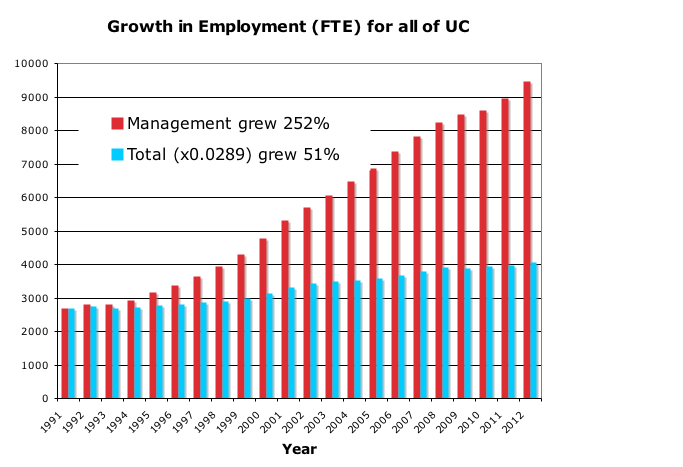
UC Administration Continues to Grow Relative to Faculty

https://gerrycanavan.files.wordpress.com/2013/02/image001.png

Last time we wrote on this subject was September 2011, when for the first time UC senior administrators officially began to outnumber faculty. Now, via Charlie Schwartz, we have the most recent data on administrative bloat at the UC, which goes up to October 2012.

Schwartz writes:
This shows the continuing outsized growth of the management cadre (defined as the employees classified in Senior Management Group and Management & Senior Professionals): their numbers grew by 252% over the 21 year period while total employee numbers grew by a mere 51%. (The total number of employees shown in this graph is scaled down so that one can compare the relative growth, over time, of each population.)
For another comparison, the latest total number in this management category (SMG + MSP) is 9,457 FTE (full time equivalent employees) while the number of Regular Teaching Faculty is 8,657 FTE.
Similar graphs for each individual campus of the university system can be found here (.doc) or here (.pdf). For several campuses we note a mild decrease in the Management numbers in the past few years but then a new upward surge with the latest data.
Elsewhere I have written about the repeated requests for UC’s top officials to either justify this apparent bloat or to get rid of it; and their inability to do either. My previous estimate was that, if the apparent excess is not justifiable, then UC is wasting something like $1 Billion per year.
The UC administration constitutes a parasitic bureaucracy that grows and expands by consuming those elements of the university that remain outside of it. It can only survive by extracting tuition from students and wages from university workers. In return, it does not grow the university—it grows only itself. While budget cuts at the state level are an important piece of the crisis of higher education, the administrative bureaucracy at both campus and system level is by no means an innocent actor. It is the UC administration that must be held responsible for expanding, intensifying, and accelerating the processes of privatization.

Wednesday, December 19, 2012

Open Letter to President Yudof on UC Logo Fiasco

http://i.imgur.com/DTYpu.jpg

December 15, 2012

Mark Yudof, President
University of California Office of the President
1111 Franklin Street, 12th Floor
Oakland, CA 94607

Dear President Yudof:

The enormous public backlash to the UC logo change evidences a major problem at your office. Open communication between the Office of the President and your faculty, students, and alumni is being ignored. Whether this was intentional for this rebranding project or an oversight, it is unacceptable.

I write you as a senior professor of Art at UCSB, where I have taught since 1992. I have also taught at UC Berkeley, and have served as a visiting assistant at the Davis, Irvine, Los Angeles, Riverside, San Francisco, Santa Cruz, and San Diego campuses. I attended UCLA and received my BA and MFA degrees from UC San Diego. In short, I am both intimately familiar with and acutely invested in the University of California.

How an in-house design team can operate for three+ years rebranding the university's visual identity without the university's own Art faculty knowing is beyond me. Our campuses boast internationally renowned experts in the visual arts, design, and criticism. We educate scores of cutting edge MFA candidates each year. My top undergraduate art students are the best in the country. Why were none of us consulted? In this time of budget cuts and clustering, why weren't our own resources tapped? What happened to the UC's esteemed history of self-governance and openness? And who, exactly, oversaw these decisions? My colleagues and I are dumbfounded.

My problem is actually less with the final campaign logo and video (which I find vapid and derivative), and more with the way this entire process came to light. The UC sits at a critical crossroads in the public eye and can no longer rely on our historical reputation and prestige to see us through. Yes, the California electorate passed Prop 30, but debate continues on tuition hikes, state pensions, administrative accountability, and the role of state funds in higher education. I know firsthand how important state support is and how valuable and life-changing a UC education can be. We need to present these stories to the public, not get entangled in critical and emotionally charged mistakes like this. I urge you to immediately implement a more open dialogue between your office and UC faculty, students, and alumni. I ask you to implement the type of communication that would have steered this rebranding program from the beginning.

On a related note, I was not previously familiar with any members of this UCOP in-house design team, but I am appalled by the public immaturity and lack of professionalism being tweeted by the Creative Director. Again, I ask -- who hired these people and oversaw these decisions?

Sincerely,

Kip Fulbeck
Professor

Monday, December 17, 2012

Progressive Labor Party Defends Rapists

reposted from Necessary Means:

In 2006 Progressive Labor Party member Seth Miller raped an anarchist activist who had been his close friend and a fellow organizer for many years in the Los Angeles area. The activist found no recourse in the legal system but hoped that PLP leadership would intervene and do something to hold Seth accountable for being a rapist. The party leadership did nothing despite the activist reaching out multiple times.

Early in 2012 the activist found renewed support for holding Seth accountable after learning that he had recently been part of some organizing spaces with the activist’s allies. The activist, along with a small collective of allies, approached PLP again in May 2012 to remind them of the rape and demand a process of accountability. After several weeks and a meeting between the activist, her allies, and a member of PLP leadership, the party seemed to acknowledge it was harboring a rapist but refused to act unless the activist provided “conclusive evidence” that Seth had raped her. Instead, the party leadership engaged in victim-blaming and insinuated that the activist was merely feeling guilty about consensual sex. While party leadership agreed to take up the issue, they opposed any process that didn't conform to their terms and obstructed progress on holding Seth accountable by canceling meetings at the last minute and issuing unreasonable expectations for rescheduling.

It is now several months after those initial conversations with PLP’s new leadership, and Seth remains an operating member of PLP, though he is now based in New York City. Recently the activist found through her own investigation that the party held a secret meeting in New York in July or August during which they agreed that while there was no “conclusive evidence” to their standards proving that Seth is a rapist, they would require him to drink with a buddy from now on and write a self-criticism about his relationship to women and patriarchy. These so-called solutions do nothing to protect our communities from a known rapist.

PLP leadership has failed to acknowledge this meeting just as they have failed to protect our communities from this predator. The party has, however, asked that the activist and her allies stop spreading “gossip” about Seth because they see the activist’s rape as a private matter rather than a political matter.

PLP is incapable of promoting truly revolutionary politics because it refuses to acknowledge individual and systemic sexual violence. In response, we ask a few things of you. The first is to exclude PLP from all activism and organizing spaces. The second is to warn your allies of the fact that PLP is defending and harboring at least one known rapist. The third is to examine and address the patriarchal behavior throughout all of our activist communities that protects and promotes sexual violence. The fourth is to actively support and defend the many individuals in our community that have suffered sexual violence. Finally, we ask you to address these matters in the best way you see fit - you do not need our permission to act.