Thursday, January 31, 2013

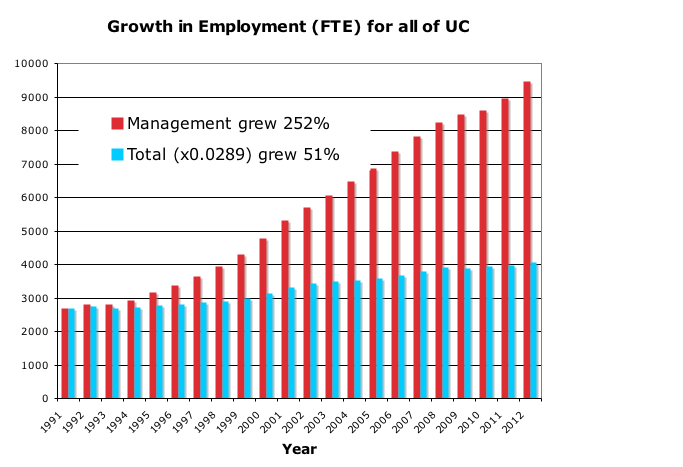
UC Administration Continues to Grow Relative to Faculty

https://gerrycanavan.files.wordpress.com/2013/02/image001.png

Last time we wrote on this subject was September 2011, when for the first time UC senior administrators officially began to outnumber faculty. Now, via Charlie Schwartz, we have the most recent data on administrative bloat at the UC, which goes up to October 2012.

Schwartz writes:
This shows the continuing outsized growth of the management cadre (defined as the employees classified in Senior Management Group and Management & Senior Professionals): their numbers grew by 252% over the 21 year period while total employee numbers grew by a mere 51%. (The total number of employees shown in this graph is scaled down so that one can compare the relative growth, over time, of each population.)
For another comparison, the latest total number in this management category (SMG + MSP) is 9,457 FTE (full time equivalent employees) while the number of Regular Teaching Faculty is 8,657 FTE.
Similar graphs for each individual campus of the university system can be found here (.doc) or here (.pdf). For several campuses we note a mild decrease in the Management numbers in the past few years but then a new upward surge with the latest data.
Elsewhere I have written about the repeated requests for UC’s top officials to either justify this apparent bloat or to get rid of it; and their inability to do either. My previous estimate was that, if the apparent excess is not justifiable, then UC is wasting something like $1 Billion per year.
The UC administration constitutes a parasitic bureaucracy that grows and expands by consuming those elements of the university that remain outside of it. It can only survive by extracting tuition from students and wages from university workers. In return, it does not grow the university—it grows only itself. While budget cuts at the state level are an important piece of the crisis of higher education, the administrative bureaucracy at both campus and system level is by no means an innocent actor. It is the UC administration that must be held responsible for expanding, intensifying, and accelerating the processes of privatization.

Wednesday, December 19, 2012

Open Letter to President Yudof on UC Logo Fiasco

http://i.imgur.com/DTYpu.jpg

December 15, 2012

Mark Yudof, President
University of California Office of the President
1111 Franklin Street, 12th Floor
Oakland, CA 94607

Dear President Yudof:

The enormous public backlash to the UC logo change evidences a major problem at your office. Open communication between the Office of the President and your faculty, students, and alumni is being ignored. Whether this was intentional for this rebranding project or an oversight, it is unacceptable.

I write you as a senior professor of Art at UCSB, where I have taught since 1992. I have also taught at UC Berkeley, and have served as a visiting assistant at the Davis, Irvine, Los Angeles, Riverside, San Francisco, Santa Cruz, and San Diego campuses. I attended UCLA and received my BA and MFA degrees from UC San Diego. In short, I am both intimately familiar with and acutely invested in the University of California.

How an in-house design team can operate for three+ years rebranding the university's visual identity without the university's own Art faculty knowing is beyond me. Our campuses boast internationally renowned experts in the visual arts, design, and criticism. We educate scores of cutting edge MFA candidates each year. My top undergraduate art students are the best in the country. Why were none of us consulted? In this time of budget cuts and clustering, why weren't our own resources tapped? What happened to the UC's esteemed history of self-governance and openness? And who, exactly, oversaw these decisions? My colleagues and I are dumbfounded.

My problem is actually less with the final campaign logo and video (which I find vapid and derivative), and more with the way this entire process came to light. The UC sits at a critical crossroads in the public eye and can no longer rely on our historical reputation and prestige to see us through. Yes, the California electorate passed Prop 30, but debate continues on tuition hikes, state pensions, administrative accountability, and the role of state funds in higher education. I know firsthand how important state support is and how valuable and life-changing a UC education can be. We need to present these stories to the public, not get entangled in critical and emotionally charged mistakes like this. I urge you to immediately implement a more open dialogue between your office and UC faculty, students, and alumni. I ask you to implement the type of communication that would have steered this rebranding program from the beginning.

On a related note, I was not previously familiar with any members of this UCOP in-house design team, but I am appalled by the public immaturity and lack of professionalism being tweeted by the Creative Director. Again, I ask -- who hired these people and oversaw these decisions?

Sincerely,

Kip Fulbeck
Professor

Monday, December 17, 2012

Progressive Labor Party Defends Rapists

reposted from Necessary Means:

In 2006 Progressive Labor Party member Seth Miller raped an anarchist activist who had been his close friend and a fellow organizer for many years in the Los Angeles area. The activist found no recourse in the legal system but hoped that PLP leadership would intervene and do something to hold Seth accountable for being a rapist. The party leadership did nothing despite the activist reaching out multiple times.

Early in 2012 the activist found renewed support for holding Seth accountable after learning that he had recently been part of some organizing spaces with the activist’s allies. The activist, along with a small collective of allies, approached PLP again in May 2012 to remind them of the rape and demand a process of accountability. After several weeks and a meeting between the activist, her allies, and a member of PLP leadership, the party seemed to acknowledge it was harboring a rapist but refused to act unless the activist provided “conclusive evidence” that Seth had raped her. Instead, the party leadership engaged in victim-blaming and insinuated that the activist was merely feeling guilty about consensual sex. While party leadership agreed to take up the issue, they opposed any process that didn't conform to their terms and obstructed progress on holding Seth accountable by canceling meetings at the last minute and issuing unreasonable expectations for rescheduling.

It is now several months after those initial conversations with PLP’s new leadership, and Seth remains an operating member of PLP, though he is now based in New York City. Recently the activist found through her own investigation that the party held a secret meeting in New York in July or August during which they agreed that while there was no “conclusive evidence” to their standards proving that Seth is a rapist, they would require him to drink with a buddy from now on and write a self-criticism about his relationship to women and patriarchy. These so-called solutions do nothing to protect our communities from a known rapist.

PLP leadership has failed to acknowledge this meeting just as they have failed to protect our communities from this predator. The party has, however, asked that the activist and her allies stop spreading “gossip” about Seth because they see the activist’s rape as a private matter rather than a political matter.

PLP is incapable of promoting truly revolutionary politics because it refuses to acknowledge individual and systemic sexual violence. In response, we ask a few things of you. The first is to exclude PLP from all activism and organizing spaces. The second is to warn your allies of the fact that PLP is defending and harboring at least one known rapist. The third is to examine and address the patriarchal behavior throughout all of our activist communities that protects and promotes sexual violence. The fourth is to actively support and defend the many individuals in our community that have suffered sexual violence. Finally, we ask you to address these matters in the best way you see fit - you do not need our permission to act.

Tuesday, November 27, 2012

Update: Eshleman Hall Barricaded in Defense of Multicultural Student Spaces


Update, 10:50 Tuesday, Nov. 27: The Occupation has ended, following a negotiation with UCB Administrators.  Everyone was allowed to leave the building, without having IDs checked.  The Administration conceded to the demand for amnesty; they agreed to let the Bridges community vote on whether their rooms would be on the 2nd floor, 4th floor, or in the basement of the future student center (whereas previously the administration had decided unilaterally to move the Bridges community's rooms to the basement); and they agreed to have a task force (rather than review board) on the Multicultural Student Development Offices and Recruitment and Retention Center, which will include six members chosen by the Bridges community who will present demands directly to the chancellor.   

This afternoon, a group of students barricaded themselves on the sixth floor of Eshleman Hall at UC Berkeley, reclaiming a building that has been designated for demolition and demanding that the Administration abandon plans to cut support for the recruitment and retention of students of color.  At this point, a couple hundred supporters have gathered in lower Sproul Plaza, while the police have closed off the building.  Those barricading the building are calling on supporters to gather at Eshleman in order to protect those inside and intensify the force of their resistance. 

The demands:

We Demand that the Multicultural Student Development Offices be restored to their former structure by Vice Chancellor Gibor Basri.  Countless students and the ASUC as an entity have voiced this opinion and received no changes.

We demand that the budget allocation of the multicultural student development offices be increased to meet the needs of their work.

We demand that none of the peaceful protesters in this occupation receive any punishment or repercussions for this activity.

We demand an increase in funding for the Recruitment and Retention Center to assist in their mission of increasing the enrollment of underrepresented minorities on campus.


Friday, November 9, 2012

Until we have more than speech and linked arms at our disposal...

The following speech was given by Professor Geoffrey O'Brian on Sproul Plaza, during the walkout on November 8.

Sophia Elia/Staff 

It feels good to be with you.

I could write that sentence ahead of time because I remember what it feels like from other moments when we’ve come together to risk saying what the Regents and the administration would rather we didn’t even think, let alone shout. Most sharply, I remember this feeling from last November 9th, when we gathered to protest what we still have before us to protest. I remember what it’s like to protect strangers like they are the only people you know; to establish a line and hold that line while the Alameda Sheriff’s Dept. wades in with batons in obedience to an absent Chancellor. Our line didn’t last very long that day, but it lasted longer than a police line would last if it didn’t have guns and gas, shinguards and faceplates, sound cannons and an afterlife in false charges and malicious prosecution.

The powers that would like to take the public out of public education don’t have our conviction, they have greed plus an arsenal; they don’t have community, they have closed-door meetings and staging areas. And as their cops hit us last year they were also striking at what we expressed in the linkages of our arms. They were jealous of our resolve and unhappy to be reminded it’s possible. They were unhappy we didn’t have names and serial numbers on our chests. Which is why we felt good even then and can feel good now as we gather (despite their having tried to turn on the rain machine and the cold). This feels like living. This feels like not being in debt.

The Pakistani poet Faiz Ahmed Faiz, in a poem about the necessary bravery and the certain vulnerability of the protestor, wrote a line that has stayed with me for years: “Come today in fetters to the marketplace.” That is, bring your problems back to their source, bring them as part of what you offer and are, bring your discomfort with leaving privacy behind. Because doing so might make the marketplace simply a place, a place where a public can dream itself back into being and out of the prison of only private lives. In our current struggle here, for “fetters” read debt, for “marketplace” read the rapidly privatizing university, pricing out the poor, and turning as ghostly as an online education pilot program. But for “today” still read today, the only day available to us again and again, the only day between us and the wrong future, the day wherein we gather to see the first person break its fetters and go plural. We need to strengthen and populate that plural until we can do more than protest, can instead refuse things and have our refusals be more than symbolic. Until we can claim and keep the Gill Tract. Until we have more than speech and linked arms at our disposal.

That we are not that many yet is hard, but it isn’t as hard as not trying would be. This is what we have -- after Proposition 30 has passed, which I’m glad of, but which is a bandaid, written by the governor to tax the rich less than the proposed Millionaire’s Tax would have and which swaps some of the burden to the working class through a sales tax increase. This is what we have, with a new Chancellor and UC Police Chief on the horizon from whom we can expect nothing but more of the same; while intellectual property is sold to British Petroleum and campus child care is outsourced to a Bain subsidiary named Bright Horizons, and staff are laid off and furloughed, this is what we have. We have each other, now, today, in the rain. But this is living rather than seeking not to. This feeling, as solidarity becomes purpose and it runs through us, is what we have, and it has to be enough. Keep coming, and bring your fetters with you.

(Photo from the Daily Cal)

Wednesday, November 7, 2012

Third Debtors' Assembly at UCB

In anticipation of tomorrow's walkout at UC Berkeley, we will be holding the third Debtors' Assembly tonight on the east lawn of California Hall, from 5-6PM. Joshua Clover will be among the speakers talking about approaches to resistance. There will also be a a collective discussion.

Debt is a permanent feature of most of our lives. Yet the socialization of risk debt isolates individuals, locking us in the private misery of our dealings with banks and creditors. Medical debt, student debt, consumer debt, foreclosures -- these social forms mark so many personal failings and moral obligations, we are told. Debt, in other words, not only insures our continued servitude to the corporate pursuit of dwindling private profits. It also serves to alienate us from one another and foreclose the possibility of collective resistance.

Debtors’ Assemblies, then, are a first step in fighting back to reclaim our stolen futures. Please join us Wednesday, November 7 at 5pm in front of California Hall for our last Debtors’ Assembly to learn more about the many forms of debt and discuss ways to resist debt’s claim upon our lives.

And remember, tomorrow (November 8) is the walkout and sleepout on campus.

Monday, November 5, 2012

November 8 Walkout

Meet up at Sproul Plaza, Noon. 
Public education in California is facing a severe crisis. State budget cuts and austerity measures have accelerated administrators’ efforts to privatize our public colleges. This November, UC Regents and CSU Trustees plan to submit our universities to radical, privatizing reforms. 
Even if Prop. 30 passes, in the best-case scenario, it would only maintain the status quo; meaning excessive fees, under-funded programs, overcrowded classes, layoffs and pay-cuts for campus workers, and an ongoing process of privatization. And that’s the best-case scenario! This would preserve the UCs as inaccessible for tens of thousands of low- and middle- income students, and for already under-represented students of color. And for those who do make it in, a lifetime of debt awaits. University privatization also involves attacks on public sector workers, from pension raids to mass layoffs.
The future of public education is bleak, unless we act in the present to prevent the indebting of students and the walling off of our public institutions. By taking collective, mass action this fall, we can begin to reverse the waves of fee-hikes, course reductions, budget cuts, and layoffs.
 
Through collective struggle, we can defend and sustain public education in California, and we can counter state austerity.
 

Saturday, October 20, 2012

Student Debt in a Global Context: Neoliberalism and Crisis

Debt is a permanent feature of most of our lives. Yet the socialization of risk debt represents isolates individuals, locking us in the private misery of our dealings with banks and creditors. Medical debt, student debt, consumer debt, foreclosures -- these social forms mark so many personal failings and moral obligations, we are told. Debt, in other words, not only insures our continued servitude to the corporate pursuit of dwindling private profits. It also serves to alienate us from one another, and foreclose the possibility of collective resistance. Debtors’ Assemblies, then, are a first step in fighting back to reclaim our stolen futures. Please join us Wednesday, October 24th from 5-6 in front of California Hall for the first in a series of weekly Debtors’ Assemblies to learn more about the many forms of debt and discuss ways to resist debt’s claim upon our lives. Robert Meister will speak briefly at the beginning of the first assembly.