
More info at http://strikemay1st.com

provisional home of the College of Debtors in Defiance
Chancellor Katehi failed to express in any meaningful way her expectation that the police operation was to be sharply limited so that no use of force would be employed by police officers other than their demand that the tents be taken down. The lack of effective communication by the Chancellor at this time not only contributed to misunderstandings that made it difficult to evaluate the decision to use police to take down the tents. This communication failure also substantially undermined the goal of avoiding a physical confrontation between the police and protesters. — from the Reynoso Report.

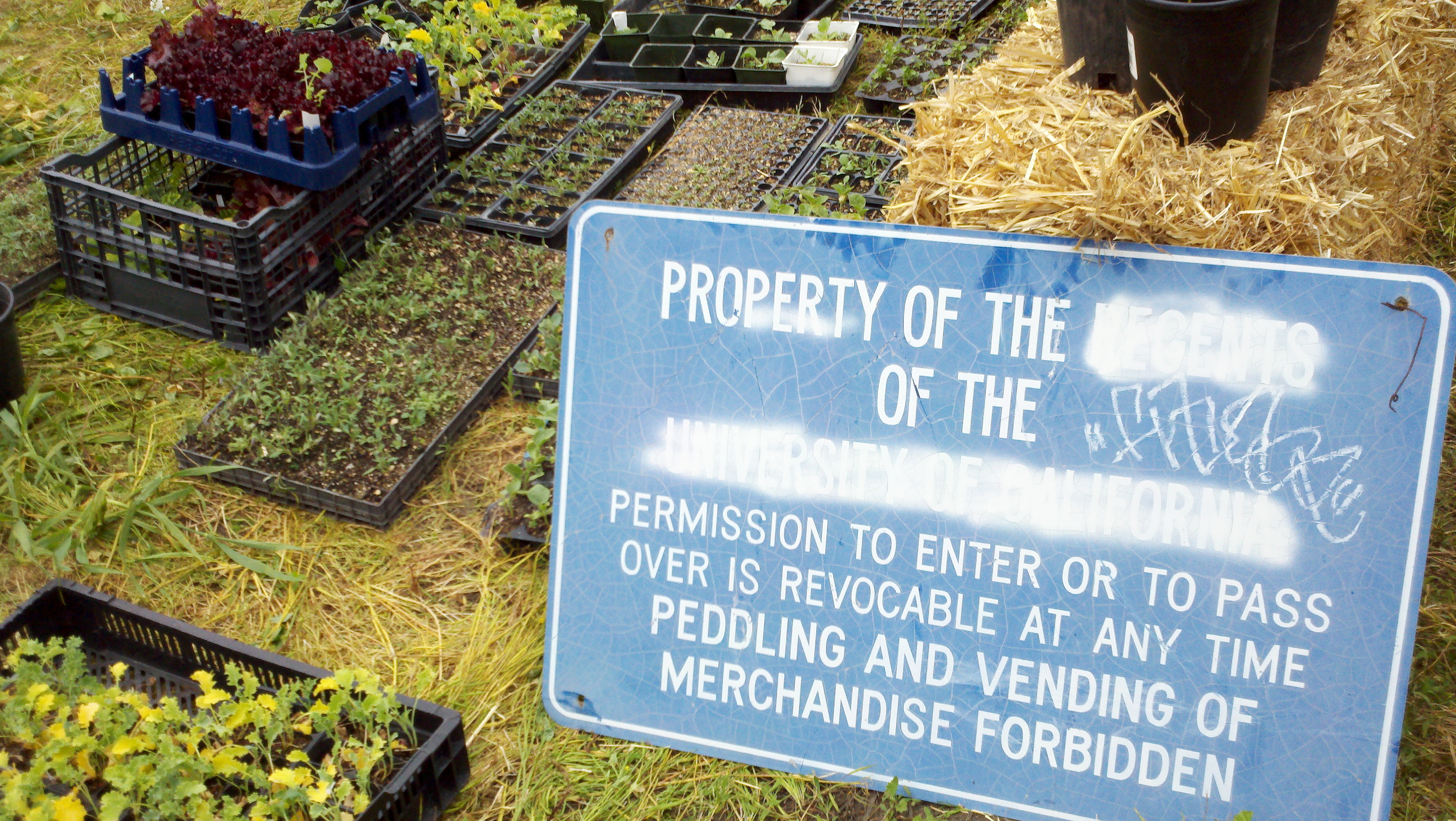
FOR IMMEDIATE RELEASE:
April 22, 2012
Occupy the Farm Activists Reclaim Prime Urban Agricultural Land in SF Bay Area
Contact: GillTractFarm@riseup.net
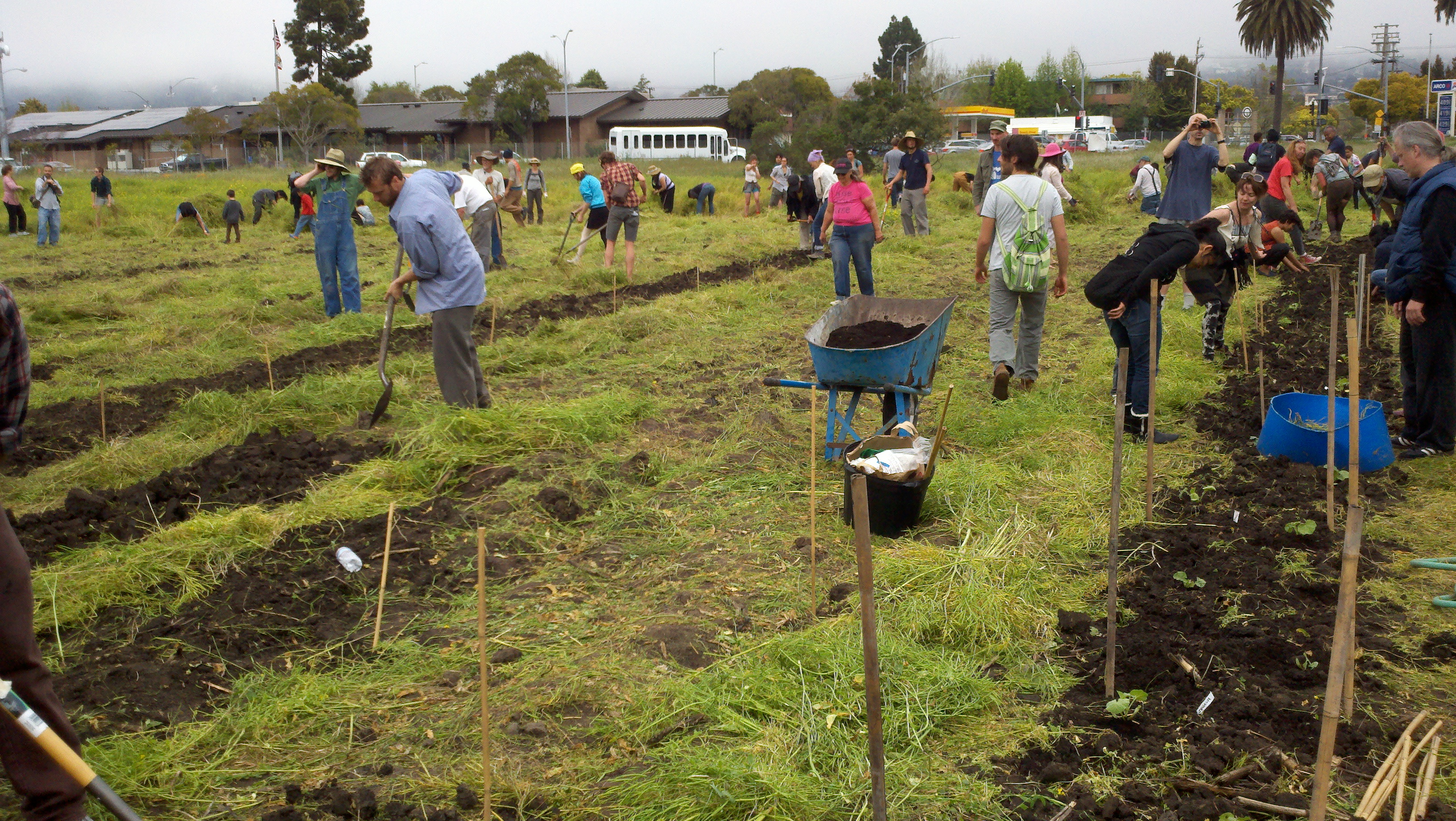
(Albany, Calif.), April 22, 2012 – Occupy the Farm, a coalition of local residents, farmers, students, researchers, and activists are planting over 15,000 seedlings at the Gill Tract, the last remaining 10 acres of Class I agricultural soil in the urbanized East Bay area. The Gill Tract is public land administered by the University of California, which plans to sell it to private developers.
For decades the UC has thwarted attempts by community members to transform the site for urban sustainable agriculture and hands-on education. With deliberate disregard for public interest, the University administrators plan to pave over this prime agricultural soil for commercial retail space, a Whole Foods, and a parking lot.
"For ten years people in Albany have tried to turn the Gill Tract into an Urban Farm and a more open space for the community. The people in the Bay Area deserve to use this treasure of land for an urban farm to help secure the future of our children," explains Jackie Hermes-Fletcher, an Albany resident and public school teacher for 38 years.
Occupy the Farm seeks to address structural problems with health and inequalities in the Bay Area that stem from communities’ lack of access to food and land. Today’s action reclaims the Gill Tract to demonstrate and exercise the peoples’ right to use public space for the public good. This farm will serve as a hub for urban agriculture, a healthy and affordable food source for Bay Area residents and an educational center.
“Every piece of uncontaminated urban land needs to be farmed if we are to reclaim control over how food is grown, where it comes from, and who it goes to,” says Anya Kamenskaya, UC Berkeley alum and educator of urban agriculture. “We can farm underutilized spaces such as these to create alternatives to the corporate control of our food system.”
UC Berkeley has decided to privatize this unique public asset for commercial retail space, and, ironically, a high-end grocery store. This is only the latest in a string of privatization schemes. Over the last several decades, the university has increasingly shifted use of the Gill Tract away from sustainable agriculture and towards biotechnology with funding from corporations such as Novartis and BP.
Frustrated that traditional dialogue has fallen on deaf ears, many of these same local residents, students, and professors have united as Occupy the Farm to Take Back the Gill Tract. This group is working to empower communities to control their own resilient food systems for a stable and just future – a concept and practice known as food sovereignty.
Occupy the Farm is in solidarity with Via Campesina and the Movimiento Sin Tierra (Landless Workers Movement).
The Gill Tract is located at the Berkeley-Albany border, at the intersection of San Pablo Ave and Marin Ave.
• Join us: Come dressed to work! We need people to help till the soil, plant seedlings, teach workshops, and more.
• Donate/lend: We need shovels, rakes, pickaxes, rototillers, drip irrigation tape, gloves, hats, food, and anything else farming related!
• Monetary donations can be sent through our website at www.takebackthetract.com


Although its $321 million price tag would make it one of the most expensive renovations in college sports history, the university said the project would be funded privately, largely through long-term seat sales and naming rights.
But three years into the fund-raising effort, a projected $270 million from the sale of seats has failed to materialize. At the end of December, the school had collected only $31 million in the first three years of the sale. Now it has become clear that the university will have to borrow the vast majority of the money.
In recent interviews, university officials acknowledge that if revenue projections fall short and won't cover the bond payments, the shortfall "would have to come from campus."
The idea that money for the football stadium could come from campus funds, which include student fees, is an admission likely to stir outrage at a school that's already facing possible double-digit tuition increases. "It is disconcerting that the university may be gambling with student fees and other academic funds to cover a massive financial commitment for a football stadium," said Cal computer-science professor Brian Barsky.
(...)
The nearly half-billion-dollar Cal athletic project encompasses a $321 million renovation of Memorial Stadium that opens Sept. 1 and $153 million for a new multisport training facility. That's far more than Stanford University spent building a new stadium in 2006.
In public pitches for the project starting in 2006, university officials talked about raising hundreds of millions through an "Endowment Seating Program" that was to endow all 29 of Cal's varsity sports and more yet by selling naming rights to various components of the stadium. The official name will remain Memorial in honor of war veterans. But the economic downturn hindered sales and by November 2010, [Sandy] Barbour [Cal's athletic director] had posted online a letter to fans saying she was "heartbroken that the program's intentions will, in all likelihood, not be fully realized."
The total bonded debt for the project, including the training center, will be $447 million. That's apparently an unprecedented amount of borrowing for a college-sports project, far above the $220 million that Minnesota borrowed to build a new stadium in 2009, the $200 million that Washington has borrowed for its stadium renovation and the $148 million that Michigan took out to add luxury seats that opened in 2010.

In planning its response to Occupy-related activism, the Leadership Team discussed the presence of “non-affiliates” in the Occupy group. According to Chancellor Katehi, “We had noticed that this group, this year specifically, has people -- even when they came to Mrak -- who were not students.” “We were worried at the time about that because the issues from Oakland were in the news and the use of drugs and sex and other things, and you know here we have very young students . . . we worried especially about having very young girls and other students with older people who come from the outside without any knowledge of their record . . . if anything happens to any student while we’re in violation of policy, it’s a very tough thing to overcome.”The language of the administration depicts the "non-affiliate" as a highly sexualized, racialized, and criminalized body, a foreign, contaminating body, a body that does not belong, that, like a cancer, presents a clear and present danger, that must be quickly identified and surgically removed. As Elizabeth Freeman writes,
According to Vice Chancellor Meyer, “our context at the time was seeing what's happening in the City of Oakland, seeing what's happening in other municipalities across the country, and not being able to see a scenario where [a UC Davis Occupation] ends well . . . Do we lose control and have non-affiliates become part of an encampment? So my fear is a long-term occupation with a number of tents where we have an undergraduate student and a non- affiliate and there's an incident. And then I'm reporting to a parent that a non-affiliate has done this unthinkable act with your daughter, and how could we let that happen?” (Kroll, pp. 27-28; emphasis added)
[T]his is a public, land-grant university, whose mandate is to be open and accessible and to serve the people. All California residents, indeed all residents of the U.S., are “affiliates” of the UC system. The Morrill Act, granting the land for land-grant universities, also contained legislation that authorized the federal government to systematically steal Native American lands by interfering with both Native American and Mormon systems of kinship and inheritance. Thus most of us are in the first place the outsiders occupying these tracts, our very presence here legitimated by the government’s enforcement of Protestant norms of gender, sexuality, and kinship. Second, since the Americas were settled, the discourse of rape has been used to terrorize people of color as potential rapists, and to limit the freedoms of white women as potential victims. I imagine that any female participants in the Occupy protests would find Vice Chancellor’s remarks patronizing in the extreme. Third, the rhetoric of “Save Our Children” has been a pernicious part of anti-gay movements since at least Anita Bryant’s 1977 campaign against legislation prohibiting discrimination on the basis of sexual orientation in Miami. It was part of Proposition 8. Anyone knowing anything about the history of anti-gay organizing in this country cannot fail to see that invoking the specter of the violated child is a right-wing tactic.Similarly, Nathan Brown writes,
The specter of the “stranger” raping the young has been used to legitimize all kinds of violence. I cannot accept leaders who would mobilize it to defend the use of force against political protest.
Ah, once again, “the City of Oakland,” so close to the City of Davis, and yet so far. What sort of people might one find there? But is it not the case that what was actually happening in the City of Oakland and other municipalities was egregious police violence against peaceful demonstrators -- including the near-killing of protester Scott Olsen in Oakland on October 25? And what is it, exactly, that our tepid Vice Chancellor has in mind when he refers to “this unthinkable act” that might transpire between an undergraduate and a "non-affiliate"? Does he mean rape? It seems this is either a concept he does not understand (“with your daughter,” he says) or a word he is unable to use in a sentence. But perhaps he just means “sex and other things”? Perhaps the very notion that an undergraduate -- and a “daughter” no less -- might have sex with a “non-affiliate” is an unthinkable act in the view of our painstakingly upright administrators. Confronted with the cultivated ambiguity of the Vice Chancellor's formulation, I suppose we can conclude that when you don't know what you're talking about, it's best to equivocate.As Freeman and Brown effectively demonstrate, the report points to something that cannot be fixed by implementing some policy or other, clearer guidelines for crowd-control, a more effective organizational structure for the pathetic "Leadership Team," or sanctions of individual police officers for their brutal oversteps. Even in the few cases where they are laid out clearly and forcefully, such policy recommendations would represent piecemeal attempts to manage the symptom of a problem that runs much deeper. The problem has to do, rather, with a particular way of seeing the world, with the administrative gaze. What activates the administration's response, its rapid and reflexive turn to its repressive arm, the UCDPD, is the shimmering and intangible image of students as "very young [white] girls" threatened by outsiders, "older people" from "Oakland." At the same time, it is precisely the student's abstract nature in the eyes of the administration that enables and rationalizes the violent assault against its real, flesh-and-blood counterparts.
In brief, all that the pathetic and infantile discourse of the “Leadership Team” has to offer in its defense is the danger of sex and drugs, of “older people,” and the terribly frightening specter of “Oakland.” One needn’t look far to find an identical sexist, paternalist, pseudo-moralistic discourse deployed in the most unbearably racist, xenophobic contexts. It is always the same thing with authoritarian bureaucrats who send in police to guard the young and innocent against those who “come from the outside”: they are more than willing to sanction brutal violence to buttress whatever obscene fantasy of purity serves as their faulty moral compass.
While the deployment of the pepper spray on the Quad at UC Davis on November 18, 2011 was flawed, it was the systemic and repeated failures in the civilian, UC Davis Administration decision-making process that put the officers in the unfortunate situation in which they found themselves shortly after 3 p.m. that day.
When explaining their decisions on Nov. 17 and 18, UC Davis administrators repeatedly referenced this concern about individuals not affiliated with the university at Occupy movement protests and encampments on campus, and the security risks created by their presence. Indeed, in Chancellor Katehi’s letter distributed to campus protesters on Nov. 18, the day of the pepper spray incident, the Chancellor wrote “We are aware that many of those involved in the recent demonstrations on campus are not members of the UC Davis community. This requires us to be even more vigilant about the safety of our students, faculty and staff.” As our report will indicate these concerns were not supported by any evidence obtained by Kroll.
....
Leading up to the eviction, Chancellor Katehi and Vice Chancellor Meyer were not swayed by the reports from Student Affairs staff that the Occupy activists were overwhelmingly comprised of students.
It is clear that the UCDPD leadership was concerned about its legal authority to remove the tents, at least during the daytime. It is equally clear that the UC Davis Administration was adamant that it did not want tents on campus and that the tents were considered a threat to health and safety. Just as the Leadership Team ultimately failed to arrive at a policy that appropriately constrained the conduct of campus police, so too did it fail to press for a definitive legal assessment of the scope of its authority to order the removal of the tents. In the course of its investigation, Kroll has been unable to identify the legal basis for the decision of the Leadership Team to act against the protesters and for the operation mounted by the UCDPD. It appears that the UCDPD mounted its operation absent the clarity of legal authority under pressure from the Administration to do something to get rid of the tents.3) On the administration’s failure to heed warnings about the probability of a police confrontation with students if the eviction was carried out at 3:00pm on Friday afternoon:
In the 24 hours before the police operation commenced, both Student Affairs staffers and campus police provided warnings to members of the Leadership Team that a confrontation might occur between activists and police on the Quad. These warnings do not appear to have impacted the decision-making of the Leadership Team, however....While the Chancellor viewed herself as chairing a consensus-driven discussion, her subordinates instead heard her issue an executive order. By insisting that the tents not be allowed to stay up on Friday night, Chancellor Katehi did in fact make a tactical decision: that the tents would be removed during the day....Based on the accounts of several officers, including Lieutenant Pike, Chief Spicuzza informed her officers that key and controversial decisions, including the 3 p.m. time for the operation, had been made by Chancellor Katehi herself.4) On the Chancellor’s failure to pursue any real measures that might prevent the use of force against students:
Chancellor Katehi failed to express in any meaningful way her expectation that the police operation was to be sharply limited so that no use of force would be employed by police officers other than their demand that the tents be taken down....Vice Chancellor Meyer explained that “he did not understand that Chancellor Katehi believed that no force at all would be employed in taking down the tents until her comments following the November 18 police action.”...No members of the Leadership Team took responsibility for ensuring that all the members of the Team including the Police Chief had a common understanding of the scope and conduct of the police operation to be executed on Nov. 18.
We were worried at the time about that because the issues from Oakland were in the news and the use of drugs and sex and other things, and you know here we have very young students…we worried especially about having very young girls and other students with older people who come from the outside without any knowledge of their record.
Our context at the time was seeing what’s happening in the City of Oakland, seeing what’s happening in other municipalities across the country, and not being able to see a scenario where [a UC Davis Occupation] ends well . . . Do we lose control and have non-affiliates become part of an encampment? So my fear is a long term occupation with a number of tents where we have an undergraduate student and a non-affiliate and there’s an incident. And then I’m reporting to a parent that a non-affiliate has done this unthinkable act with your daughter, and how could we let that happen?”
1) condemns both the dispatch of police and use of excessive force in response to non-violent protests on November 18, 2011
2) opposes violent police response to non-violent protests on campus
3) demands that police deployment against protestors be considered only after all reasonable efforts have been exhausted and with direct consultation with Academic Senate leadership.

This is why shutting down the bank of campus is not just a sensible idea but an obvious first step in reclaiming education. The bank is not only profiting, but it is also the emissary of the profit motive; it does nothing else. Perhaps the closing of this small branch is purely symbolic; it won’t end global capitalism, after all.While there's no question that the bank blockade directly caused US Bank to withdraw from the campus of UC Davis, it would be absurd to suggest that the same blockade was responsible for scaring US Bancorp into deciding that student debt was no longer worth it. It's not just a question of scale. For the bank's financial managers, student debt simply wasn't generating enough profit to justify the expense. And with defaults rising, those same profits may appear increasingly risky in their speculative eyes.
But perhaps it’s something more. Everybody starts small. You fight where you can. The fact that there are ten thousand banks doesn’t mean you don’t begin with one -- it means you do. Closing a single recruiting center wasn’t going to end the military, but one by one, such closings helped end the war. The bank is fighting a war on your future, and for the moment the university is collaborating -- on the wrong side.


Campus police officers . . . took a more private approach to get their message to the district attorney.Apparently, the cops were pissed off by Chancellor Birgeneau's vacuous letter to the DA, which politely asked the DA to "be sensitive to the context of the campus environment and to the strong feelings this has raised on campus."
They called Ron Cottingham, president of the 62,000-strong Peace Officers Research Association of California, the most powerful police group in the state, and asked him to call the district attorney.
During the subsequent conversation with Chief Assistant District Attorney Kevin Dunleavy, Cottingham was told that no decision had been made, and that, yes, the police would be listened to as well.
As we've seen recently at UC Berkeley, with the filing of criminal charges as well as stay-away orders against a number of prominent student protesters, UC administrators willingly collaborate with the offices of their respective DAs. In order to do this, the administration sends UCPD to actively search out information ("evidence") against student protesters, which is then forwarded to the DA. At times, this evidence has come from the medical records of students who had sought treatment at University Health Services after being assaulted by the police themselves.And that's why we say NO COPS NO BOSSES!


