Today, Sather Gate, noon. (More info here.)
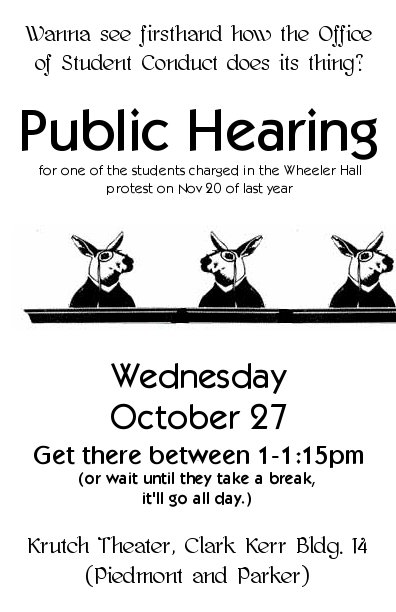
Also, don't forget about the public student conduct show trial that's taking place at more or less the same time (bad timing!). It's at Clark Kerr campus, building 14. It starts officially at 1:30pm, but they're asking folks to get there between 1-1:15pm in order to be let in.
Updated [1:57pm]: picture from the ongoing grade-in...
Wednesday, October 27, 2010
Monday, October 25, 2010
Student Conduct and Terrorism
Last December, Governor Schwarzenegger invoked a rhetoric of terrorism to describe protests that had taken place on UC Berkeley campus:
The following was circulated in an email from Jerlena Griffin-Desta, director of student services at the Student Affairs Office of the President. These changes may be included in the discussion at the November Regents' meeting. The first point is particularly problematic, but note that the third almost as bad:
California will not tolerate any type of terrorism against any leaders including educators. The attack on Chancellor Birgeneau’s home is a criminal act and those who participated will be prosecuted under the fullest extent of the law. Debate is the foundation of democracy and I encourage protestors to find peaceful and productive ways to express their opinions.At the time, Schwarzenegger's hyperbolic language, along with that of UC Berkeley administrators, was widely ridiculed. But now the University of California Office of the President (UCOP) is looking to insert specific language about "terrorism" into the guidelines that determine how the Codes of Student Conduct on individual UC campuses are written. The proposal is to incorporate this language into the section on hate crimes.
The following was circulated in an email from Jerlena Griffin-Desta, director of student services at the Student Affairs Office of the President. These changes may be included in the discussion at the November Regents' meeting. The first point is particularly problematic, but note that the third almost as bad:
REVISED: Proposed Policy Changes to Address Hate Crimes
1. Terrorizing Conduct
The following new language would be added to the Policy on Student Conduct and Discipline (section 102.00 Grounds for Discipline):
“[The following is prohibited:] Conduct, where the actor means to communicate a serious expression of intent to terrorize, or acts in reckless disregard of the risk of terrorizing, one or more University students, faculty, or staff. ‘Terrorize’ means to cause a reasonable person to fear bodily harm or death, perpetrated by the actor or his/her confederates. ‘Reckless disregard’ means consciously disregarding a substantial risk. This section applies without regard to whether the conduct is motivated by race, ethnicity, personal animosity, or other reasons. This section does not apply to conduct that constitutes the lawful defense of one’s self, of another, or of property.”
2. Sanction Enhancement for Violations Motivated by Hate
The following new language would be added to the Policy on Student Conduct and Discipline (section 104.00 Administration of Student Discipline):
“Sanctions [for any violations of the Grounds for Discipline] may be enhanced where the victim was selected because of the victim’s race, color, national or ethnic origin, citizenship, sex, religion, age, sexual orientation, gender identity, pregnancy, marital status, ancestry, service in the uniformed services, physical or mental disability, medical condition (cancer related or genetic characteristics), or perceived membership in any of these classifications.”
3. Discipline for criminal convictions
The following new language would be added to the Policy on Student Conduct and Discipline (section 102.00 Grounds for Discipline):
“[Students may be subject to discipline, i.e., discipline is possible, not mandatory, on the basis of] A conviction under any California state or federal criminal law, when the conviction constitutes reasonable cause to believe that the student poses a current threat to the health or safety of any person or to the security of any property, on University premises or at official University functions, or poses a current threat to the orderly operation of the campus.”
Labels:
anti-conduct,
bobby b,
november 2010,
student conduct,
terror,
UC administration,
yudof
Public Conduct Hearing, Wed 10/27 [Updated]
Updated [Tuesday 10/26]: The hearing will take place in the Krutch Theater (building 14) of Clark Kerr campus. Get there between 1-1:15 or during a break to minimize disruptions.
If all goes according to plan, updates will be published on the Reclaim UC twitter feed.
Update [Wed 6:06pm]: We've been live tweeting the hearing. Check out @reclaimuc; most of the tweets have a #ucstrike and/or an #occupyca hashtag. Also check out @joshwolf's twitter feed.
Update [Thurs 1:32am]: The hearing panel left to deliberate at about 11:30, returned at about 12:15 to announce that they couldn't come to a decision. Deliberation and sanctioning will be postponed until the week of November 8. Also, for a pretty complete record of the hearing check out this twitter list.
Friday, October 22, 2010
Open Letter to the UC Administration Regarding Student Conduct
Dear Vice Chancellor Harry LeGrande et. al,
I am writing to voice my concerns regarding my interactions with the Office of Student Conduct and to inform you of my experience in dealing with the process as a student journalist accused of participating in the November 20 demonstration in Wheeler Hall last fall. I am one of about 40 students who the university charged with student conduct violations in relationship to the demonstration. As I understand it, the Code of Conduct doesn’t include a provision for an “interlocutory appeal,” but my experience last night calls out for intervention by your Office.
On Thursday, Oct. 20, Dr. Robert DiMartino led a pre-hearing conference to discuss my charges under the code of student conduct. The previous month I participated in a previous pre-hearing conference under a different chair, Dr. Georjana Barnes of the Department of Molecular Biology. Dr. Barnes aborted that meeting after the lawyer for the University of California Office of the President said he couldn’t stick around to see the meeting to completion.
In all previous meetings involving student conduct, the university officials permitted Thomas Frampton, a law school student and my advisor in this matter, to speak on my behalf. I had no reason to think the situation would be any different coming into my most recent meeting, but my experience yesterday differed dramatically from my previous experience.
Almost immediately after our meeting began, DiMartino ordered my observer Stephen Rosenbaum to leave. Rosenbaum is on the Berkeley Law School faculty and is also a practicing attorney. After returning from a discussion with Frampton about my charges, DiMartino announced that my advisor would not be allowed to speak on my behalf; not only is this inconsistent with my previous experiences, but it is a clear departure from other pre-hearing conferences on campus.
DiMartino’s position is that because an advisor is not explicitly allowed under the code to speak at pre-hearing conferences, there is an implicit prohibition on his doing so, which is the same reason he cited for ejecting Rosenbaum. DeMartino further suggested that I should be aware of this prohibition, despite the fact that his conclusion is based on a nuanced interpretation of the code that runs counter to my own past experience and that of others.
After explaining that I was not fully-prepared to argue all of the issues we planned to bring up at the pre-hearing, DiMartino countered with the option to file a written brief addressing two issues he deemed pertinent to the pre-hearing: Whether the hearing should be open, and what witnesses I planned to call in my defense, a provision which is itself not explicitly allowed under the code. After explaining that I wasn’t prepared to answer whether such a proposal would be acceptable, I asked for a recess and a new pre-hearing date.
DiMartino refused to reschedule the pre-hearing and said that any objection I had to proceeding this way could only be taken up after the panel has delivered its decision in the charges I’m facing. Have I therefore exhausted all of my administrative remedies available to me at this time?
I realize that it is important for the panel chair to retain some discretion over the student conduct process, but it is imperative that the code is clear on exactly what is within his or her discretion. Student conduct is heralded as an educational process, but I’m really fumbling over what I’m supposed to learn from this experience, and I know other students facing conduct charges feel the same way.
A few years ago, a federal judge sent me to jail for refusing to turn over my unpublished materials of a political demonstration I filmed in San Francisco. During the seven months I spent at a federal detention center fighting for the rights of a free press, many described my situation as Kafkaesque. It saddens me to realize that my experience at UC Berkeley has been a far more appropriate use of the term.
Given the clear deficiencies in the code of student conduct, which the university has acknowledged by calling for a task force to address these problems, I ask that you suspend this process for myself and others until there is policy in place that serves an educational function of the world-class caliber this institution offers in academics.
I would be happy to meet with anyone to address my concerns over the code of conduct, and I know that other students facing charges and members of the Campus Rights Project, an advocacy group comprised of law school students who are providing pro-bono representation to students facing conduct charges, would also be willing to make themselves available to discuss this issue as well.
Thank you for your consideration,
Josh Wolf
UC Berkeley Graduate School of Journalism
2011 Master’s candidate in documentary
Tel: 415.794.2401
e-mail: joshwolf@berkeley.edu
CC:
Robert Birgeneau
Chancellor
Jonathan Poullard
Dean of Students
Susan Trageser
Director of Student Conduct
Laura Bennett
Student Conduct Officer
Nanette Asimov
San Francisco Chronicle
Gerry Shih
The Bay Citizen
Rebecca Bowe
San Francisco Bay Guardian
Frances Dinkelspiel
Berkeleyside
Laura Dobler
Student Press Law Center
Call to Action for November 16
From the UC Santa Cruz Strike Committee (via email):
The University of California Administration and the UC Regents in particular have continued to demonstrate their callous disregard for the lives and futures of the Students and Workers who make up the University. The malicious assault which they are now leading against the pensions of employees, the conditions and wages of academic workers, and the future of students with a new proposed fee hike of as much as 20 percent, demonstrates not only the depth of their commitment to privatization but also their amnesiac forgetfulness regarding the events of last year. In the relative calm of the last few months they have forgotten the magnitude of the discontent which exploded in the form of mass occupations and strikes last November and on March 4th. As the regents meet to consider further austerity measures, we must act to demonstrate that if they fail to repeal the fee hikes implemented so far, if they continue to impose intolerable conditions on the Students and Workers of the University of California, we will render the University ungovernable. The UCSC Strike Committee calls upon Students and Workers across the UC system to take action on their campuses November 16th, both to demonstrate the continuing strength of our resistance and build the social power which can make the threat of an ungovernable university a reality.
Thursday, October 21, 2010
Tuesday, October 19, 2010
Home of the Free Speech Movement
Lt. Tejada can't spell
On the morning of October 7, the national day of action, UCPD officers broke into the Rhetoric Department library and confiscated banners.
The note reads:
TO WHOM IT MAY CONCERNThey did it again this week. This time, they stole the following materials, which had to be "re-recovered" from UCPD: a few boxes of paint, medical supplies, water, plus a couple of signs.
THE BANNERS IN THIS ROOM
WAS [sic] RECOVERED BY UCPD
AS FOUND PROPERTY IT IS
HELD AT UCPD ANY QUESTIONS
PLS CONTACT CAPT. RODRICK
LT. TEJADA
UC Berkeley: Home of the Free Speech Movement.
Labels:
banners,
cops pigs murderers,
free speech,
libraries,
media,
october 7,
propaganda
Wednesday, October 13, 2010
A Call for Disassembly
From anti-capital projects:
No more General Assemblies • No more Statewide Conferences • No more Days of Inaction
The fiasco of the Oct. 7th “sit-in” demonstrates the utter bankruptcy of the General Assembly: a political form more effective than tear-gas or billy-clubs in bringing an action to a close. In our fight against the university administration, we have ceded our power to administrative mechanisms that are little better.
How is it that an institution widely regarded last year as farcical came to assume ownership over the university struggle, to assert yet again its supposed sovereign power to broker all meaningful decisions? How can we assure that the General Assembly never again comes to assume the power to neutralize, silence, and demobilize? How can we finally demystify the GA’s absurd self-presentation as a space of democracy, participation and openness?
It is tempting to think that the failures of the General Assembly are those of personality, ineptitude, and opportunism. As we all know, the GA is run by a small clique of “socialist” organizers and future politicians who follow a political script unchanged, in its unflagging failure, since 1983. These are people who have, at every turn over the last year and a half, opposed proposals for direct action, or deferred them to some never-arriving future moment when they have “built the movement.”
Labels:
abolish it,
direct action,
general assembly,
october 7,
regents,
solidarity,
strike
Subscribe to:
Posts (Atom)