Tuesday, May 8, 2012

UC Considering Another Round of Tuition Hikes [Updated]

More tuition hikes are on the horizon:
University of California students could face significantly higher tuition if the state doesn't increase funding and voters don't approve the governor's tax initiative.

University officials are considering a plan to raise tuition by 6 percent this fall if the state doesn't increase funding by $125 million for 2012-13.

Administrators say the 10-campus system would need to consider a mid-year tuition increase in the "range of double digits" or make drastic campus cuts if voters don't pass Gov. Jerry Brown's tax plan in November.

The tuition plans were outlined in an agenda for a UC Board of Regents meeting that was posted online Monday.

Board members are scheduled to discuss various tuition scenarios when they meet in Sacramento on May 16. No action is expected until July.
[Update Wednesday 6/9 4:43pm]: Chris Newfield analyzes some of the possible tuition scenarios here:
The document identifies a current year shortfall of $847M, and a $1 billion shortfall next year -- even assuming the Governor's small January revenue increases and further efficiency savings. Existing budget parameters build in further cuts in what we cannot cut without irreparable harm. Cutting the uncuttable is what we do at UC -- now on an annual basis. This document shows that we will be doing it again next year, even though we can't.

The Governor's May Revise may buy out the tuition increase that you haven't heard about, defined here as 6% for next year.

In Scenario A, in which good revenue numbers come in, the state provides an additional $125.4 M to avoid this increase. As the UCLA FA blog has pointed out, receipts are actually behind projections. This increases the likelihood of Scenario B, which is the 6% increase. Looming in the background is the unidentified Scenario C, in which revenues are behind, the November tax increases fail, UC is subject to a further $200 M cut, and that tuition increase is doubled to at least the low double digits. 12% would bring the base tuition to about $13,700 next year, plus the "Student Services Fee" of $972, and campus fees -- check out the many fees! -- that would bring tuition to about $17,000 for in state students.

Sunday, May 6, 2012

Occupy the Farm and the Conditions of Academic Freedom

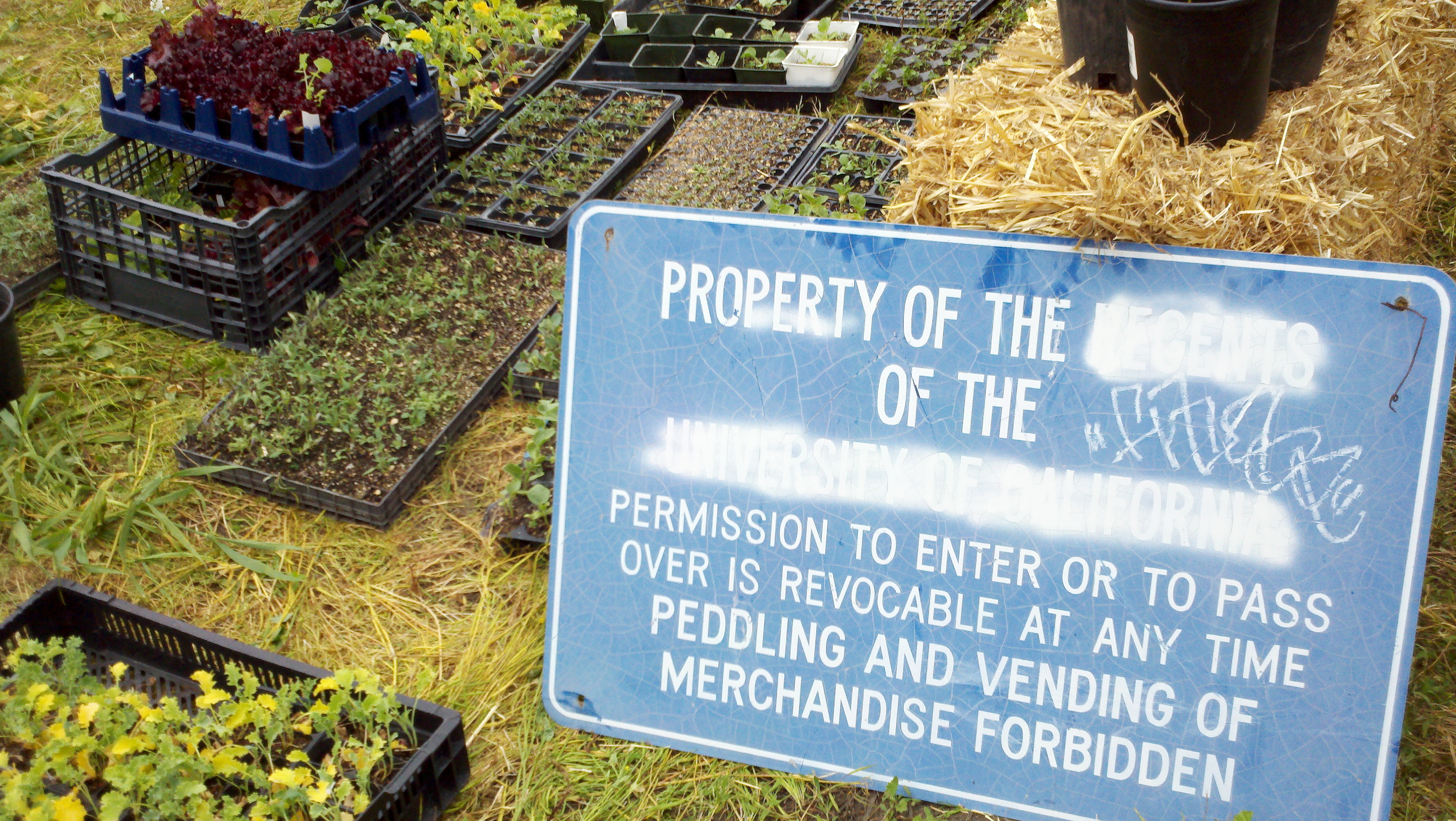
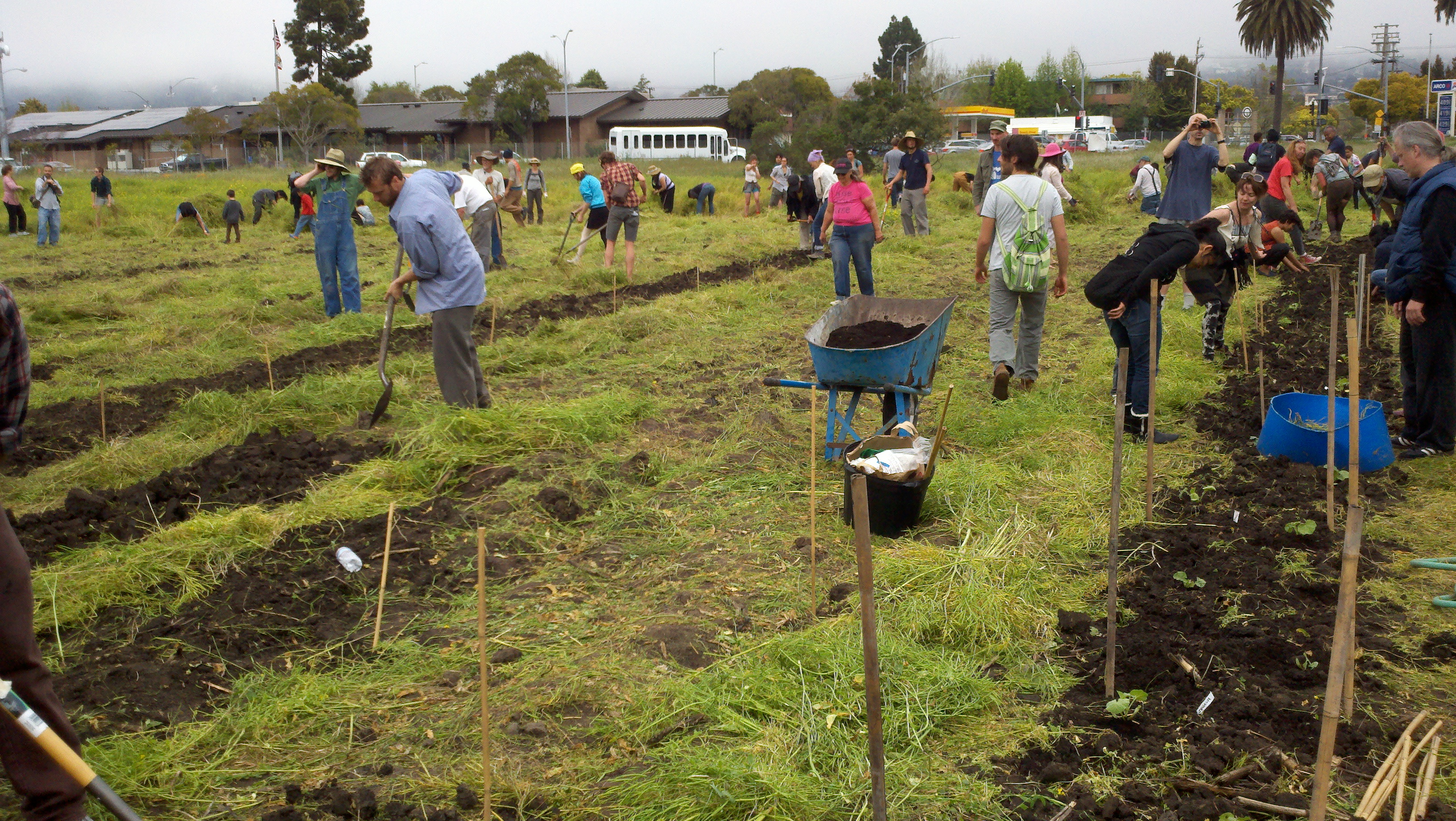
For two weeks now, a group of food justice activists, UC students, Albany residents, and occupy movement stalwarts have been farming and living continuously on a couple acres of UC-owned land, known as the Gill Tract. Those farming didn't ask the University permission before tilling and sewing the plot, setting up tents and a food station, or holding daily educational events for children. Instead, upon learning that much of the Gill Tract was slated for development – including for a Whole Foods – organizers simply made a plan for where and how to plant some vegetables on the tract, invited supportive people to join them, and started digging lines in the ground.

In response to this bold – if also understated – gesture, the University initially responded in a manner reminiscent of the Quan administration in Oakland: they claimed to the press that the encampment's facilities were unsanitary, fixating particularly on the activists' composting toilet. But this line of attack never really caught on, and was soon replaced with a colder, eminently reasonable tale – namely, that the unsanctioned farm was impeding scientific research, and would ultimately have to be dismantled in order that the ideal of free inquiry might be upheld. An added advantage of this updated administrative rationale for police intervention was that a number of professors and university researchers were willing to express similar views to the press, meaning that, in forcing a confrontation with those farming on the Gill Tract, University administrators could claim to be acting in support of researchers. This Friday, Vice Chancellor Breslauer issued an ultimatum to the farmers that cast their continued presence on the land as a stark threat to academic freedom:
On Thursday evening representatives from UC Berkeley and the group engaged in the occupation of agricultural research fields on the Gill Tract met to discuss the possibility of a peaceful resolution to the protest.... During the discussion Keith Gilless, Dean of the College of Natural Resources, emphasized that by the middle of May college staff need to begin work on the tract in support of faculty and student research, and that this requires that full control of the property revert to the university. He also emphasized that these complicated projects require meticulous supervision and cannot be carried out in the midst of an encampment. At the same time, we reiterated that if the encampment is voluntarily disbanded, we will commit to include occupation participants in a broad-based discussion about the continuation of urban farming under university supervision on a portion of the tract, as well as any future discussions about the long-term future of the property. Also discussed was the value and principle of academic freedom that allows faculty members at UC Berkeley to pursue their educational and research interests without interference. During Wednesday's Spring Divisional meeting of UC Berkeley's Academic Senate, the chairperson, Prof. Bob Jacobsen, noted that faculty research had been "usurped" by the protesters' unilateral actions and stated that, "If there is no way to reach a win-win resolution, then I believe that the faculty's freedom to do their planned research must be supported as a key principle. As a faculty, I think we must stand by this." We are now waiting for the occupiers' response to our offer to participate in a broadbased community dialogue if they agree to end their encampment. Today, in a letter to their attorney, campus counsel outlined the process for the proposed community dialogue that would be led by the College of Natural Resources, and requested a response no later than Saturday night, May 5th. If they decide not to peacefully end their illegal occupation of the agricultural research field and refuse the offer to subsequently participate in the formulation of a plan for continued urban farming under university supervision and control, we have every intention of honoring our commitment to ensure the research activities are not impeded, and the rule of law is maintained.
What's interesting about this ultimatum is the degree to which it turns on the recognition that particular material conditions are necessary in order to uphold the ideal of academic freedom. In this case, Breslauer and Jacobsen want to argue that planned agricultural research projects have as their precondition an undisturbed and uninhabited tract of land. Moreover, we're told, this land must be “under university supervision and control,” meaning that a particular configuration of ownership and governance are being presented as conditions of free academic research. Breslauer's concluding line makes this linkage of property laws and academic freedom abundantly clear: “[W]e have every intention of honoring our commitment to ensure the research activities are not impeded, and the rule of law is maintained.”

 While it would certainly be possible to read Breslauer's concluding line as revealing the pretextual quality of his purported concern with academic freedom, I want instead to ask after some of what would follow from his conflation of university ownership and academic freedom, particularly in this moment of educational privatization. If Breslauer presents one view of what underlies academic freedom, what are the implications of this view? And what are some possible counter-views as to how material conditions might enable the realization of freedom, academic and otherwise?

The University's ultimatum to those farming on the Gill Tract implies that academic inquiry, in order to be free, should occur entirely within the bounds of the university, and that it should be carried out using university property, undisturbed by any thing or person not bound contractually to the UC Regents. This is a conception of the proper 'location' of academic research that is also reiterated every time a University employee is forced to sign a form declaring that the fruits of their academic labors – their discoveries, curricula, and lectures – are property of the UC Regents. It's a narrow (not to mention fantastical) conception of free inquiry, which assumes that knowledge can be cordoned off from broader publics and can be wholly contained within the parameters of private ownership. According to this view of academic inquiry, the greatest threat to academic freedom is the possibility that research might be contaminated by the bodies and minds of those not affiliated with the university, whether they be squatters on university farmland, those who would freely disseminate inventions or other effects of research, or publics that would seek to give direction to professors' research. For someone like George Breslauer, university police and administrators exist to keep such unruly elements at bay, and thus to allow academic research to be carried on in isolation.

 Of course, research is never, in fact, quite so enclosed or self-contained. Breslauer's view, while materially consequential, rests upon a fantasy of autonomy that occludes the degree to which universities remain dependent upon worlds beyond their gates. Social scientific research, for instance, generally involves the transcription of words spoken and gestures made by those not associated with universities. And natural scientific research, while often occurring on land controlled by universities, also takes place within state-controlled parks, on the open seas, or on someone else's property. University researchers are trained to treat populations and places pretty much anywhere as sites from which knowledge may be extracted. Moreover, researchers themselves are socialized and educated outside the universities (by parents, public school teachers, self-publishing bloggers, etc.), meaning that their work is enabled by the labors of those not enclosed within the bounds of the university. Universities thus feed, in an exploitative mode, on worlds to which they give little back, at least not directly.

The process of university privatization we're currently facing casts these exploitative dynamics in particularly sharp relief. Higher tuition rates, for instance, create a situation in which enrolled students fund university research by taking out massive debt burdens, and in which working class communities, particularly communities of color, are increasingly excluded from participation (first as students, and ultimately as researchers) in university life. Of course, even as they are excluded from direct participation in university life, working class communities will continue to be studied, to have knowledge extracted from them, to be objects of the academic gaze...

University privatization – which, let's not forget, is being enforced by campus administrators – reshapes not only the composition of the student body and the conditions of academic life and research, but also the content of this research. Public and private foundations, corporations, and wealthy donors are increasingly shaping the direction of academic research, ensuring that the work academics do is more directly generative of knowledge useful for managers and technicians at private firms and state institutions. Which is to say: university privatization is a threat to academic freedom, among other things we might value.

But it's not enough simply to call for the restoration of unrestricted state funding as a way to defend unfettered free inquiry. Such funding would merely ensure that research was a little less determined by instrumental ends; it wouldn't alter the exploitative relations underlying what we've come to know as university research – relations that are being put into question by the reclamation of Gill Tract. Open, self-governing formations, such as the Gill Tract farm – where, everyday, workshops are allowing those interested to learn how to grow food, and where experiments in autonomous social reproduction are continuously being carried out – provide bits and pieces, glimpses, of the material conditions necessary for free, and freeing, educational life.

For the sake of free inquiry and autonomous life and learning, we should defend the Gill Tract farm from those who would prevent, through force if necessary, the cultivation of such freedoms. One simple way to do so is to attend and speak up at this Tuesday's open forum on Occupy the Farm, which is being held at 6:30pm in Morgan Hall, on the UC Berkeley Campus.

Thursday, May 3, 2012

Reflections from UC Davis: On Academic Freedom and Campus Militarization

ucpd_lieutenant_john_pike_terrorizing_innocents.jpg  

The following article by Joshua Clover was just published in College Literature: A Journal of Critical Literary Studies. A PDF of the article is available here. We recommend reading it next to the latest piece from Nathan Brown, "Administrative Totalitarianism at the UC and the Necessity of Direct Action by Faculty."

The autumn of 2011 offered extraordinary images of police brutality against students (and not students alone) on University of California campuses. Two stand out, both seemingly following on from the national Occupy movement. On November 9, students attempting to ‘occupy’ a grassy area at the edge of Berkeley’s famed Sproul Plaza, next to the Mario Savio Steps, were batoned by riot police summoned to campus by Chancellor Robert Birgeneau, first during the day, and then again that night when Occupy Cal returned. In no small part because a couple of professors were among the beaten, the event became a national news story. This would pale in comparison to events on the Davis campus nine days later, when a low-key tent occupation on the quad — Occupy UC Davis — was broken up by riot police summoned by Chancellor Linda Katehi from three jurisdictions. The images of one corpulent and distressingly nonchalant officer disbursing military-grade pepper spray to the faces of a couple dozen seated students would swiftly become one of the iconic images of the year, not just for the campus or the university but globally.

In train, there has been considerable discussion of removing the Chancellors who either authorized such actions or were too incapable to command the situation adequately. There has also been a perhaps more consequential debate around the presence of police on college campuses, regarding either their presence per se (for those familiar with the internationally and historically common situation of police-free universities), or in terms of their increasingly militarized form. And these changes in campus dynamics — toward the heavy hand bearing advanced weaponry — have prompted concerns about the implications for the intellectual and academic pursuits of the university, and what we might expect to develop from here.

I want to argue as directly as possible that grasping this new security regime as primarily pertinent to campus intellectual climate is misguided. While this line of inquiry is no trivial matter, it confuses and obscures core issues.

The confusion comes from two entangled commonplaces regarding these dramatic events (and others like them in kind, if not in media saturation). The first is the assumption that we can identify in each case a two-part sequence of cause and effect, in which students protest and police overreact disastrously. The second (with evident implications for the question of academic freedom tout court), is that this to-and-fro is to be conceived exclusively as a freedom of speech issue.

These assumptions form a unity. In this understanding, students first protest, as students are wont to do. The question arises as to the limits of protest, and to what extent certain actions — in this case, politicized camping — count as protected speech. ‘Time, place, and manner’ provisions are invoked; the police are summoned, heavy with tools. Orders to disperse are given, no dispersal is forthcoming, and then the intolerable thing happens, and everyone scrambles to understand and manage the aftermath.

There can be no doubt that these ‘overreactions’ are judiciously calculated to produce a chilling effect on student struggle. As with the endless nuisance charges levied against student (and other) organizers, they are designed to exhaust resources, both inner and material. And further there can be no doubt that this chilling effect spills over to the entire campus. In this sense it is certainly reasonable to consider the implications of these actions for free thought and intellectual exploration.

But there are also good reasons — better reasons, I believe — not to shift the debate onto the terrain of thought, ideas, expression, and so forth. It has suited all sides to allow that this drama revolves around First Amendment issues. Under considerable internal and external pressure, both Chancellors conceded that in these cases, the riot police may indeed have curtailed what really should be protected rights of speech and assembly. Katehi insisted (twice; she is in the habit of using the same formulaic language in multiple press releases) that: “Our campus is committed to providing a safe environment for all to learn freely and practice their civil rights of freedom of speech and expression” (2011a, 2011b); her counterpart at Berkeley, Chancellor Birgeneau, extolled the same virtues. Meanwhile, students did not hesitate to pillory both administrations for having failed the Bill of Rights, while dismayed if still-timorous faculty demanded that Birgeneau “respect freedom of speech and assembly on the Berkeley campus” (UC Berkeley Academic Senate 2011).

The fantasy at play here is that what has gone wrong somehow concerns the excessive assertion of First Amendment rights by students, or conversely, the excessive limiting of same by the administration. The logical remedy is inevitably discovered to be a rebalancing of these matters, extending adequate protections to ‘protest’ and ‘expression’ as abstract ends in and of themselves.

The underlying reality is radically different. What must first be recognized is that in neither case did we see the abstract two-part motion, protest/repression. The unity of each event is considerably more concrete: administrations must deploy force to implement austerity policies. The initiating acts were not student protests but university policies designed to assure that the costs of running an educational system increasingly devolve to students, who are at once ever more compelled to pursue higher education for competitive advantage in a forbidding employment landscape, and concomitantly less able to afford the same without increased debt and workloads.

This misrecognition of the sequence of substantive events is compounded by another, whereby the campus protests are presented as arising from the charisma of Occupy Wall Street and the ensuing national movement over the course of the preceding months. As the Occupy movement has not made a significant issue of education, and as students (especially at purportedly elite or top-tier universities) are often thought to be cushioned at least temporarily from the buffets of the economy (especially the employment market), the inference is frequently drawn that the campus variants of Occupy are lacking real content of their own, and are thus reducible to protest for the sake of protest.

What is forgotten is that the Occupy movement, doubtless inspired by 2010’s ‘Arab Spring’ and Europe’s ‘Movement of the Squares,’ has its local roots in recent US campus organizing, specifically the anti-privatization campaigns of 2009-2010 on UC campuses. They have been ongoing if uneven, and characterized throughout by police violence. The shock over recent events at Berkeley and Davis this November must be taken with a grain of salt. After all, only two Novembers before, both Chancellors called riot police from multiple jurisdictions onto the same campuses to break up anti-privatization occupations. Both times, the police attacked non-violent protestors, and lawsuits are still pending. In short, we are looking at a clearly defined confrontation that has been in progress for some time, on the concrete terrain of economic crisis — not a timeless confrontation between academic freedom and policing, on the abstract terrain of rights.

So we might say that a mistaken assessment of the sequence of events, both this November and over the last few years, allows for a misrecognition of the fundamental issue.This seems perhaps a neutral slippage; aren’t rights good for everyone? However, this reflexive motion — in which future political organizing and action turns on itself to address the formal conditions of previous actions rather than the preceding causes — in actuality serves the university administration admirably by displacing the debate into the arena of form rather than content. The administration can offer a remedy, with tonalities of magnanimous self-correction: they can promise to be more thoughtful and diligent about respecting the right to protest, and thus seem to slip out of their position in the struggle, that is, as enthusiastic co-authors of the privatization process. They themselves turn to become a context, not a class antagonist.

This is indeed precisely what has happened. One suspects there will be some payouts to injured students, and that a cop or two will be pastured. And the matter will be tentatively resolved, despite the economic content remaining entirely unaddressed; thus, the administration wins by ‘losing.’

One can see that this movement has become a substantial quagmire for the professoriat within this political cycle: what is sometimes called ‘the articulation trap.’ It is a double truism of the faculty member’s position, especially the professor’s, that she is not identified clearly with either side of the current struggle between the economic interests of students and administrators; at the same time, her job’s basic supposition (especially in the humanities) is that position-taking is itself an action. These two factors supply a powerful if implicit determination toward intervening not by entering into the content of this struggle, but by offering, at a remove, often-eloquent assessments that tend toward seemingly neutral ethical (or pseudo-ethical) categories like rights and freedoms. I fear we professors are quite often guilty of looking for our car-keys under the streetlight — that is, participating in this particular antagonism in the ways we are best equipped for, rather than in the ways that the conditions and goals demand.

In thinking about campus militarization, UCSC professor Bob Meister provides an extraordinarily useful account of the relation between campus securitization and securitization of university economies, as they have recently developed. In his talk on “Debt, Democracy, and the Public University,” he sets forth the cruel historical developments through which William Bratton was retained to lead the investigation into the pepper spray incident, and what it reveals about “the link between the privatization of public universities, the financial services industry and the national security industry” (Meister 2011). Meister observes that:
Since 9/11 the US defense industry of the Cold War has morphed from being mainly in the military hardware business into a new role as global provider of security services that enables government and corporations throughout the world to outsource intelligence, policing, background checks, construction of secure sites and various operations that may need to be deniable — as well as the public relations efforts necessary to support such deniability.

Most Americans do not know that there is a huge domestic market for services provided by the defense industry....The fastest growing market for the defense and security services industry is in the area of local government and public agencies that feel threatened by political protests, such as the Occupy movement, and that have reporting and other obligations under the Patriot Act. Former LA Police Chief William Bratton was hired to build this market for Kroll Security by its parent company, Altegrity, a defense contractor that is itself now owned by a private equity firm that also invests in both for-profit higher education and financial services (Meister 2011).
While the specifics of such connections inevitably vary from place to place and situation to situation, the systemic logic is plain enough. Heightened campus security is inextricably linked to heightened campus securitization in its two main forms: the decision of universities to pursue a certain line of investment strategies which move money away from educational services and into capital projects; and the corresponding decision to cover those educational costs by shifting burdens to students at a rate which can only be financed though student loans, concomitantly providing profitable investment for banks laden with otherwise fallow capital. The rise in tuition and indebtedness within the context of economic crisis simply is the militarization of campus; they are one and the same.

It is impossible to conclude other than this: even if one does adhere to the belief that the matters of intellectual freedom, free speech, and free assembly are fundamental to this unfolding political economic sequence, the place where such things will be arbitrated is not on their own terrain — the terrain of formal rights — but elsewhere. The necessary arena in which such rights might be protected presently and for the longer durée is the arena of direct antagonism between, on the one side, those fighting against backdoor privatization and austerity programs on campus, and on the other, those who implement and enforce them. This is not a rhetorical struggle, and moreover, the retreat into the sphere of articulation risks affirming the misrecognition of the struggle’s character. Such formal rights are far less an enabling condition for this struggle than an outcome of its material content.

Professors: stand with your students, literally. It is the best thing to be done for academic freedom; it is the least you can do for them.

Monday, April 30, 2012

Wednesday, April 25, 2012

We Do Not Misunderstand You

Chancellor Katehi failed to express in any meaningful way her expectation that the police operation was to be sharply limited so that no use of force would be employed by police officers other than their demand that the tents be taken down. The lack of effective communication by the Chancellor at this time not only contributed to misunderstandings that made it difficult to evaluate the decision to use police to take down the tents. This communication failure also substantially undermined the goal of avoiding a physical confrontation between the police and protesters. — from the Reynoso Report.
It is no doubt in the interest of Linda Katehi and the UC Davis administrative class to take refuge behind the idea of a “misunderstandings.” The Reynoso and Kroll reports paint a striking picture of incompetence, malign stupidity, and an organizational “culture” that, barring any countervailing force, moves naturally in the direction of physically hurting people it believes to be in its care. This is, regardless of any questions of intent, an entirely adequate argument not just for removing the leading incompetents, but dissolving the structure itself.
The flimsy pretext to which Katehi clings is absence of malice. No matter how incompetent, delusional, and unable to exercise either command or good judgment, she is somehow credited with good intentions. Things would not have gone so poorly for the students, we are meant to believe, if not for a series of misunderstandings which should have been avoided but were not. The legal standing of the protest; the supposed presence of “non-affiliates” among the students; the authorized force level to be deployed against the protestors; and many other matters were all supposedly subject to misunderstandings.
This is not the case. Linda Katehi we do not misunderstand you.
ONE
Let us first grant all the disavowals. We don’t believe them for a second: they are the filler text of brutes and stooges, and we have seen them a thousand times.
But let us accept them all at face value:
¶ that the application of a law on a Friday afternoon which prohibits “non-affiliates” (and non-affiliates only) from camping overnight on the Davis campus was somehow merely a misunderstanding of that code (110).
¶ that claims regarding the presence of these “non-affiliates” — which proved utterly false, and which were authoritatively contradicted in advance of any police action by the only administrator who had visited the quad — were somehow just misunderstandings of who was there (21).
¶ that the purported desire of Linda Katehi that no violent force be used was simply misunderstood over and over again down a long chain of command, despite all indications to the contrary (34).
Let us grant all that; we are generous souls. What then remains that all sides and parties agree upon — that involves neither actual nor implied misunderstandings?
The following: that Linda Katehi did intend to deploy the force of law against “non-affiliates” to remove them from campus where they were legally disallowed. This is clear in the law cited and in her orders, and led directly to the violence (113). No one disputes this point, nor was there any misunderstanding regarding this rationale.
Let us now restate the November situation in which nothing is misunderstood:
In order to justify arrest and extraordinary physical force against students, on November 18th, 2011, Linda Katehi chose to consider the open quad of the UC Davis campus to be private, reserved for students, staff and faculty of the university.
TWO
Let us now move forward to March of 2012, some four months later, when 12 affiliates (eleven students, one faculty) were served with arrest warrants by mail threatening eleven years each in jail, and a million dollars in damages. Half of these affiliates were pepper-sprayed and/or arrested on November 18, unfortunate casualties of that series of misunderstandings amidst the military-grade war on non-affiliates.
The charges are as follows: one count each of “conspiracy to commit a misdemeanor” and 20 counts each of said misdemeanor. The conspiracy was, it would seem, a conspiracy to sit on the hallway floor in front of the US Bank lodged in the Memorial Union, allegedly obstructing said hallway. This was what the University went with. We know from the record that these charges were first chosen by the UC Davis police at the behest of the administration, and then forwarded to the District Attorney.
Said misdemeanor is California Penal Code 647c: “Every person who willfully and maliciously obstructs the free movement of any person on any street, sidewalk, or other public place or on or in any place open to the public is guilty of a misdemeanor.” For the purpose of bringing the force of law to bear on affiliates, the hallway of the Union is to be considered, as a legal matter, a public thoroughfare — that is, not limited in access to campus affiliates. The law in question applies only insofar as it protects the access of non-affiliates.
Here then is the March situation in which nothing is misunderstood:
In order to justify arrest and extraordinary charges against students and faculty, in January through March. 2012, Linda Katehi chose to consider the Memorial Union to be public, which is defined as freely open to non-affiliates.
THREE
Let us pause to restate this curious double situation.
In November, the presence of non-affiliates on the quad was officially and openly treated as cause to send in riot cops with unauthorized weapons in which they were untrained and bring grievous harm to students sitting peacefully.
In March, the full force of law and threat of eleven years in prison were levied officially and openly against these same affiliates to protect the right of passage of non-affiliates.
Linda one can see how this might be confusing. We have already stipulated all your ludicrous disavowals, the ones believed by small children and science professors. Even if we reduce it to matters on which all parties openly and officially agree, you wish to have it both ways. The campus is closed to all but the university community, and affiliates must be protected from non-affiliates; the campus is open for business and non-affiliates must be protected from affiliates. One can imagine how misunderstandings might arise from such contradictions, such an absurd jumble of desperate positions that shift with the breeze.
Linda we do not misunderstand you.
Behind this there is absolute coherence. Not around the law, not around campus health and safety, not around basic reason. The only coherence is this: If those who work and study on your campus gather together as a body with a political purpose, you will mobilize whatever petty and ludicrous pretext is to hand in order to beat, pepper spray, and arrest them. That is the goal for you. The evidence here is, we fear, inarguable. It cannot be misconstrued. Indeed the clarity of the situation and of your desperation is rather pathetic.
You are not a serious person but you are a dangerous person. We do not misunderstand you.
FOUR
It will have escaped the notice of nobody that the convenient slippage between public and private which appears above as contradiction is a shadow cast by the central drama of the University of California over the last three or thirty years — the stage-managed indistinction between whether or not the school is public (as it claims to be in matters requiring public sympathy) or private (as it behaves otherwise, ceaselessly shifting cost and labor burdens onto the backs of students and workers). Surely it is this development, which has occasioned increasingly ambitious counter-struggles by students and staff, that has in turn allowed Linda Katehi and her crack team to bring the pain no matter the given circumstance.
In truth the circumstance is more precise and perverse than this. Images may help. Here are the two places on campus described above, the quad and the Memorial Union, which are in fact immediately adjacent each to the other:
So it is not a simple slippage but a true inversion — or a chiasmus, as the Greeks would have it.  The quad, with its double memory of shared, common space —the meadow and the agora — turns now to become private, and will be defended by military force from the public real or imagined. The student union, larded now with private franchises from the gleaming new food court to the corporate travel agency (there used to be a bank here as well, we gather) must be protected by the university and the District Attorney on behalf of the public.
FIVE
And it is now we realize that Linda Katehi, while a manifestly failed administrator, is perhaps a gifted educator. Clearly she specializes in Greek thought. For is this not a lesson in the dialectic itself: each antagonistic term folding into its opposite, until a higher truth is revealed? This hides behind every contradiction, after all.
It is not a static opposition, to be sure, but a historical one. It is eerily familiar, in truth. The first scene is that of enclosure, the privatizing by force of common lands that inaugurates the modern world of employers and employees, commodities and wages, blood and fire. The second scene is that of globalization, wherein every corner of the earth must be drawn into the dream of liberal democracy, open to all — in so far as every corner of the earth might thereby become another outpost of the market, hiring a few, dispossessing a few more, and assuring that commerce is equally available to each with sufficient coin in purse. The whole history of capitalist modernity in four months!
Perhaps the higher truth is as simple as this: the opposition of public and private, and the insistence the administration is stewarding us in a single direction is itself inadequate to understand the present situation. “The public” in fact persists; it now refers to purchasers, who literally have no business on the quad; the businesses await behind the Memorial Union’s doors. We might, we must demand “public education” because this is an idea cherished by the public.
But at the same time we must understand that “public” too takes on a perjured meaning. Every word can be a double agent, as a Belgian gentleman once said. The word “public” is only too happy to serve power, to serve those who advance in a double column of armies and bankers, making free with the pepper spray and the debt machines. These too are public, as needed. It would be a misunderstanding, finally, to settle for “public” as the realm of freedom. It would be a misunderstanding to think that the administration will not embrace such things, if it justifies the crushing of any political act. And it would be a misunderstanding to think that we will stop before the shell game of public and private is annihilated, and the history that our friend has so recently summarized for us is brought to an end.
Linda we do not misunderstand you. Do not misunderstand us.

Monday, April 23, 2012

Candlelight police station "attack"

Reposted from: a project of take back uci.


On the night of April 19, we met at the UC Irvine campus police station at 8:00—undergraduate and graduate students, a few faculty, and a light brown dachshund named Chewy. We plugged a projector and laptop into an outlet behind a tree and threw on the exterior wall of the station facing Pereira St. a compilation of footage of the last few years’ campus police violence: the infamous beatings of protesters last November in Berkeley, the pepper-sprayings of students at Davis, Santa Monica City College, and the CSU Regents’ meeting at Cal State Long Beach; militarized police confrontations with peaceful students at Riverside and Irvine. This large color video covered the upper part of the station’s brick wall and was visible to cars passing from the street. We watched the footage over and over as the sun set, and when it was finally dark we lit white and red taper candles, purchased just minutes earlier from the Albertson’s across the street. A little later, we lowered the station flags to half-mast. We had thought of the event as a vigil in solidarity of people brutalized by campus police violence.

The features of this event, which we experienced at the time and now as complicated and beautiful, raise interesting questions about how our response to police repression is evolving. The scenes of brutality are so relentless and egregious that the person who had the task of editing the footage together was moved to tears during her work by her immersion in it. At more than life-size on the outdoor wall, it was easy to feel again the visceral injustice of the scenes. At the same time, the main collective reaction to the appearance of the first images was delight—not at the violent content, of course, but at the capacity to make this happen. In the video we made of the action in turn, you can hear one woman yelling “It’s me! It’s me!” at the Long Beach scene. Everyone is laughing. Right away someone exclaimed, “This is not the reaction you would normally expect at police brutality!” and everyone laughed again. One of us with a small megaphone (which wasn’t turned on) took on the voice of a stereotypical cop to furnish a voiceover for some of the scenes: “The problem with these hippies is that they like it! They keep coming back for more!” It seemed appropriate to light a candle on a donut. The guy with the megaphone made an announcement: “For donuts, see the man with the donuts.”

After hours, there are generally two officers on duty inside the station. After about twenty minutes, one of them came out and turned to see the projection on the wall. He started and seemed uncertain what to do. He walked around the perimeter of the crowd and asked “Who’s the leader of this group?” Everybody laughed. After a while someone pointed to the violence on the wall and asked whether he’d been at the scene. “I wasn’t at that one,” he said. After a minute he wandered back the way he’d come.

As the evening goes on you can hear bits of ordinary conversations about work and activism: someone accepted a marginal teaching post “just to have something”; someone makes a reference to “the shittiness,” which sounds general; there are passing ideas about other actions and a reference to some stolen anti-UCPD posters. Milano cookies are offered around and accepted with gratitude. People struggle to keep their candles alight, cupping and enjoining flames in protest against the indifference of the wind. Someone grafts his dying red candle onto the white stump of another, and we make an intrusive joke about biraciality. Someone else expresses fatigue. Too many drops of candle wax fall on Chewy, who doesn’t complain.

We’ve preserved the casual soundtrack of our irreverence because it reflects the things that UCPD brutality interacts with in daily life. The laughing and talking in no way ignores or diminishes the violence; it indicates what we have to process the violence with. There were moments (also captured in the video) when in solitude or in collectivity we became meditative, lost in the edges of things—candlewicks, the flickering of images, in the not- knowing-how-to-feel-or-exactly-what-to-say. This night was a reflective expression of support for everyone whom campus police have beaten, whose fingers have been broken, and who has been sprayed with chemical agents in the last three years and a festive repurposing of UCPD’s public space. In retrospect, it was most of all a statement that anger, sorrow and joy can co-exist in the face of, and literally in the front yard of, police repression. Rather than sublimating pain and reversing it into an aggrandizing power, projecting the images created a new arena where people could do various things with the recent history plainly on view. “This is not the reaction you would normally expect!” expresses the pleasure of surprise in exceeding expectations.

Remarks at 4/23 rally for the Davis Dozen

Today's rally in support of the Davis Dozen was inspiring; those speaking offered compelling accounts of the mutually constitutive, and mutating, relations between university privatization and forms of state repression, and there were lots of people out, talking to each other and writing letters to the DA and the Chancellor. Everybody should make sure to call the Yolo County D.A. and Chancellor Katehi this week, and demand that the charges against the Davis Dozen be dropped.

DA Reisig's number: (530) 666-8180
Chancellor Katehi's number: (530) 752-2065

-a.


Hi everybody.... Along with twelve others, I've been facing stay-away orders and charges from November 9th, a day when hundreds of students linked arms around the occupy cal encampment, facing waves of police aggression. A number of people had their ribs broken or bruised that day. And a few, including someone who was standing next to me, had to go to the hospital because of their injuries.

Among the thirteen of us being charged, many of us were struck but almost all of us weren't even arrested on the 9th; rather, we simply received a letter this March from the District Attorney informing us of our arraignment dates. It seems that the UCPD and the Chancellors selected a number of organizers and groups they wanted to shut down this spring, and, not having the legitimacy on campus to prosecute us through the office of student conduct, they just asked the District Attorney to do the work of repressing student protest for them. But their plan hasn't worked: the attempted prosecutions have been met with pickets and other expressions of outrage, including dozens of phone calls on our behalf from students and instructors at UC Davis. The pressure you all and others have been able to exert seems to have convinced Chancellor Birgeneau and the District Attorney to back off on the charges.

We're organizing against the charges, but the charges haven't subsumed our organizing or shut down other protests: these past weeks, we've continued fighting the Regents' attempts to take even more from students; their attempts to impose ever heavier debt burdens, and to convert UC campuses into homes for banks and other capitalist firms. Just yesterday, hundreds of people, including dozens of UC students and alumni, reclaimed a tract of land that the University was planning to sell to Whole Foods. We remade the field into a small farm, planted 15,000 seedlings, and established an encampment beside the rows of vegetable shoots. We're fighting to reclaim the material conditions of our lives and for our learning; and as we fight, we won't let them cut us off from each other, or cut any of us down.

In many ways, what's been happening at Berkeley echoes what's been going on here in Davis. There's a similarly discredited chancellor, who is similarly trying to shut down student protest by getting the DA to bring severe charges after the fact against a dozen-or-so people. Our outgoing chancellor discredited himself in various ways last fall: but not nearly as badly as your chancellor, Katehi. A lot has been said and written about what they've done though; I don't have much to add right now about that. Instead, I want to say a little bit more about how we've responded to their acts of aggression.

In November, after they struck and sprayed us, we cared for and supported each other, linking arms, washing each other's eyes out with liquid antacid and water, putting bandages on cut up backs, staying up at night beside the tents to watch out for raids, and escorting from campus those who attacked friends and classmates. We came together in ways we hadn't before. In the hours and days after the police injured us, we gathered in assemblies of thousands and called strikes, asking people on other campuses to join us as well, to leave their classrooms for a day and take action together against fee hikes and recent police violence.

How students at Berkeley and at Davis acted in concert on these days was particularly inspiring. You all were there for us then; and you've come through for us more recently as we've faced stay-away orders and charges. In November, you all were gathering, partly in support of us, when Lt. Pike sprayed burning chemicals across your faces and down your throats. A number of those pepper sprayed that day are now facing charges in connection with another action. You all have exposed yourselves to risk in standing with us; now, we're going to be there for you as you face these charges. We'll chip in and make calls this week. And we'll talk to our classmates and fellow workers about how they can support those being charged. A number of us in the GSI union, from different campuses, actually just put together an email that's being sent out to all our members statewide, asking that they call the Yolo County DA and Chancellor Katehi, and demand that the charges on the Davis Dozen be dropped.

Together, let's get these charges lifted. And let's keep up our struggles to abolish student debt and to reclaim the spaces and times of our lives.

Sunday, April 22, 2012

Occupy the Farm

[Update: lots more beautiful pictures, including the one below taken by Dave Id, at Indybay.]

640_2012-04-22_15-21-20_416.jpg original image ( 3264x1840)

From Occupy the Farm (via fb):
FOR IMMEDIATE RELEASE:

April 22, 2012

Occupy the Farm Activists Reclaim Prime Urban Agricultural Land in SF Bay Area

Contact: GillTractFarm@riseup.net

(Albany, Calif.), April 22, 2012 – Occupy the Farm, a coalition of local residents, farmers, students, researchers, and activists are planting over 15,000 seedlings at the Gill Tract, the last remaining 10 acres of Class I agricultural soil in the urbanized East Bay area. The Gill Tract is public land administered by the University of California, which plans to sell it to private developers.

For decades the UC has thwarted attempts by community members to transform the site for urban sustainable agriculture and hands-on education. With deliberate disregard for public interest, the University administrators plan to pave over this prime agricultural soil for commercial retail space, a Whole Foods, and a parking lot.

"For ten years people in Albany have tried to turn the Gill Tract into an Urban Farm and a more open space for the community. The people in the Bay Area deserve to use this treasure of land for an urban farm to help secure the future of our children," explains Jackie Hermes-Fletcher, an Albany resident and public school teacher for 38 years.

Occupy the Farm seeks to address structural problems with health and inequalities in the Bay Area that stem from communities’ lack of access to food and land. Today’s action reclaims the Gill Tract to demonstrate and exercise the peoples’ right to use public space for the public good. This farm will serve as a hub for urban agriculture, a healthy and affordable food source for Bay Area residents and an educational center.

“Every piece of uncontaminated urban land needs to be farmed if we are to reclaim control over how food is grown, where it comes from, and who it goes to,” says Anya Kamenskaya, UC Berkeley alum and educator of urban agriculture. “We can farm underutilized spaces such as these to create alternatives to the corporate control of our food system.”

UC Berkeley has decided to privatize this unique public asset for commercial retail space, and, ironically, a high-end grocery store. This is only the latest in a string of privatization schemes. Over the last several decades, the university has increasingly shifted use of the Gill Tract away from sustainable agriculture and towards biotechnology with funding from corporations such as Novartis and BP.

Frustrated that traditional dialogue has fallen on deaf ears, many of these same local residents, students, and professors have united as Occupy the Farm to Take Back the Gill Tract. This group is working to empower communities to control their own resilient food systems for a stable and just future – a concept and practice known as food sovereignty.

Occupy the Farm is in solidarity with Via Campesina and the Movimiento Sin Tierra (Landless Workers Movement).

The Gill Tract is located at the Berkeley-Albany border, at the intersection of San Pablo Ave and Marin Ave.

• Join us: Come dressed to work! We need people to help till the soil, plant seedlings, teach workshops, and more.

• Donate/lend: We need shovels, rakes, pickaxes, rototillers, drip irrigation tape, gloves, hats, food, and anything else farming related!

• Monetary donations can be sent through our website at www.takebackthetract.com

640_2012-04-22_14-50-39_457.jpg original image ( 3264x1840)